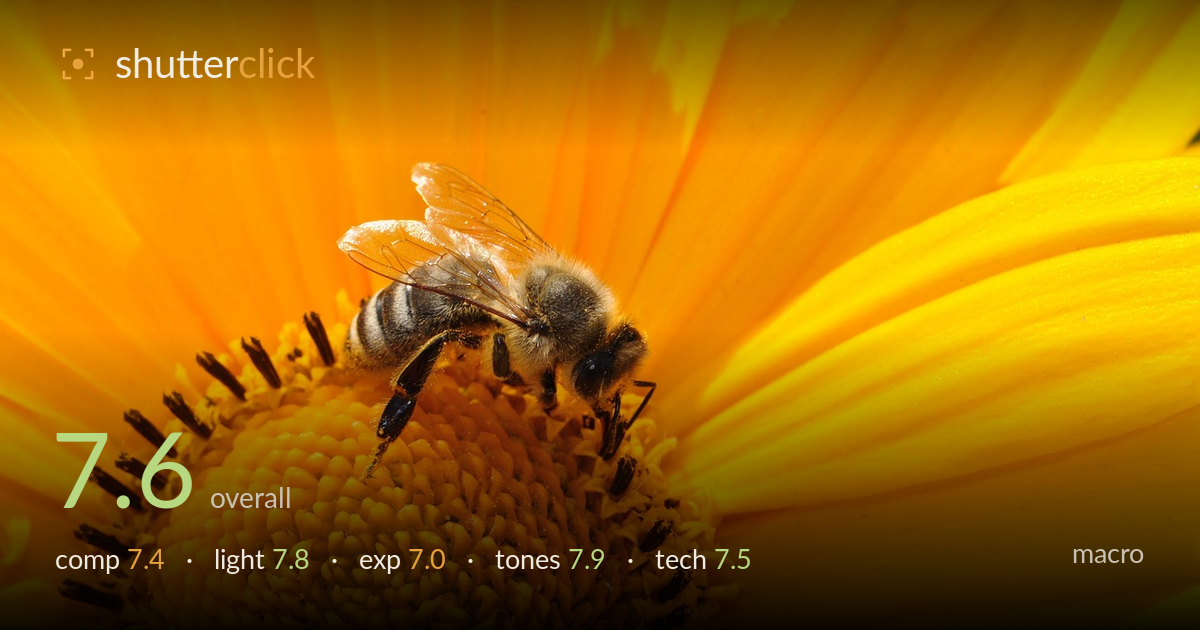
Honeybee on a yellow bloom
Photo by katja

No EXIF metadata in this file
Technical analysis based on visual assessment only.
A honeybee feeding on a yellow flower, carried by strong sharpness on the head and near legs and a rich warm palette that unifies subject and setting. The bee sits at an effective intersection, with the spiralling floret disc providing texture and the radiating petals acting as natural leading lines. What most holds it back is the shallow plane of focus that lets the wings and abdomen drift soft, plus highlight brightness in the upper petals that edges toward clipping. The dominant yellow, while beautiful, flattens tonal separation between subject and flower in places.
The bee is placed slightly above centre and reads clearly against the disc, with the radiating petals forming natural lines that draw the eye inward. The floret spiral in the lower third adds satisfying texture and repetition. The diagonal orientation of the bee gives energy. However, the top-right corner is a fairly featureless expanse of petal that adds little, and the composition could breathe more with the bee given slightly more room in its direction of gaze. The frame edges crop the flower somewhat arbitrarily.
Soft, fairly directional daylight models the bee's fuzzy thorax and translucent wings nicely, catching subtle sheen without harsh specular hotspots on the insect itself. The light reveals the fine texture of the disc florets well. Shadow rendering under the bee is gentle and appropriate for the subject. The main weakness is the intensity on the upper petals, where the light pushes toward the top of the range and loses some of the delicate petal veining that softer or angled light would preserve.
Midtones on the bee and disc are well placed, holding good detail in the thorax fur and floret texture. The exposure keeps the insect readable, which is the priority. The concern is the brightest petals in the upper frame, which sit near clipping and lose gradation in the pure yellows. Pulling exposure down a touch would have recovered that petal detail while the darker disc and bee could tolerate the loss. Shadow detail in the bee's dark banding is retained cleanly.
The warm yellow-to-orange progression is the image's strongest tonal asset, saturated but not garishly so, and the black-and-amber banding of the bee provides welcome contrast against the monochromatic flower. White balance reads accurate and natural. The disc florets show pleasing tonal variation from deep amber to pale gold. The risk is that the overwhelming yellow reduces separation, and a few upper petals verge on a single flat tone. Overall the colour cohesion serves the subject well and feels intentional.
Focus lands accurately on the bee's head, eye, and near foreleg, which is the correct priority for a macro insect shot, and the fine hairs render crisply. The depth of field, however, is thin: the wings, abdomen, and far side of the body fall progressively soft, and the floret disc sharpens only in a narrow band. For a static-enough subject, a slightly smaller aperture or a short focus stack would have carried more of the bee and disc into acceptable sharpness. Detail on the pollen-dusted florets is excellent where the plane falls. There is no visible motion blur, suggesting a shutter speed sufficient to hold the bee, and noise is well controlled with clean shadows. The working distance and framing suggest a capable macro lens used near its close-focus limit. Sharpness falloff is the main technical limiter here, an inherent trade-off of single-frame macro at wide apertures rather than an error, but one worth managing for fuller subject rendering.
What would elevate it
Tags
Shot something like this?
Expert photo critique, on demand — scored across six categories, EXIF-aware. Start with 3 free critiques, no credit card.
critique my photo — free