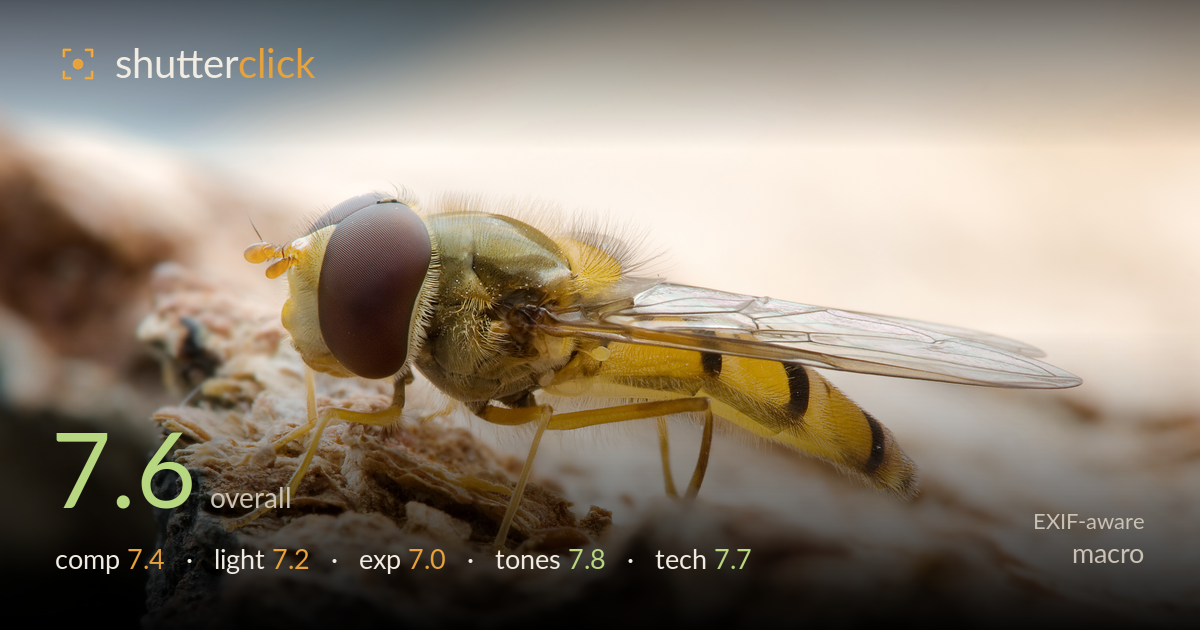
Hoverfly resting on bark
Photo by Richard Bartz

| Focal length | 180 mm |
| Aperture | f / 14.0 |
| Shutter | 1/4 s |
| ISO | ISO 200 |
| Exp. comp. | 0.67 EV |
| Shot at | 13:10 · Jul 5, 2009 |
A clean, well-executed hoverfly portrait carried by a razor-sharp compound eye and beautifully rendered wing venation. The lateral profile shows the whole insect from eye to abdomen, and the bark perch adds context and texture without cluttering. What holds it back most is the depth of field: even at f/14, the rear of the abdomen and wingtip drift soft while the head stays crisp, so the eye lands firmly on the front third. The highlight-heavy background borders on washed out in the upper right. A focus stack and a touch of negative exposure compensation would push this from strong to exceptional.
The side-on profile reads clearly and the diagonal of the bark gives the fly a natural stage, with the head placed into the left third and the body leading rightward across the frame. Space ahead of the insect is generous, which supports the gaze direction. The tail and wingtip crowd the right edge a little, and the large empty highlight in the upper right pulls attention with no payoff. A hair more room behind the abdomen would balance the strong forward lead.
Soft, diffused light wraps the subject well and avoids harsh specular hotspots on the chitin, keeping the fine thoracic hairs and eye texture readable. Direction is fairly flat and frontal, which flatters the yellows but does little to sculpt form or separate the body from the pale backdrop. A raking side light would carve more dimension into the abdomen banding and hairs. The single small catchlight in the eye is clean but modest; a second, stronger highlight would add life.
Exposure on the fly itself is well judged, holding detail across the yellow banding and the delicate wing membrane without clipping the brightest chitin. The +0.67 EV compensation helps the pale subject but pushes the already bright background toward blown-out white in the top right, where detail is essentially gone. The shadowed underside of the bark blocks up slightly. Reining in a third of a stop and lifting shadows in post would recover both ends and keep the tonal transition smoother.
The warm yellows and browns of the fly and bark form a cohesive palette, cooled nicely by the soft blue wash upper left, giving a pleasant warm-cool balance. White balance looks accurate, and the amber body reads natural against the neutral wood. The compound eye's deep reddish-brown adds a rich focal accent. Saturation is restrained and believable. The background gradient is smooth, though the upper-right zone drifts toward a flat, near-colourless white that weakens the otherwise handsome tonal range.
The 180mm macro lens is the right tool and delivers excellent rendering where focus lands: the compound eye, facial hairs and wing veins are genuinely crisp. At f/14 diffraction is beginning to soften micro-detail but remains a sensible compromise for this magnification. The real limitation is depth of field, insufficient to hold the whole insect from eye to wingtip and rear abdomen at this working distance, so the tail falls off. ISO 200 keeps noise negligible and preserves clean tonal gradation. The 1/4s shutter is the notable risk: this demands a tripod and a still subject, and while the head is sharp, that slow speed leaves no margin for any breeze or subject twitch, likely contributing to some of the rearward softness. A focus stack of several frames would resolve the DOF shortfall entirely, and a flash with diffuser would permit a faster shutter and a smaller effective aperture penalty. Overall, solid technical execution with focus reach as the main constraint.
What would elevate it
Tags
Shot something like this?
Expert photo critique, on demand — scored across six categories, EXIF-aware. Start with 3 free critiques, no credit card.
critique my photo — free