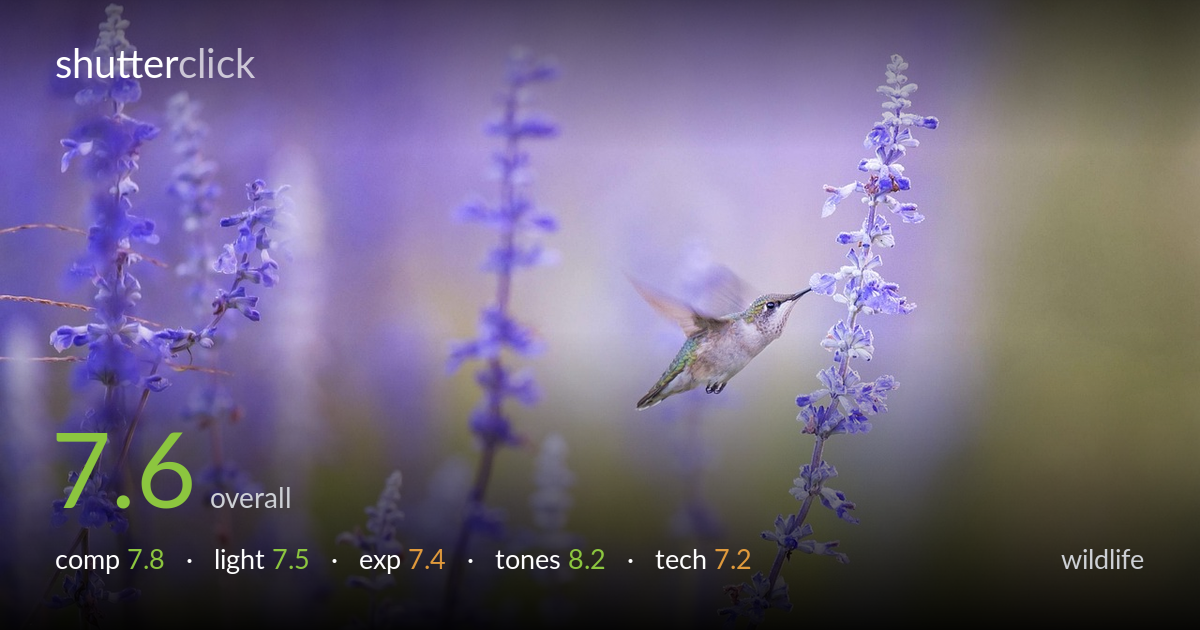
Hummingbird feeding among lavender blooms
Photo by Pexels

No EXIF metadata in this file
Technical analysis based on visual assessment only.
A delicate, well-observed feeding moment — the hummingbird meeting the salvia bloom reads instantly and the lavender-toned field gives it a cohesive, painterly setting. The behaviour is the strength here: beak to flower, wings caught mid-blur. What holds it back is focus precision on the bird's eye and head, which sit just soft of critically sharp, and the wing blur reads more as missed shutter than deliberate motion. The bird also sits low and tight against the right-edge flower stalk, leaving a large soft expanse above. Sharper eye detail and a touch more breathing room would lift this from lovely to genuinely arresting.
Placing the bird in the lower right with the salvia stalk anchoring that side creates a satisfying diagonal relationship between subject and food source. The foreground flower stalks on the left add depth and frame the scene. However, the large soft purple expanse across the top dominates more than it needs to, and the bird sits quite low and tight to the right stalk, leaving little space into which it can feed or move. A fraction more room ahead of the beak would ease that crowding.
Soft, diffused light — likely overcast or open shade — flatters the delicate subject and renders the lavender field as a gentle wash. The bird's throat and breast catch enough light to read texture, and the iridescent green on the flank shows faint sheen. The trade-off is a lack of directional modeling: the light is flat enough that the bird's form and the flower detail stay muted. A little more directional light, even a soft rim, would have given the subject more separation and dimension.
Exposure is gently high-key and suits the airy mood, holding highlight detail in the pale flowers without clipping the brightest blooms. The bird's mid-tones are placed well enough to retain feather detail on the breast and throat. Shadows are minimal and open, consistent with the soft light. The eye and darker head feathers could carry slightly more weight to draw the gaze, and the overall brightness flirts with washing out subject contrast. A touch more midtone separation on the bird would help it stand clear of the pastel field.
The dominant lavender-to-sage palette is the image's greatest asset — cohesive, calm, and quietly beautiful, with the cool purples grading into warm green on the right. White balance is handled with restraint and the pastel harmony feels intentional rather than accidental. The hummingbird's muted greens and greys sit naturally within the scheme without disappearing. Saturation is well judged, never garish. If anything, the bird could carry marginally warmer or more contrasted tones to register more decisively against the soft surrounding wash.
The shallow depth of field is appropriate for isolating a small subject in a busy floral environment, and the background melts into a clean, creamy blur that is exactly what this kind of shot needs. The salvia stalk the bird feeds from is rendered with reasonable sharpness, confirming the focal plane landed near the subject. The critical weakness is the eye and head: they sit just short of tack-sharp, which is the single most important plane in any wildlife frame. The wing blur is heavy enough that it reads as an insufficient shutter speed rather than a clean intentional motion — for a hummingbird, either a much faster shutter to freeze the wings crisply or a deliberately graceful blur would serve better than this in-between state. Noise is well controlled and the lens delivers pleasing rendering. Nailing focus precisely on the eye, even at the cost of a slightly stopped-down aperture, would elevate the technical execution considerably.
What would elevate it
Tags
Shot something like this?
Expert photo critique, on demand — scored across six categories, EXIF-aware. Start with 3 free critiques, no credit card.
critique my photo — free