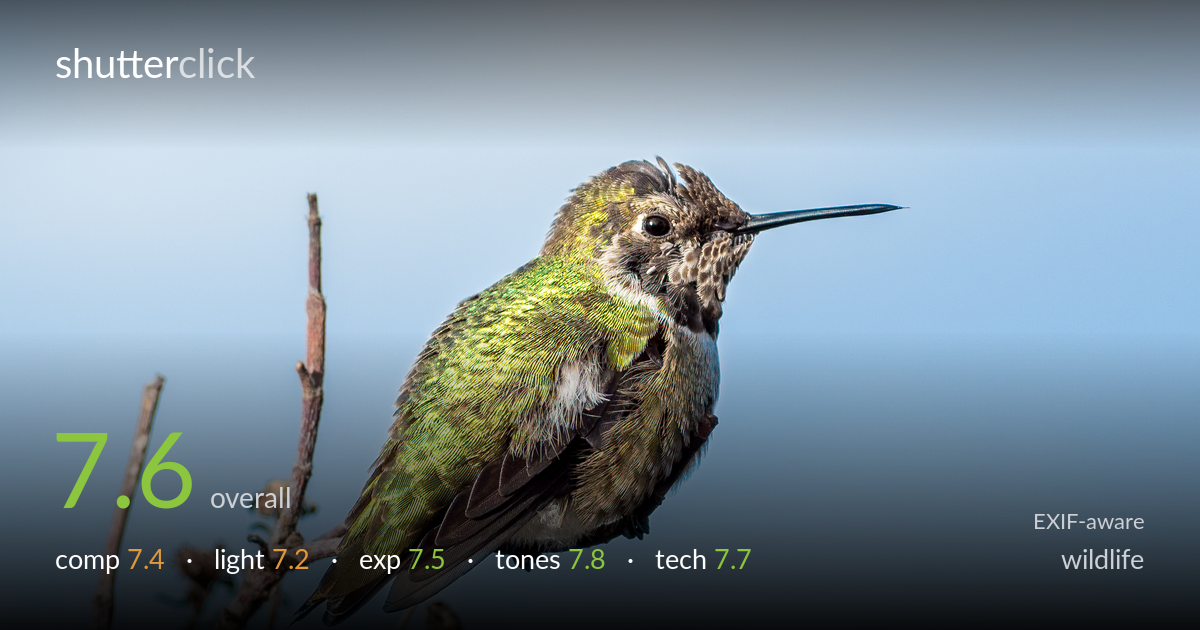
Hummingbird perched against a blue sky
Photo by Rhododendrites

| Focal length | 150 mm |
| Aperture | f / 5.6 |
| Shutter | 1/1250 s |
| ISO | ISO 400 |
| Exp. comp. | 0.0 EV |
| Shot at | 18:13 · Feb 4, 2019 |
A crisp, well-resolved hummingbird portrait carried by a tack-sharp eye and lovely iridescence in the gorget and back feathers. The bird sits naturally on a perch with dried seed heads adding context, and the clean blue sky isolates it cleanly. What holds the image back most is placement: the subject crowds the upper-left quadrant while the right two-thirds is empty sky, and the bird faces toward the heavier side. The perch leads in well from the lower left, but the framing leaves the gaze with little room. Strong fundamentals, with composition the clearest area to refine.
The diagonal perch from the lower left is an effective lead-in, and the dried seed heads add a seasonal context that bare twigs would lack. The problem is balance: the bird sits high and left while the right two-thirds is empty sky, yet the bird's gaze and beak point right into that void without quite using it. The result feels slightly off — too much dead space on the heavy side, too little breathing room above the head. A tighter crop bringing the bird toward thirds would strengthen the gaze line.
Low-angle sunlight from the front-left does the essential job for a hummingbird: it ignites the iridescent green of the back and crown, which only flares with proper angle. The light is fairly direct and a touch hard, giving good feather detail but also some flatness on the shaded right side of the body. The eye catches a small specular highlight, which keeps it alive. Softer, more diffused light would round the form, but for revealing iridescence this directional sun is a reasonable trade.
Exposure is well managed against a bright sky, which often fools metering into underexposing the subject. Here the bird retains detail in both the dark wing feathers and the pale belly, with no obvious clipping in the brightest throat highlights. The sky sits as a clean, slightly graduated blue without blowing out. Shadow areas on the lower body hold texture rather than blocking up. The histogram appears comfortably centred with deliberate placement; nothing reads as accidental. A very minor lift in the shaded flank would be the only refinement.
Color is the image's strength. The metallic greens shift convincingly from yellow-green to deeper emerald, and the warm browns of the wings and twigs balance the cool blue backdrop nicely. White balance is neutral and believable, with the sky a natural pale blue rather than a cyan cast. Contrast is judged well — enough to give the feathers dimension without crushing detail. Saturation stays restrained on the green so it reads as iridescence rather than oversaturated paint. The overall palette is cohesive and pleasing.
The 150mm reach on the E-M5 Mark II (300mm equivalent) is at the limit of what this lens offers for wildlife, and the crop suggests a fairly close subject — fortunate, because more reach would have been welcome. Focus is accurately placed on the eye, which is critically sharp, and feather detail across the gorget and back is excellent, evidence of a steady plane and a good capture. At f/5.6 the depth of field covers the bird while the background blurs into clean sky, ideal isolation. The 1/1250s shutter froze the perched subject with no motion blur, leaving headroom had the bird moved. ISO 400 is conservative and keeps noise negligible, with clean shadows and smooth sky tones. The variable-aperture kit lens performs above its reputation here. The main technical limitation is simply reach — a longer lens or teleconverter would allow a tighter, more frame-filling composition without cropping. Execution overall is clean and deliberate, with focus and shutter choices well suited to the subject.
What would elevate it
Tags
Shot something like this?
Expert photo critique, on demand — scored across six categories, EXIF-aware. Start with 3 free critiques, no credit card.
critique my photo — free