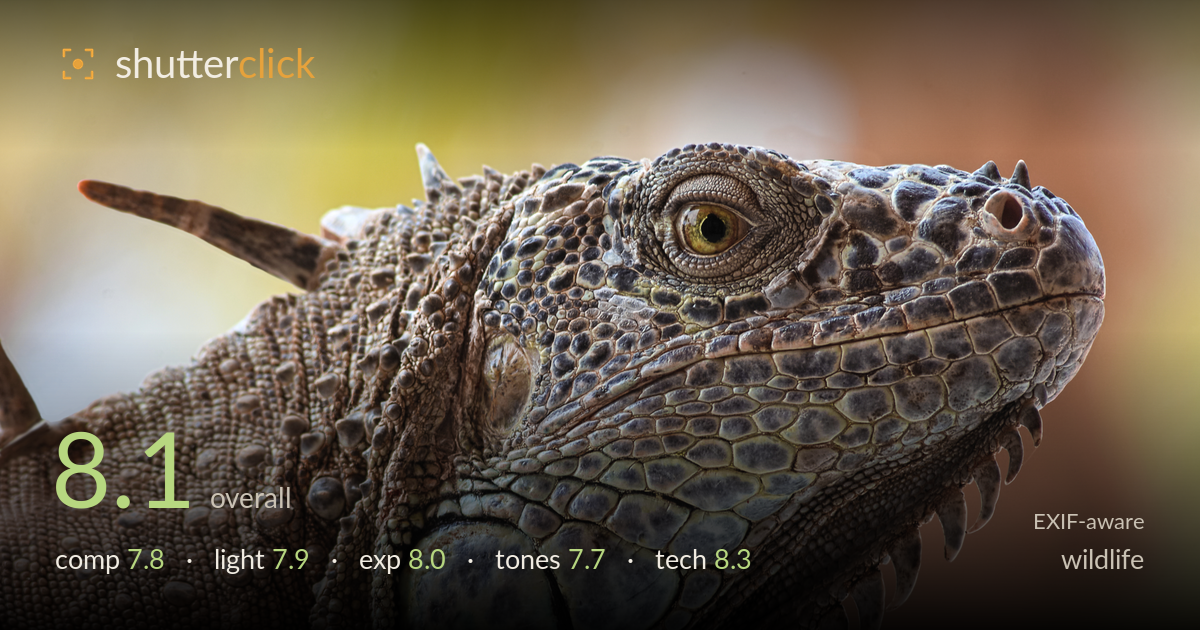
Iguana in profile up close
Photo by Carlos Valenzuela

| Focal length | 300 mm |
| Aperture | f / 11.0 |
| Shutter | 1/60 s |
| ISO | ISO 100 |
| Exp. comp. | 0.0 EV |
| Shot at | 12:08 · May 5, 2019 |
A detail-rich reptile portrait carried by exceptional close-range texture rendering and a clean, colourful background. The eye is sharp and the scale detail across the head reads beautifully, from the dewlap to the spiny crest. What holds it back most is the profile framing: the head faces frame-right with limited breathing room ahead of the snout, and the crest is clipped at the top edge. The face-on parallel-to-sensor pose also flattens the animal slightly. Nonetheless the technical craft — depth of field, focus placement, and background separation — is strong, and the subject rewards the long look.
The profile fills the frame with commanding presence, and the diagonal from lower-left shoulder up to the snout gives the composition energy. The out-of-focus warm background sets the subject off cleanly. However, the snout crowds the right edge, leaving too little space in the direction the animal faces, which feels cramped. The dorsal crest is clipped at the top, and the horn-like spine at upper left points into dead space. A touch more room ahead of the head and above the crest would balance the gaze and the anatomy.
Soft, diffused light wraps the head evenly and reveals the fine mosaic of scales without harsh shadows — well suited to showing texture. The subtle modelling around the jowl and eye ridge gives dimension. Direction appears frontal-to-slightly-side, which keeps the eye readable and the catchlight present, though a lower raking angle would deepen the relief of individual scales. Highlights on the pale cheek scale stay controlled. The lighting serves the detail well but errs slightly flat, sacrificing some sculptural depth for even coverage.
Exposure is well judged for the subject. The mid-tone grey and brown scales sit comfortably, the pale cheek scute retains texture without blowing out, and shadow detail in the darker neck folds holds. The eye reads with a clean iris and defined pupil. At ISO 100 the file is clean with no visible noise penalty. The bright background stays diffused rather than clipping distractingly. Nothing appears accidental here — the brightness placement across the tonal range is deliberate and controlled throughout the frame.
The muted palette of grey-blue, olive, and warm brown scales is rendered naturally, and the turquoise tint in the cheek scale adds a welcome accent. White balance looks accurate. The warm yellow-to-orange background gradient complements the cooler head tones pleasantly. Contrast is moderate, appropriate for retaining scale detail, though the overall grade sits slightly soft and could benefit from a modest lift in local contrast on the head to make the texture snap. Saturation is restrained and believable rather than pushed.
The 300mm focal length delivers strong subject compression and a clean, melted background, and f/11 was a sound choice for this near-parallel profile — it holds the eye, snout, and dewlap acceptably sharp across the plane while the background stays fully dissolved. ISO 100 keeps the file pristine with excellent detail retention in the scales. Focus is placed accurately on the eye, which is critical for wildlife, and the resolving power on the head texture is impressive. The one real concern is the 1/60s shutter at 300mm: that is below the reciprocal rule for this reach, so any subject or camera movement risked blur. It held here, likely on a tripod or a very still animal, but it left little margin. A faster shutter, or the same aperture at slightly higher ISO, would have bought safety without visible noise cost. Overall the execution is clean and deliberate, with focus and depth of field handled well.
What would elevate it
Tags
Shot something like this?
Expert photo critique, on demand — scored across six categories, EXIF-aware. Start with 3 free critiques, no credit card.
critique my photo — free