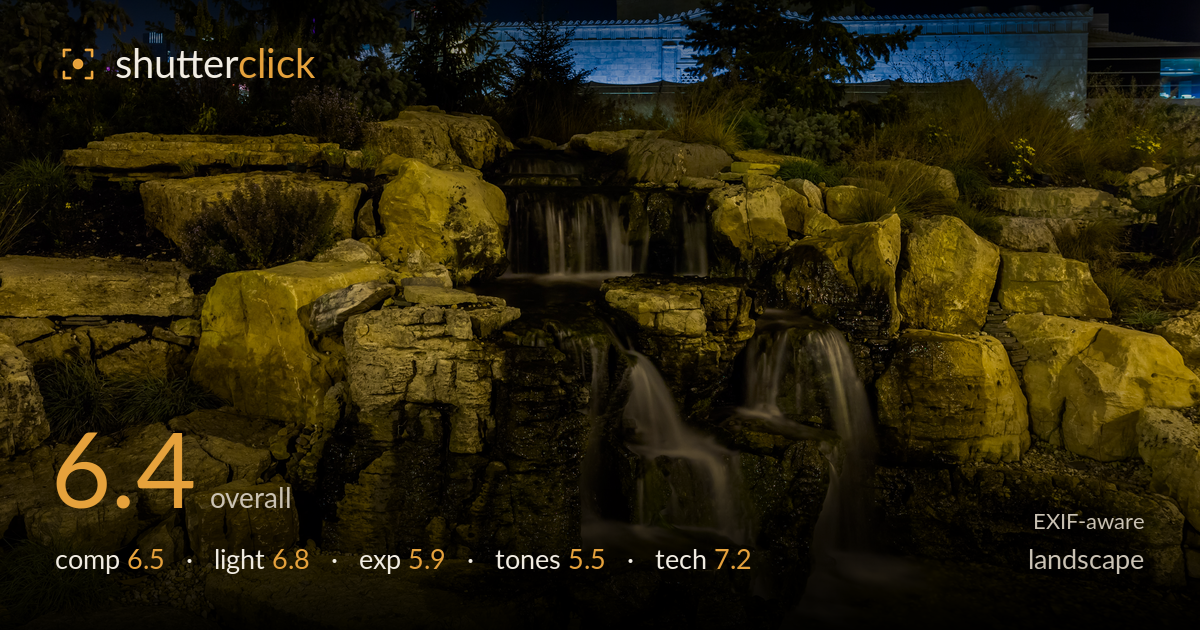
Illuminated waterfall below a lit dome
Photo by Diego Delso

| Focal length | 28 mm |
| Aperture | f / 10.0 |
| Shutter | 6.0 s |
| ISO | ISO 200 |
| Exp. comp. | 0.0 EV |
| Shot at | 03:17 · Oct 22, 2012 |
A nicely conceived night scene that layers a silky cascade foreground against a floodlit domed building — the depth is there and the long exposure earns its keep. What most holds it back is the tonal treatment: the foreground rocks glow an intense, artificial yellow-orange from tungsten lighting while the building sits in cold blue, a colour clash that fights rather than complements. The foreground also runs bright and slightly overcooked against a deep, near-black sky, flattening the balance. Reining in the yellow cast and lifting midtone separation would let the strong compositional bones and the well-frozen water breathe.
The waterfall reads as a clear foreground anchor, with the lit dome forming a distant focal counterpoint — good use of near-to-far depth. The stacked cascades lead the eye upward toward the building, which is well placed off-centre to the right. Framing trees on the left balance the mass, though the upper cascade and the building don't quite align into a single reading path, leaving the mid-ground a little cluttered. The large expanse of empty sky occupies nearly half the frame without contributing much beyond negative space.
The scene relies on mixed artificial light: warm landscape spots on the rocks and cool floodlights on the building, plus the purple dome accent. That contrast of temperature creates separation between foreground and background, which helps depth. The water catches enough directional light to render texture in the falls. However, the rock lighting is harsh and uneven, with hot patches and deep unlit gaps, and the sky is entirely dead. A more even wash on the foreground would have shaped the stone more gracefully.
The six-second exposure smooths the water well without blowing the highlights on the falls, and the bright dome accent holds colour. The foreground rocks, however, sit noticeably too bright and edge toward glaring in the most-lit patches, pulling attention from the intended balance. The sky is crushed to near-black with little gradation, and shadow areas among the rocks lose detail. A slightly darker overall exposure, or a graduated approach, would have tamed the hot foreground and preserved a touch more life in the transitions.
This is the weakest element. The tungsten-lit rocks read as a saturated, unnatural yellow-orange that dominates and clashes with the cold blue building — the two colour zones don't reconcile. White balance appears uncorrected for the mixed sources, exaggerating the divide. Midtone separation in the rocks is muddy where warm and shadow meet. The purple dome is a pleasant accent but competes for attention. Dialling back the yellow saturation and warming the shadows slightly would ease the clash and let the palette feel intentional rather than accidental.
The settings are well matched to the task. At f/10 and 28mm on the 5D Mark II, depth of field comfortably spans the foreground rocks to the distant dome, and focus lands cleanly on the near cascade. ISO 200 keeps noise negligible in the shadows, an appropriate choice for a tripod-based night frame. The six-second shutter is the right call for the flowing water — enough to render it silky while retaining structure in the strands, rather than smearing it to featureless white. The EF 17-40 f/4L delivers respectable corner-to-corner sharpness at this aperture, and diffraction hasn't become a problem. Verticals on the building look reasonably controlled for a wide focal length. The main technical caveat is that the long exposure combined with strong foreground lighting pushed the rocks brighter than ideal, so the highlight balance across the frame wasn't fully managed in-camera — bracketing or a shorter foreground exposure blended in post would have given more control over that dynamic range spread.
What would elevate it
Tags
Shot something like this?
Expert photo critique, on demand — scored across six categories, EXIF-aware. Start with 3 free critiques, no credit card.
critique my photo — free