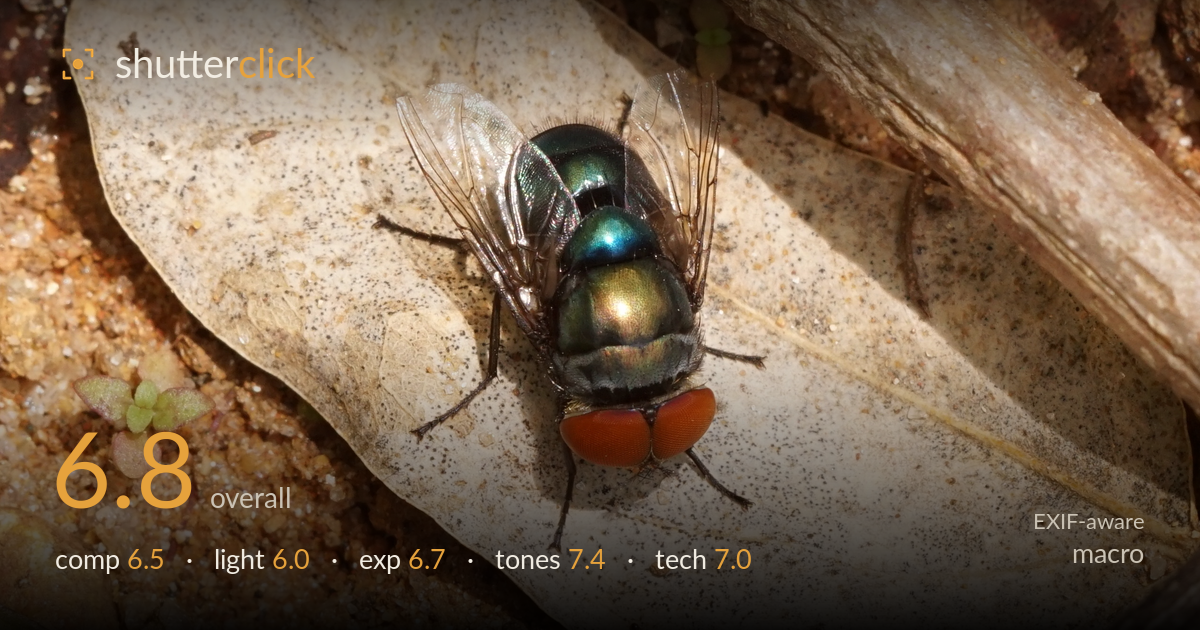
Iridescent fly on a dried leaf
Photo by Vengolis

| Focal length | 150 mm |
| Aperture | f / 11.0 |
| Shutter | 1/250 s |
| ISO | ISO 400 |
| Exp. comp. | 0.0 EV |
| Shot at | 11:31 · Aug 26, 2015 |
A blowfly rendered with strong iridescent colour on the thorax and abdomen, but the frame's key plane sits behind the peak of sharpness. The metallic green-and-bronze sheen and the deep red compound eyes carry genuine appeal, and the dried leaf gives a neutral stage. What holds it back most is that critical detail on the eyes and facial bristles is slightly soft while the thorax reads sharpest, and hard overhead sun creates blown speculars and heavy shadows. A cleaner focus lock on the eyes and diffused light would lift this considerably.
The fly sits roughly centred on the leaf, which reads as a deliberate stage but leaves the composition static. The dried leaf's diagonal orientation adds some dynamism, and the twig top-right and sandy gravel frame the subject reasonably. However, the fly is angled head-down toward the lower frame with limited breathing room below the eyes, while empty leaf dominates the upper left. Shifting the subject slightly off-centre with more space in the direction it faces would create better visual flow and reduce the flat, specimen-like feel.
Hard, direct overhead sun defines the light here. It does render the iridescence of the thorax and abdomen with punchy saturation, but it comes at a cost: strong specular hotspots on the wings and cuticle blow out, and the shadows cast by the legs are harsh and distracting. The eyes fall partly into shadow, muting their detail. Diffused light — a cloud, a diffuser panel, or shooting in open shade — would tame the speculars and reveal even texture across the whole insect.
Exposure is broadly well judged for a high-contrast subject. Midtones on the leaf sit cleanly and the metallic body retains colour without going muddy. The main concern is clipped highlights on the wing membranes and the brightest points of the thorax, where specular reflections have lost detail. Shadow areas under the body and legs hold enough information. A third of a stop of negative compensation, or exposing for the highlights, would have preserved the delicate wing structure that currently burns out in places.
The strongest aspect. The interplay of iridescent green, blue, and bronze across the body is rich and believable, and the deep red eyes provide a satisfying complementary accent. White balance on the neutral grey leaf looks accurate, and the warm sandy surroundings sit comfortably without an overcast colour shift. Contrast is on the high side owing to the hard light, which slightly compresses the tonal gradation in the metallic sheen, but overall the colour rendering is the image's clearest success.
The 150mm f/2.8 macro at f/11 is a sound choice for the subject, giving enough depth of field to carry the thorax and abdomen while keeping the background soft. ISO 400 is clean, and 1/250s froze the stationary fly without issue. The limiting factor is focus placement: the sharpest plane sits on the mid-thorax, so the compound eyes and facial bristles — the natural focal point for a fly portrait — are marginally soft. At this magnification, even a small plane shift matters, so focusing on the eyes and possibly stepping to f/13 for a touch more front-to-back coverage, or a short focus stack, would put critical detail where it counts. Hand-holding at this reach also risks tiny plane drift; a rail or tripod would tighten precision. The lens resolves texture well where focus lands, and diffraction at f/11 is not yet a serious concern on this sensor.
What would elevate it
Tags
Shot something like this?
Expert photo critique, on demand — scored across six categories, EXIF-aware. Start with 3 free critiques, no credit card.
critique my photo — free