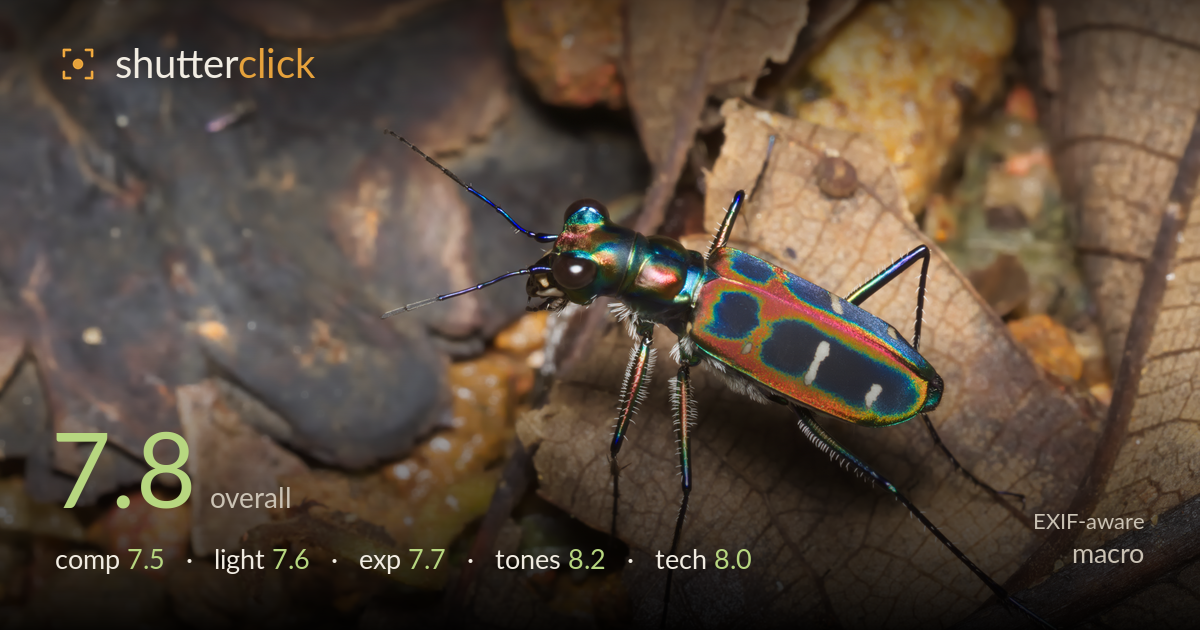
Iridescent tiger beetle on leaf litter
Photo by Jeevan Jose, Kerala, India

| Focal length | 150 mm |
| Aperture | f / 16.0 |
| Shutter | 1/160 s |
| ISO | ISO 100 |
| Exp. comp. | -0.3 EV |
| Shot at | 11:00 · Jul 12, 2015 |
A tiger beetle rendered with striking iridescent colour and crisp detail across the elytra and thorax — the metallic reds, greens and blues carry the frame effortlessly. The critical plane, from the eye through the elytra, is sharp and the diffused light avoids blown metallic highlights. What holds it back is placement: the subject sits high and centred with the frame heavy on the dead-leaf background, and the front legs and mouthparts fall soft. Focus stacking would have rescued that near plane. Still, the colour rendering and detail make this a genuinely rewarding macro worth refining.
The beetle is placed slightly right of centre and fairly high, leaving a large expanse of muddy leaf litter across the lower-left that adds little. The diagonal orientation gives some dynamism, and the crossing twig in the lower right introduces a mild leading element. The head faces frame-left with room ahead, which reads correctly. A crop tighter on the animal, or a lower angle to bring more of the substrate into play, would concentrate attention. As framed, the negative space is busy rather than restful.
The light is soft and even — likely diffused flash — which is the right call for a metallic subject, since it holds the iridescent colour without carving hard specular hotspots across the elytra. Direction is fairly frontal, giving good colour but limited modelling of the beetle's rounded form. The fine setae on the legs and thorax catch just enough light to register texture. A touch more raking side light would add dimensional separation from the flat background without sacrificing the colour saturation that works so well here.
Exposure is well judged for a difficult iridescent subject. The metallic highlights on the elytra hold colour rather than clipping to white, and the pale cream markings retain detail. Shadow areas in the leaf litter stay open with recoverable information. The -0.3 EV compensation was a sensible hedge against the reflective carapace. Midtones sit a little dark across the substrate, which flattens the background, but the beetle itself is placed cleanly in the tonal range with no significant loss at either end.
The colour is the standout. The elytra's transition from magenta-red edges through blue-black spots to green shoulders is rendered with rich, believable saturation, and the white tick-marks provide crisp accent. White balance is neutral, letting the metallic hues read true without a colour cast. The earthy browns and ochres of the leaf litter form a complementary, muted backdrop that lets the beetle's colour sing. Contrast is well controlled — no crushed shadows fighting the iridescence. A very strong tonal result for the subject.
The 150mm f/2.8 macro is an ideal choice here, and stopping to f/16 was the right instinct to extend depth of field on a three-dimensional insect — the elytra, thorax and eye sit sharply in plane. At f/16 diffraction softens fine detail slightly, but the setae and cuticle texture still resolve well, so the trade favoured coverage over ultimate acuity. ISO 100 keeps noise absent and the metallic colour clean. The 1/160s shutter, presumably supported by flash, froze the subject adequately. The limitation is depth of field: even at f/16, a single frame cannot cover a beetle at this magnification, so the near front legs and mouthparts drift out of focus while the far legs are soft too. A focus stack of several frames would have held the whole animal sharp without pushing the aperture further into diffraction. Focus was accurately placed on the eye and body, which is the correct priority.
What would elevate it
Tags
Shot something like this?
Expert photo critique, on demand — scored across six categories, EXIF-aware. Start with 3 free critiques, no credit card.
critique my photo — free