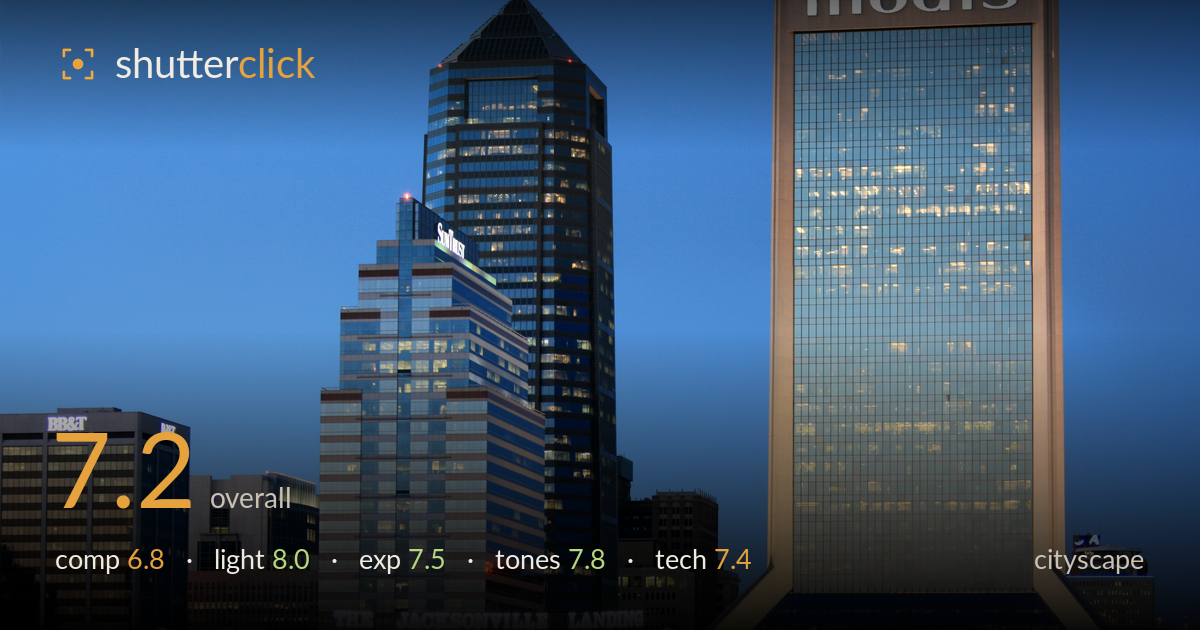
Jacksonville skyline at blue hour
Photo by “Jonathan Zander (Digon3)”

No EXIF metadata in this file
Technical analysis based on visual assessment only.
A clean, well-timed blue-hour cityscape that captures the balance between deepening sky and warm artificial glow at its ideal moment. The Modis tower and the central peaked skyscraper anchor the frame with strong verticals, and the illuminated waterfront reads clearly. What most holds it back is a heavy expanse of empty upper sky that pushes the skyline low and leaves the top half underused, plus a foreground of water that offers little reflection payoff. The frame reads as documentation more than interpretation — competent and technically sound, but a tighter, more deliberate arrangement would lift it from record to statement.
The two dominant towers create a solid vertical rhythm, and the Jacksonville Landing signage draws the eye along the waterfront. But the framing devotes nearly the top half to empty sky, compressing the skyline into the lower portion and weakening the balance. The water foreground is broad yet largely featureless, offering little reflection to reward the space. Verticals stay reasonably true, which suits the genre. A crop that trims the dead sky, or a composition that layered stronger reflections below, would tighten the whole arrangement considerably.
The blue-hour timing is the image's strongest asset — the sky still holds saturated colour while the buildings glow with interior and signage light, and neither overwhelms the other. The window grids read with warmth against the cool sky, and the Modis facade catches a soft ambient sheen. Shadow areas at the base of the buildings stay legible rather than crushing to black. This is the narrow window when a cityscape looks alive, and it was caught cleanly with a good balance of ambient and artificial sources.
Exposure is well judged for the difficult dynamic range of twilight. Highlights in the lit windows and signage hold detail without blooming badly, and the deep sky retains gradation. Shadow areas in the darker building faces stay readable rather than blocking up. The overall brightness sits comfortably, letting the artificial lights register as accents rather than blowouts. A touch more shadow lift in the waterline structures could reveal more detail, but the balance across the tonal range appears deliberate and controlled.
The colour grade leans into the classic blue-hour palette — cool saturated sky against warm amber window light — and the contrast between the two reads pleasingly. White balance holds neutral where it should, letting the glass buildings show subtle blues and the signage read warm. The water picks up soft reflected colour without becoming muddy. Saturation is restrained enough to feel natural. The gradation in the upper sky is smooth and clean, free of banding, which supports the calm mood.
Sharpness across the building facades is strong, with fine window detail and legible signage from a considerable distance, suggesting a well-chosen focal length and careful focus on the mid-ground towers. Depth of field is deep enough to hold everything crisp, appropriate for the genre. The slightly soft, smoothed water surface points to a longer exposure, which was the right call for low light and gives the foreground a calm sheen. Noise appears well controlled in the sky and shadow regions, indicating a low ISO supported by a stable base — this kind of clean twilight capture generally rewards a tripod. The verticals are close to true, avoiding the keystoning that plagues handheld skyline shots, though a hint of convergence remains on the tallest towers. Overall execution is solid and disciplined; the main technical opportunity lies less in capture and more in framing choices — the sky expanse and thin reflection payoff are compositional rather than mechanical shortcomings.
What would elevate it
Tags
Shot something like this?
Expert photo critique, on demand — scored across six categories, EXIF-aware. Start with 3 free critiques, no credit card.
critique my photo — free