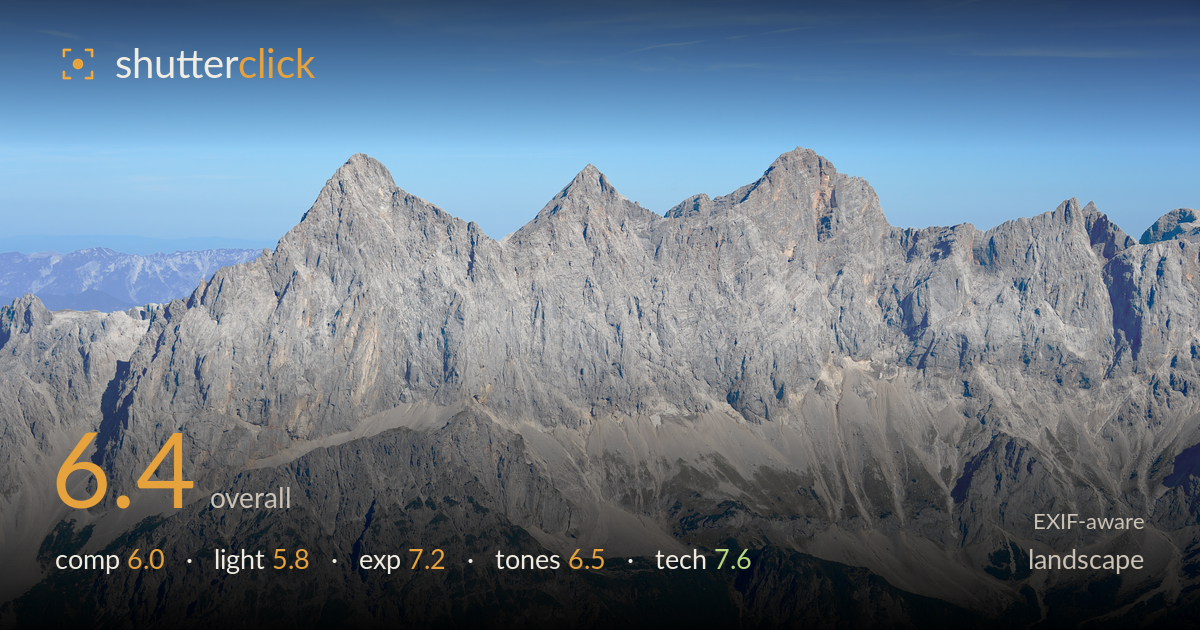
Jagged limestone peaks under blue sky
Photo by Carsten Steger

| Focal length | 65 mm |
| Aperture | f / 8.0 |
| Shutter | 1/2500 s |
| ISO | ISO 400 |
| Exp. comp. | 0.0 EV |
| Shot at | 09:39 · Sep 21, 2025 |
A crisp, well-resolved record of a limestone massif — the jagged triple peaks and scree fields are rendered with excellent detail and clean edges. What most holds the frame back is midday light: the flat, high-angle sun leaves the rock evenly grey with little modelling, so the range reads as documentation rather than drama. The sky occupies nearly half the frame as empty gradient without earning that space, and the crop truncates ridgelines at both edges. Strong technical execution and genuine subject interest, but the timing and framing keep it from resonating.
The three peaks form a natural rhythm and the scree fans below add pleasing downward flow, but the balance is off. Roughly the top half is empty blue sky that adds little, pushing the mountains low and cramped. The ridgeline is cut awkwardly at both edges, and the near-symmetry of central peaks lacks a clear anchor. A wide foreground element or a tighter crop on the summits would give the eye somewhere to settle rather than drifting across an even wall of rock.
This is the frame's weakest element. The high, near-frontal midday sun flattens the entire massif into uniform grey, flattening the very texture that makes limestone compelling. Shadows are short and offer little relief, so the vast rock face reads as one tonal plane with minimal depth. Only the faint warmth on the right peak hints at what raking light could do. Early or late side light would rake across the gullies and buttresses, carving out the three-dimensional structure the scene contains.
Exposure is handled cleanly. The bright grey rock holds highlight detail without clipping, and the darker forested slopes retain shape and texture rather than blocking up. The sky gradient is smooth and unclipped. Dynamic range across a scene this bright is managed well, and the histogram looks controlled. A touch of negative compensation could have deepened the sky and added a little more punch, but the base exposure is deliberate and technically sound throughout.
The blue-grey palette is honest to the alpine scene, and the white balance sits believably neutral. The range of greys in the rock is broad and well separated. The trouble is that the rock is tonally flat — a narrow band of mid-greys dominates, giving the massif a slightly washed, low-contrast feel. The sky is a clean gradient. A modest contrast lift or dehaze on the distant ridges would add separation and rescue some of the atmospheric flatness.
Execution is the strongest area. At 65mm, f/8, 1/2500s and ISO 400, the settings are well chosen for a distant range: f/8 sits in the D5's sharpest aperture zone and delivers front-to-back sharpness across the rock, while the fast shutter eliminates any handheld shake at this focal length. Detail resolution is excellent — individual gullies, scree channels and tree textures are crisply rendered, and there is no visible noise at ISO 400. Focus is accurately placed on the ridge. The only quibble is that 1/2500s is far faster than needed for a static subject; ISO could have dropped to 100 for marginally cleaner files, or the shutter slowed with no cost. That said, the exposure triangle produced a clean, sharp result. A polarizing filter would have cut the atmospheric haze on the distant left ridges and deepened the sky, adding the contrast the tones lack. Overall, technically assured work.
What would elevate it
Tags
Shot something like this?
Expert photo critique, on demand — scored across six categories, EXIF-aware. Start with 3 free critiques, no credit card.
critique my photo — free