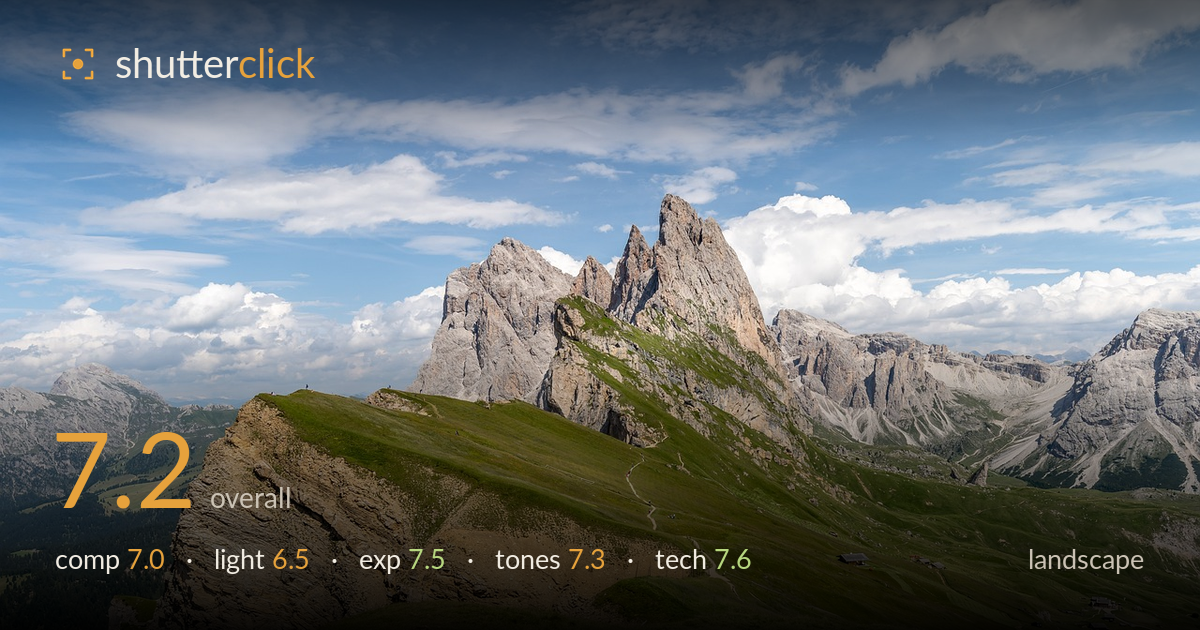
Jagged peaks above a green ridge
Photo by riddick_soad

No EXIF metadata in this file
Technical analysis based on visual assessment only.
A classic Seceda view that delivers the Dolomites' signature drama — the jagged ridge line rising against a lively sky, with the grassy foreground ridge providing a natural lead into the frame. The strongest asset is the depth: layered planes from the near green slope to the distant peaks give genuine scale. What most holds it back is the flat midday light, which drains modelling from the rock faces and leaves the greens a little muddy. A softer or lower-angled light and a stronger foreground anchor would lift this from a solid record of the place to a memorable image.
The near ridge sweeps up from the lower-left and directs the eye toward the peaks, giving a clear path through the frame. The main massif sits sensibly off-centre with the secondary ranges layering to the right for depth. The sky occupies a generous upper half, justified by the cloud interest. The immediate foreground grass is a touch empty and lacks a specific anchor — a rock, flower cluster, or figure would give the eye somewhere to land before travelling into the scene.
The light is high and near-frontal, typical of midday, which flattens the ridge's texture and mutes the modelling on the rock spires that would otherwise define this subject. Shadows are minimal and the greens read slightly flat. The clouds do add tonal variation across the sky, which rescues some interest. Golden-hour or early side light would rake across the peaks, separating the towers and deepening the grassland's dimensionality considerably.
Exposure is well controlled across a demanding range. Highlights in the brighter clouds hold detail without blowing, and the shadowed rock faces retain structure. The greens and mid-tones sit comfortably without crushing. Nothing appears clipped at either end, suggesting a careful metering choice or restrained processing. The overall brightness reads natural for the conditions. There is a little headroom to lift the darker rock shadows for more openness, but the exposure decisions look deliberate and clean.
White balance is neutral and believable, with a clean blue sky and natural greens. Contrast is moderate and suits the airy alpine mood, though the grasslands verge on a slightly dull, uniform green that a subtle luminosity or vibrance adjustment could enliven. The rock renders in convincing warm greys and tans. Sky-to-land separation is good. A touch more tonal contrast in the peaks would help the jagged forms punch against the hazier distant ranges.
Sharpness is strong across the frame, indicating a well-chosen aperture in the mid range that keeps both the near grass and distant peaks in acceptable focus — appropriate for this deep landscape. The wide focal length captures the sweep of the ridge and the full massif without obvious distortion, and the horizon and verticals read level. No motion blur is evident and noise is clean, consistent with a low ISO in bright conditions. Focus appears placed well into the scene, maintaining the front-to-back rendering a landscape of this depth needs. Slight atmospheric haze softens the far ranges, which is natural rather than a fault. The dynamic range is handled without HDR artefacts. Execution is technically sound throughout; the limiting factor is not the gear handling but the timing of the light, which no in-camera choice could fully compensate for. A polariser would have cut some haze and deepened the sky further.
What would elevate it
Tags
Shot something like this?
Expert photo critique, on demand — scored across six categories, EXIF-aware. Start with 3 free critiques, no credit card.
critique my photo — free