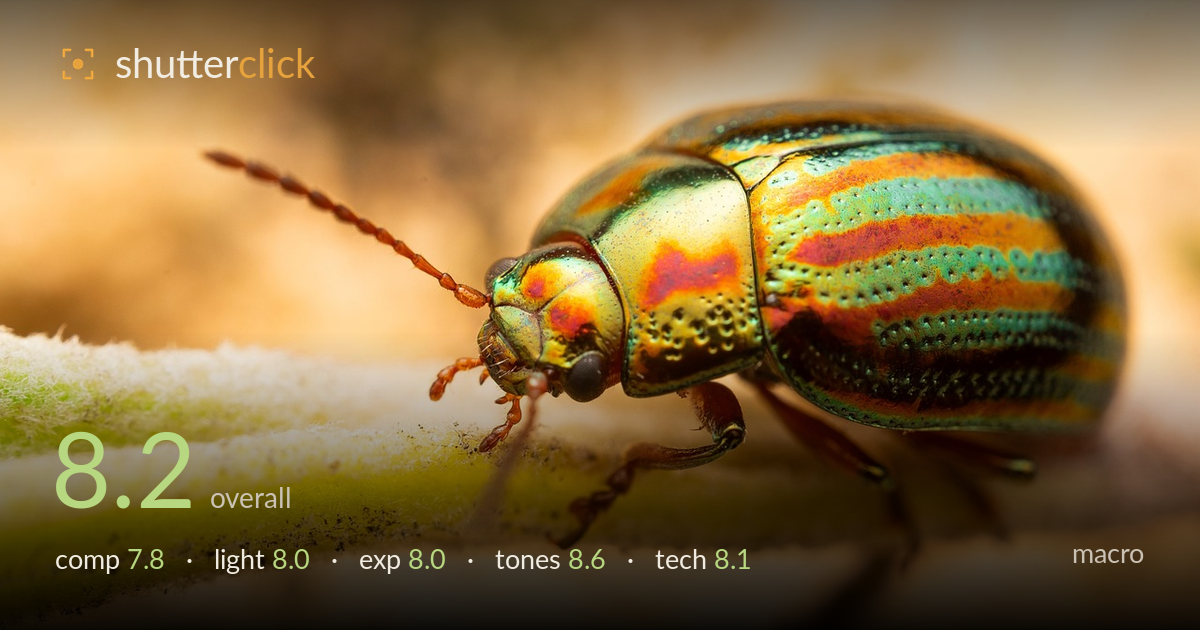
Jewel beetle on a stem
Photo by Krukower

No EXIF metadata in this file
Technical analysis based on visual assessment only.
A striking rosemary beetle rendered with jewel-like metallic colour and clean subject isolation against a warm, muted background. The iridescent green-orange-red striping is the star, and it carries the frame. The most limiting factor is the depth of field: focus lands cleanly on the head, eye, and near shoulder, but the elytra taper into softness toward the rear, so the whole insect is never fully crisp — a common macro trade-off that focus stacking would resolve. The diagonal stem provides a strong perching line, though it exits awkwardly at the lower left. Overall a confident, well-controlled macro with genuine visual punch.
The beetle sits strongly right-of-centre with the head facing into open space, a sound choice that gives the subject somewhere to look. The diagonal stem forms a natural leading line and perch, anchoring the insect and adding foreground texture. The fuzzy stem hair is a nice detail. Weaknesses: the stem meets the frame edge abruptly at lower left, and the rear of the beetle crowds the right edge, leaving little breathing room behind it. A fraction more room on the right would balance the negative space carried in the upper left.
Soft, diffused light does exactly what metallic subjects need — it wraps the iridescent shell and reveals the colour shifts across the elytra without blowing out the specular highlights that make a beetle shine. The direction, from the upper left, models the domed body and picks out the puncture-row texture. Catchlight on the eye is subtle but present. The trade-off of such even light is a slight flatness; a touch more directional raking would deepen the sculpting of the shell and separate the ridged rows even further.
Exposure is well judged for a high-key, warm-toned scene. The bright background is lifted deliberately without clipping to pure white in a way that would distract, and the beetle's metallic highlights hold detail rather than burning out — the hardest thing to protect on an iridescent subject. Shadow areas under the legs and belly retain enough information to read structure. The overall brightness leans warm and airy, which suits the mood. Nothing looks accidental; the histogram appears controlled from the shell highlights through to the muted background tones.
The colour is the photograph's greatest asset. The metallic green, gold, orange, and crimson of the shell are saturated and vivid yet remain believable, and they sing against the desaturated caramel background — a textbook complementary relationship that isolates the subject. White balance is warm and consistent. The graduated blur behind carries a pleasing tonal wash from cream to soft ochre. If anything, saturation sits at the upper edge of natural; a marginal pullback in the reds would keep the crimson stripe from bordering on glowing.
Focus is placed intelligently on the head, compound eye, and near shoulder — the correct priority for an insect — and detail there is crisp, resolving the antenna segments and facial texture. The shallow plane characteristic of macro is well managed, but it also exposes the core limitation: the rear of the elytra and the far legs drift into softness, so the full body is never rendered sharp in a single frame. A focus-stacked sequence would carry critical detail from antenna tip to rear, which for a subject this graphically rich would be transformative. The background rendering is smooth and free of harsh bokeh artefacts, suggesting a well-suited macro optic. Noise is not intrusive at this magnification. Working distance and angle put the sensor plane close to parallel with the beetle's near side, which maximised what sharpness was available. Overall a technically assured capture whose only real ceiling is single-frame depth of field.
What would elevate it
Tags
Shot something like this?
Expert photo critique, on demand — scored across six categories, EXIF-aware. Start with 3 free critiques, no credit card.
critique my photo — free