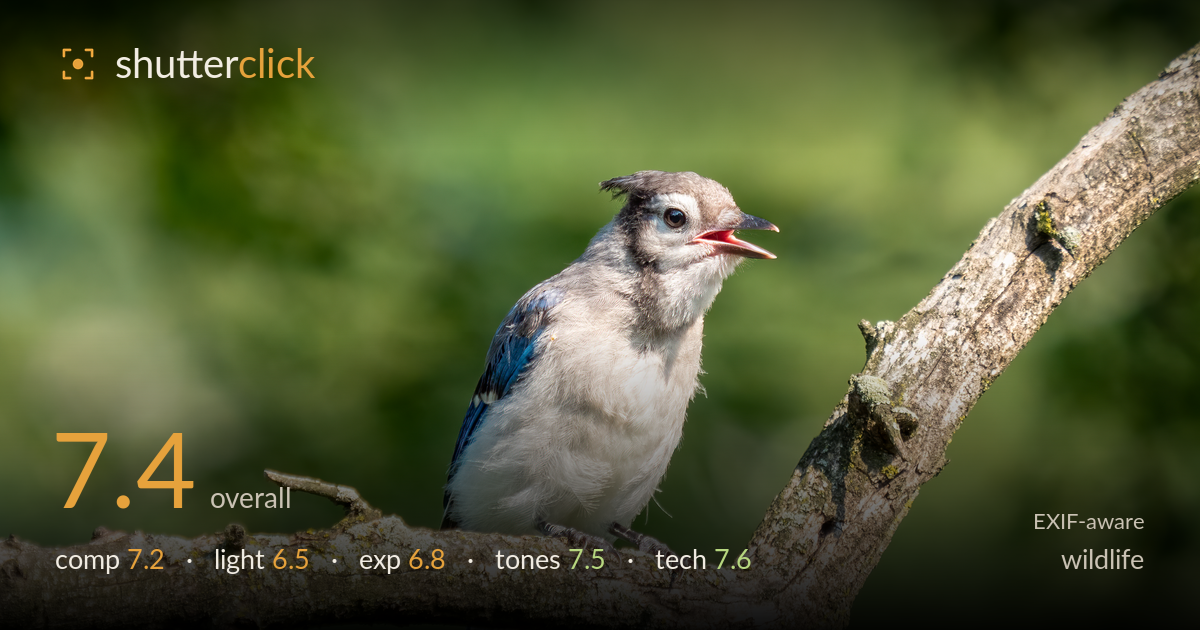
Juvenile blue jay calling on a branch
Photo by Rhododendrites

| Focal length | 300 mm |
| Aperture | f / 5.6 |
| Shutter | 1/500 s |
| ISO | ISO 640 |
| Exp. comp. | 0.0 EV |
| Shot at | 17:14 · Jul 5, 2021 |
A clean, well-timed capture of a juvenile blue jay mid-call, with the open bill and red gape adding genuine behavioural interest. The eye is sharp and the diagonal branches give the frame a natural structure that anchors the bird. What holds it back most is the light: hard, direct sun creates harsh highlights on the white breast and flat, contrasty modelling. The green background is smooth and complementary. A softer light window, a touch more headroom, and slightly reined-in breast highlights would lift this from a solid record shot toward a memorable one.
The bird sits at a strong intersection where the diagonal branches meet, and those converging limbs create pleasing lines that lead the eye toward the subject. Placement left of centre with the bird facing into open space works well. The tail runs low and slightly crowds the bottom edge, and the head sits close to the top, leaving little headroom above the crest. A fraction more breathing room top and bottom would let the pose settle. The uncluttered background keeps attention where it belongs.
Direct, hard midday sun is the weakest element here. It rakes across the white breast producing blown, texture-free patches while pushing the shaded flank into flat greys, flattening the feather detail that soft light would reveal. The catchlight in the eye is present but small. Front-ish light does keep the face and gape legible, and the red mouth reads cleanly. Shooting in the softer, more directional light of early morning or late afternoon, or on an overcast sky, would model the plumage far more gently.
Exposure is close but the bright breast is pushed to the edge of clipping, with the whitest feathers losing subtle tonal separation. The eye and darker upperparts retain detail, and the green background holds without banding. A slight negative exposure compensation, perhaps a third to two-thirds of a stop, would have preserved the highlight texture on the chest and given more room to recover in post. Midtones on the grey plumage are well placed and the shadow areas keep information.
The colour palette is one of the frame's strengths: the muted greys and whites of the juvenile jay sit cleanly against a smooth, complementary green field, and the flash of blue in the wing and the red gape provide effective accents. White balance looks natural with no obvious cast. Contrast runs a touch high from the hard light, which slightly hardens the transitions on the breast. Saturation is restrained and believable. The green gradient in the background is pleasingly even and unobtrusive.
The 40-150mm f/2.8 with the MC-20 at an effective 600mm reach is a capable wildlife setup, and it delivers here. Focus lands accurately on the eye, which is critically sharp and shows fine detail in the surrounding feathers. At f/5.6 the depth of field is enough to hold the head and body while dissolving the background into clean bokeh, giving strong subject separation. ISO 640 is well controlled with no distracting noise, appropriate for the light available. 1/500s froze the perched bird cleanly, though for a subject that might flush or lunge, a faster shutter would add safety margin. The only technical caveat is that the hard light, not the gear, limits how much micro-detail resolves on the sunlit breast. Overall the execution is sound: sharp where it counts, clean files, and sensible aperture and ISO choices for the situation. A marginally faster shutter and a touch of highlight protection would round it out.
What would elevate it
Tags
Shot something like this?
Expert photo critique, on demand — scored across six categories, EXIF-aware. Start with 3 free critiques, no credit card.
critique my photo — free