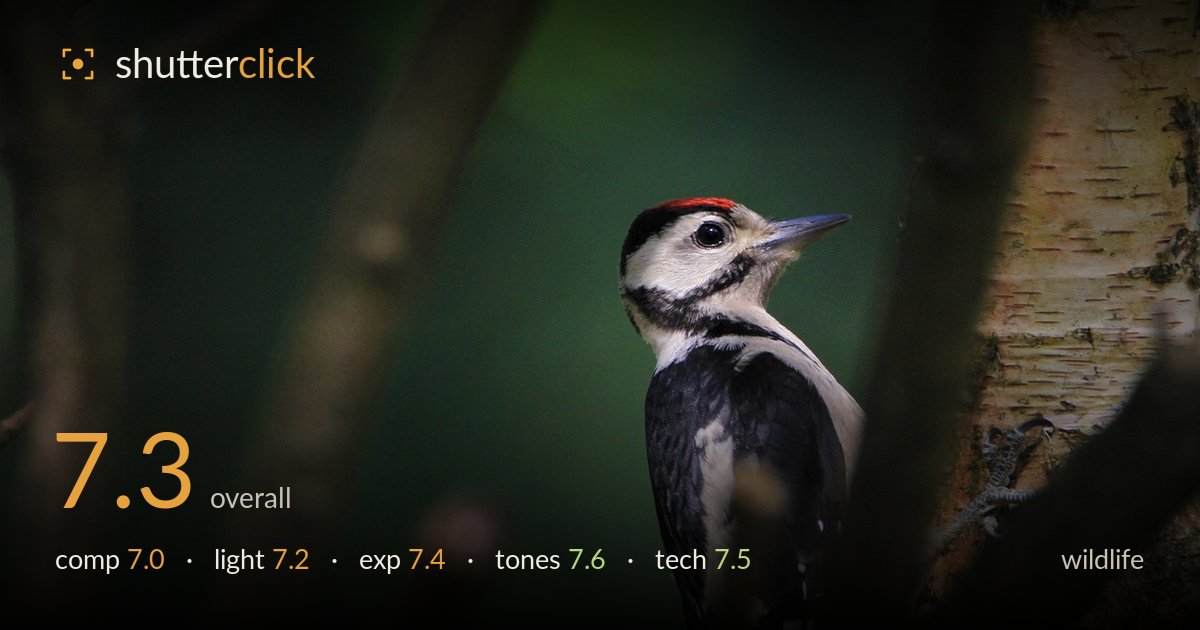
Juvenile woodpecker on a birch trunk
Photo by Carola68

No EXIF metadata in this file
Technical analysis based on visual assessment only.
A crisp, well-placed juvenile great spotted woodpecker set against a clean green backdrop that isolates the subject beautifully. The eye is sharp, the head detail excellent, and the birch-bark perch grounds the bird in a natural habitat. What holds the frame back most is the foreground clutter: the dark out-of-focus branches crossing the lower-right and left edges compete with the subject and slice into the composition. The bird's upward gaze reads as alert, but the head is placed high and the body runs into busy detail. A cleaner shooting angle and tighter management of intervening twigs would elevate this from a good record shot to a standout wildlife portrait.
The bird sits on the right third with its gaze directed into open space, a sound arrangement that gives the eye somewhere to travel. The soft green field on the left is a genuine asset. What works less well is the tangle of dark branches crossing the bottom edge and the trunk on the left — they crowd the frame and pull attention from the subject. The perch on the right is natural but heavy. Slightly more space above the head and cleaner foreground would sharpen the read.
Soft, diffused forest light suits the subject, wrapping the head and back without harsh shadow and preserving detail in both the white face and dark plumage. The catchlight in the eye is present, giving life to the face. Directionality is subtle, coming from the upper front, which models the beak and crown nicely. The overall level is a touch flat and low, typical of shaded woodland — a brighter pocket of light or a hint of rim separation would have added dimension to the black-and-white plumage.
Exposure is well judged for a high-contrast subject. The white face and belly hold detail without clipping, and the black wing feathers retain structure rather than blocking up. The dark green background sits low without going fully dead, keeping the mood. Highlights on the birch bark stay controlled. There is a little muddiness in the deepest shadows of the lower branches, but nothing objectionable. Overall the histogram appears used sensibly, protecting the tricky whites that so often blow out on this species.
The green backdrop is rich and clean, providing strong colour contrast against the monochrome bird and the warm birch tones. White balance reads natural for shaded woodland. The red crown patch pops without oversaturation, and the mid-tone gradation across the white face is smooth. The greens are perhaps a shade heavy and could feel slightly murky in the darker corners, but the palette is cohesive and pleasing. Tonal separation between the bird and background is one of the image's real strengths.
Focus lands accurately on the eye and face, the critical plane for wildlife, and the feather detail across the crown and back is well resolved. Depth of field is shallow enough to melt the background into a clean wash while keeping the bird's near side sharp, suggesting a wide-ish aperture and a decent telephoto reach. There is no visible motion blur, so shutter speed was sufficient to hold a static perched bird. Noise is well controlled given the low woodland light. The main technical limitation is not the camera work but the shooting position: intervening out-of-focus branches cross the frame, and one soft twig sits near the lower body. A step sideways or a longer wait for the bird to clear the obstructions would have yielded a cleaner line of sight. Sharpness on the tail tip and lower belly falls off slightly with the depth-of-field plane, which is acceptable here since the head is the priority.
What would elevate it
Tags
Shot something like this?
Expert photo critique, on demand — scored across six categories, EXIF-aware. Start with 3 free critiques, no credit card.
critique my photo — free