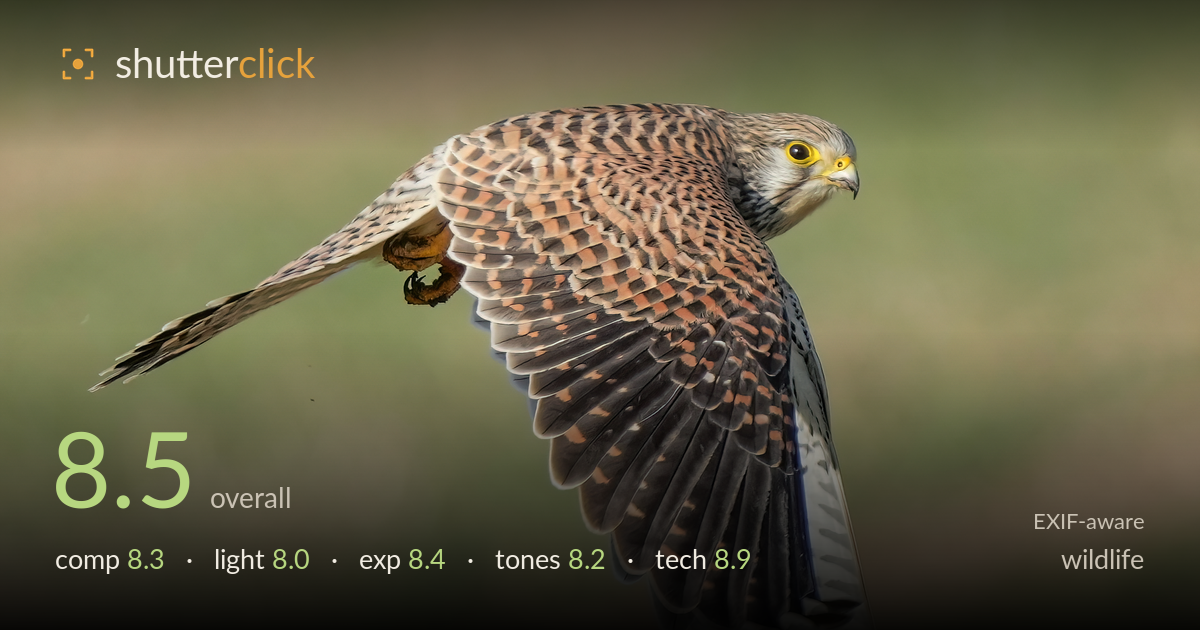
Kestrel on the downstroke
Photo by Giles Laurent

| Focal length | 600 mm |
| Aperture | f / 6.3 |
| Shutter | 1/2000 s |
| ISO | ISO 640 |
| Exp. comp. | 0.0 EV |
| Shot at | 09:24 · Feb 12, 2022 |
A crisp, full-wingspan capture of a kestrel in flight with the eye tack-sharp and a beautifully creamy green background that isolates the bird cleanly. The wing arc is caught at a graceful moment, feather detail is rich, and the head turn gives the frame direction. The main constraint is placement: the bird sits high and slightly forward in the frame, leaving little breathing room ahead of the beak while a broad, empty lower-right quadrant goes unused. The light is clean but flat and frontal, so the plumage barn-door texture reads well but lacks the modelling that low, raking light would bring.
The full downstroke wing arc fills the upper frame and the head turn gives the composition clear direction. The bird sits high, though, with the beak pushing toward the right edge and only a sliver of lead room ahead of it, which pinches the sense of forward motion. Meanwhile the lower-left and lower-right areas are large expanses of empty green. A frame that dropped the bird lower and left, opening space in the direction of travel, would balance better and let the flight read as motion rather than as a bird pinned near the top.
Soft, even frontal light sits nicely on the head and body, keeping the eye lit and the yellow cere and eye-ring glowing. It renders the barred plumage cleanly without harsh contrast. The weakness is that this same flat, near-frontal quality flattens the wing, so the underside feathers lack the depth that a lower, more raking sun would carve out. The warm tone suggests early or late light, which suits the subject, but a stronger directional angle would add dimensionality to the outstretched wing and separate its layered feathers more distinctly.
Exposure is well judged for a pale-bellied raptor against a bright field. The white underwing and belly hold texture rather than blowing out, and the barred detail there survives intact — the hardest part of exposing this bird. Shadow areas in the darker wing coverts retain feather detail without muddiness. The eye and dark primary tips read as true blacks without clipping visibly. There is very little to fault here; the histogram appears well within range, and the zero exposure compensation was the right call for this evenly lit, mid-toned scene.
The rufous browns and cream barring are rendered faithfully, with pleasing separation between the warm plumage and the muted green backdrop. White balance leans warm, which flatters the bird and the field alike. Contrast is moderate and appropriate, preserving the subtle gradations across the barred feathers. The green background is smooth and softly graded, though it drifts slightly yellow-green in places. A touch more saturation restraint on the background would keep attention on the bird, but overall the palette is cohesive and natural.
The 600mm reach on the ILCE-1 with the 200-600 G is exactly the right tool here, and it shows: the eye is critically sharp and the head detail is excellent. At 1/2000s the body and head are frozen cleanly, while the wingtips carry the faintest motion softness that reads as natural flight rather than error — a sensible tradeoff. f/6.3 wide open on this lens gives enough depth to hold the near wing and head in focus while melting the background into that clean wash, and ISO 640 keeps noise negligible with plenty of clean detail in the shadows. Focus acquisition landed on the eye, which is the whole game in a flight shot. The only minor point is that the far wingtip and the trailing tail edges soften slightly, partly depth of field and partly motion, but nothing that undermines the frame. This is confident, well-drilled birds-in-flight technique with settings that match the subject and conditions precisely.
What would elevate it
Tags
Shot something like this?
Expert photo critique, on demand — scored across six categories, EXIF-aware. Start with 3 free critiques, no credit card.
critique my photo — free