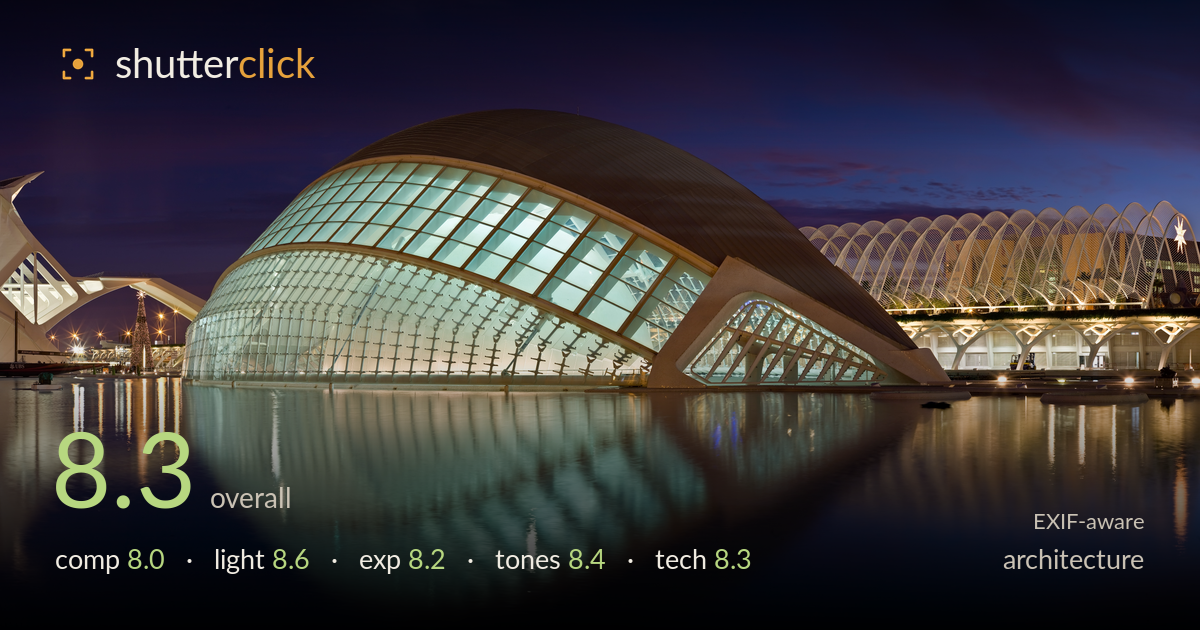
L'hemisfèric mirrored at blue hour
Photo by Diliff

| Aperture | f / 9.0 |
| Shutter | 4.0 s |
| ISO | ISO 100 |
| Shot at | 17:30 · Jan 1, 2007 |
A confident blue-hour panorama of Calatrava's L'Hemisfèric, carried by the balance between the warm interior glow and the deep dusk sky, doubled cleanly in still water. The mirrored dome anchors the frame and the arched gallery on the right adds welcome layering. What most holds it back is the panoramic stitch's slight barrel distortion, which bows the waterline and softens the geometry near the edges, and a composition that leans a touch heavy left with the boat and tree clutter competing for attention. Timing and exposure are the real strengths here.
The dome sits just left of centre with its reflection completing an almost eye-shaped form — a strong, memorable anchor. The right-side arched gallery layers depth and keeps the frame from feeling one-note. The panoramic curvature bows the waterline, though, which reads as a subtle sag through the middle. The left edge collects distractions: the boat, the lit tree, the scattered lamps pull the eye away from the main structure. A slightly tighter crop from the left would concentrate attention on the dome and its cleaner reflection.
Blue hour is worked to full advantage. The residual sky gradient — deep indigo up top warming toward the horizon cloud — plays beautifully against the cool artificial glow inside the glazing. The interior lighting reveals the structural lattice without blowing out, and the warm points along the right gallery balance the cool dome. Direction and timing are the standout here: enough ambient light to hold shadow detail in the shell, enough darkness to let the building's own illumination carry the scene. Very well judged.
The four-second exposure holds a wide range cleanly. Highlights in the brightest window panels and the lamp points stay mostly in check with only minor blooming, while the dark upper sky and foreground water retain colour and detail rather than blocking to black. The glazed shell sits in a well-placed midtone that shows both the glass and the structure behind it. A touch more restraint on the hottest interior panels would preserve the last of the pane detail, but overall this is a well-controlled histogram for a high-contrast night scene.
The teal-to-warm interplay is the tonal signature and it works — cool glazing and water against warm sodium lamps and a bruised-purple sky. White balance sits convincingly for blue hour without going artificially cyan. Contrast is handled with enough gradation to keep the sky's cloud detail and the water's soft roll-off. The saturation is rich but not garish. The one area to watch is the slight magenta cast creeping into the upper sky, which could be dialled back a hair for a cleaner dusk gradient.
The settings are well matched to the task. f/9 sits in the lens's sharp zone and delivers front-to-back depth appropriate for architecture, keeping the near water and distant gallery both acceptably crisp. ISO 100 gives clean shadows with no meaningful noise even in the darkest sky, and the four-second shutter is exactly what glassy still water and static architecture call for — the reflection is mirror-smooth without smearing. Focus lands accurately on the dome's structure. The principal technical limitation is the panoramic stitch: barrel distortion bows the waterline and stretches geometry toward the frame edges, softening the arches on the far right and undermining the vertical rigor architecture rewards. A corrective lens-profile or manual distortion pass in post would straighten the horizon and restore the converging lines. A sturdy tripod clearly did its job here; the discipline in the capture is evident.
What would elevate it
Tags
Shot something like this?
Expert photo critique, on demand — scored across six categories, EXIF-aware. Start with 3 free critiques, no credit card.
critique my photo — free