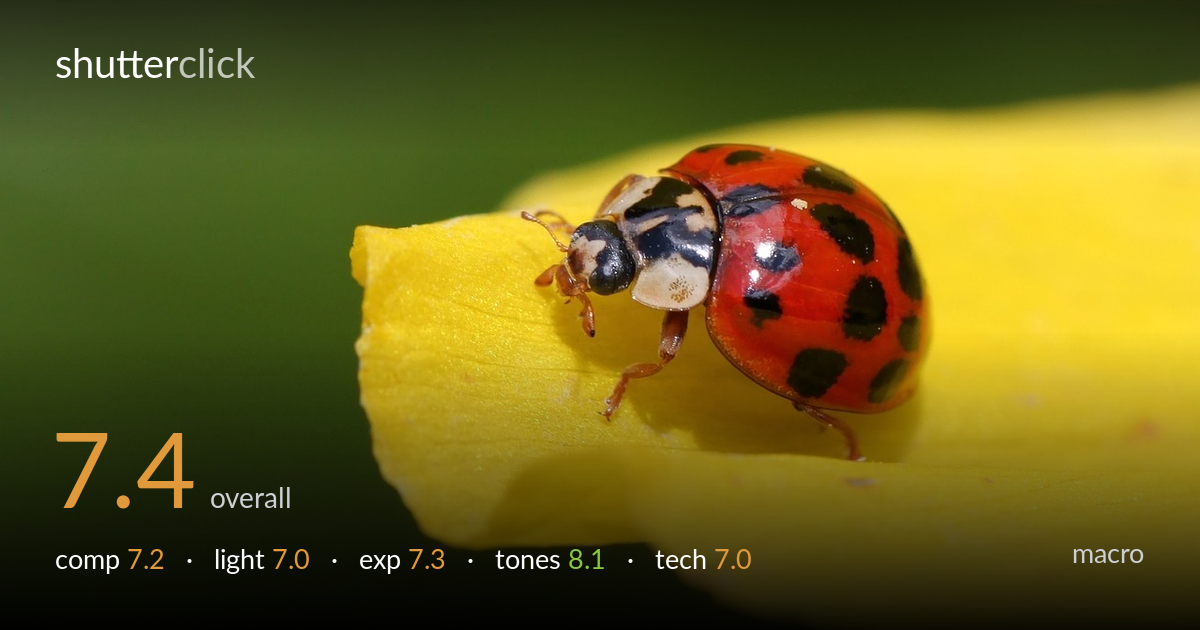
Ladybird on a yellow petal
Photo by cocoparisienne

No EXIF metadata in this file
Technical analysis based on visual assessment only.
A clean, high-impact colour study — the red ladybird against yellow petal and green backdrop is a primary-colour combination that carries instant punch. The strongest element is the colour separation; the weakest is the focus plane, which lands on the body and shoulders but leaves the head and front legs marginally soft, costing the shot its peak macro detail. The subject sits at the edge of the petal with a pleasing leading line, but it's positioned slightly tight to the upper frame. Sharper focus on the eyes and a touch more breathing room above would lift this from competent to memorable.
Placing the ladybird at the petal's tip gives a natural perch and a clean stage, and the diagonal of the petal edge leads the eye toward the subject. The large green negative space on the left balances the bright yellow mass well. The subject sits a little high and tight to the top edge, cramping the headroom and the antennae. A frame with the insect lower and more centred laterally, or angled to follow the petal's diagonal more deliberately, would give the composition more room to breathe.
Soft, diffused daylight wraps the subject without harsh shadows, which suits the rounded carapace and keeps the petal's yellow even. There are specular highlights on the shell that read as wet sheen and add life, though one or two edge toward blowing out. The light is fairly flat and frontal, so the texture of the elytra and the legs lacks the raking modelling that brings macro detail forward. A lower side light would carve more dimension into the shell and define the leg joints.
Exposure is well judged overall — the red retains saturation without clogging, and the yellow petal holds detail across most of its surface. The deep green background sits dark and rich, anchoring the frame. The brightest speculars on the shell are close to clipping, and a few petal highlights run hot near the edge. Pulling exposure down a third of a stop would have preserved that highlight detail with little cost to the midtones. The shadow areas under the body retain enough information to read structure.
This is the standout. The primary-colour triad — red, yellow, green — is vivid yet controlled, with white balance reading natural and saturation pushed just enough to sing without going garish. The green-to-yellow transition in the background is smooth and clean. Contrast between the matte petal and the glossy shell adds tactile interest. The black spots punch cleanly against the red. If anything, the reds are at the upper limit of saturation; a slight pull would protect tonal gradation in the brightest areas of the shell.
The shallow depth of field isolates the subject beautifully and renders the background as a creamy wash of green and yellow, exactly what macro work of this kind wants. The problem is where the thin plane of focus lands: it falls across the mid-body and the spotted shell, while the head, eyes, and front legs sit just outside critical sharpness. In macro the eye and face are the priority focal points, and here they read marginally soft. A narrower aperture would have pulled more of the insect into focus at the cost of background blur, or focus stacking would have held both the face and the shell sharp. The working distance and magnification are well chosen — the ladybird fills a strong portion of the frame without crowding it. Noise is well controlled and the rendering is clean. Nailing focus on the eyes is the single change that would elevate the technical execution most.
What would elevate it
Tags
Shot something like this?
Expert photo critique, on demand — scored across six categories, EXIF-aware. Start with 3 free critiques, no credit card.
critique my photo — free