Layered sandstone under a wide sky
Photo by Óðinn

| Shot at | 15:02 · Feb 20, 2012 |
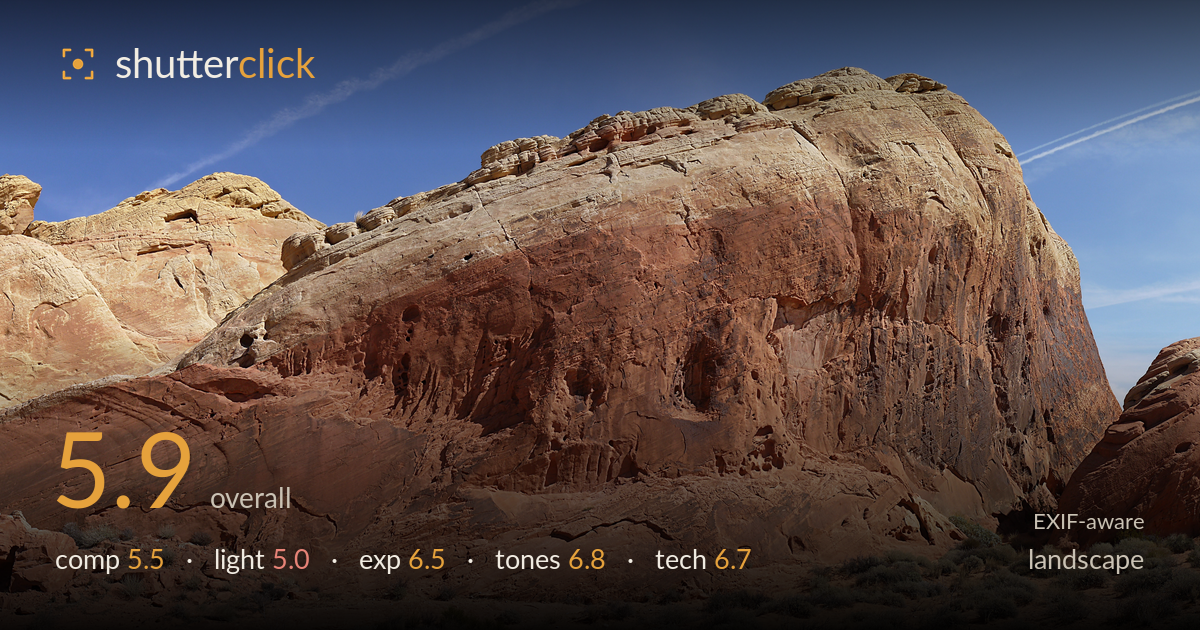
The sandstone formation itself is the strength here — the two-tone rock, from pale cream to deep rust, records beautifully and the geology reads with real clarity. What most holds the image back is the light: flat, near-overhead sun that leaves the great slab of cliff face without the raking modelling this kind of terrain needs. The panoramic stitch works technically but produces a landscape-format frame with a large, empty upper half and a thin sliver of foreground. Reworking the timing and the framing balance would lift this from a competent record shot to something with genuine depth and drama.
The panoramic sweep captures the full formation, and the diagonal ridgeline from lower left up to the high point on the right gives the frame a natural rise. But the balance is off: sky occupies nearly half the frame with only faint contrails to hold it, while the foreground desert scrub is compressed into a thin band at the bottom. There's little foreground interest to anchor the eye or establish scale. A lower vantage using the near boulders as an entry point, or a crop that trims sky and lifts the horizon, would add depth.
This is the weakest element. The sun sits high and nearly frontal, flattening the enormous cliff face and washing out the surface relief that makes sandstone compelling. Shadows are minimal and offer little modelling — the rock reads as colour rather than form and texture. The pale left dome in particular loses definition. Early or late side light raking across the face would carve out the ledges, fissures and layered strata, and warm the rust tones further. The current midday timing records the scene without dramatizing it.
Exposure is handled reasonably. The bright sandstone holds detail without clipping, and the shadowed alcoves on the right retain some structure rather than blocking to black. The sky is a touch bright but the blue holds gradation from deep at top to pale near the horizon. Midtones sit well and the dynamic range of a high-contrast desert scene is managed competently. A slight pull on the highlights of the pale cream rock would recover a little more surface texture, but there's no serious clipping or crushed shadow to correct here.
Colour is the image's quiet success. The transition from creamy white through ochre to deep oxide red across the formation is rendered naturally and with good separation, and the rust tones have appealing saturation without tipping into garishness. The blue sky is clean and complements the warm rock. White balance looks accurate for daylight. Contrast is moderate — appropriate given the flat light, though a little more local contrast on the rock face would help the strata read. Overall a faithful, pleasing tonal palette that suits the subject.
Shot on a Panasonic DMC-GF2, the capture is technically sound for the conditions. This is clearly a multi-frame panoramic stitch, and the join work is clean — no obvious seams, ghosting or misalignment across the wide frame, which is well executed. Depth of field is deep and the whole formation reads acceptably sharp, appropriate for landscape. The GF2's older Micro Four Thirds sensor limits fine detail and dynamic range compared to modern bodies, and at pixel level the rock texture is a little soft, but for a daylight scene at base ISO the noise is negligible and the file is clean. No motion issues. The main limitation is not the gear but the timing and the choice to include so much empty sky; the equipment handled the scene it was given. A polarizer would have deepened the sky and cut haze, and bracketing for a subtle blend would have squeezed more from the sensor's modest range.
What would elevate it
Tags
Shot something like this?
Expert photo critique, on demand — scored across six categories, EXIF-aware. Start with 3 free critiques, no credit card.
critique my photo — free