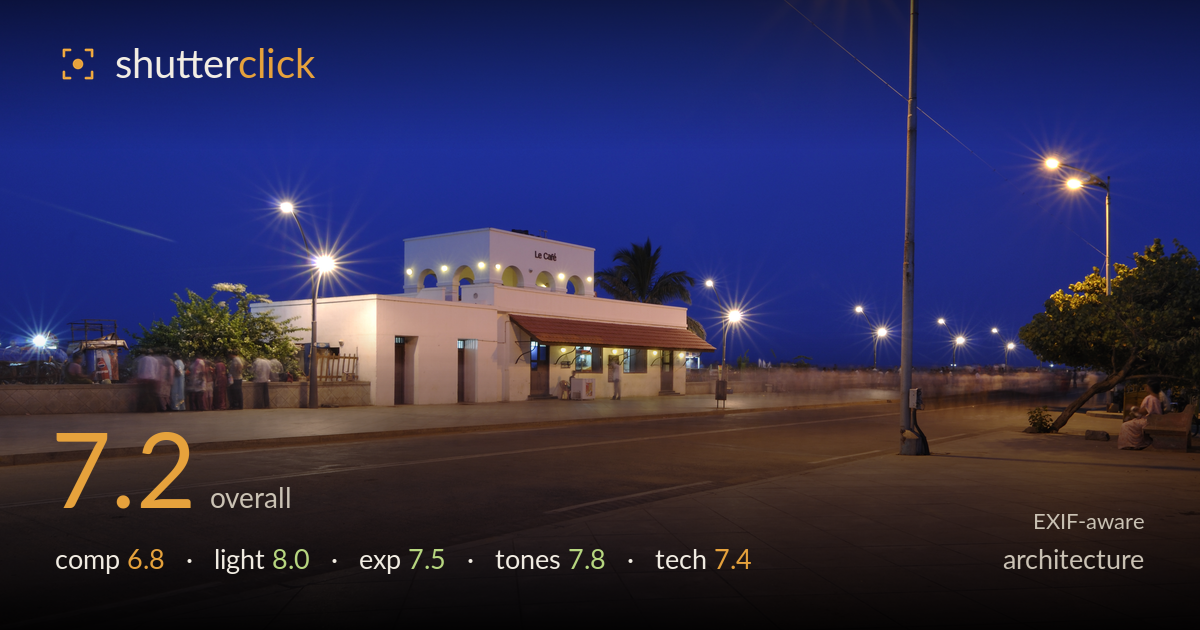
Le café at blue hour
Photo by Dey.sandip

| Focal length | 16 mm |
| Aperture | f / 16.0 |
| Shutter | 15.0 s |
| Exp. comp. | 0.0 EV |
| Shot at | 18:55 · Jun 9, 2012 |
The blue-hour timing is the real achievement here: the deep cobalt sky sits beautifully against the warm lamplight and the glowing "Le Café" facade, and the balance between artificial and ambient light is well judged. What holds the image back is the foreground — a vast expanse of empty paving dominates the lower third and pulls weight away from the café, which is the clear subject. The wide 16mm framing exaggerates that emptiness. The building is also pushed left while a bare foreground fills the right. Tightening the composition and using the promenade paving as a leading element would sharpen the storytelling considerably.
The café is placed well left-of-centre with the street lamp and trees anchoring the right, giving reasonable balance across the frame. But the lower half is dominated by empty paving that offers texture without direction — it reads as dead space rather than deliberate foreground. The receding street lamps form a pleasing diagonal that draws the eye toward the horizon. The horizon sits low, which suits the sky, yet the subject building feels small within all this negative space. A lower angle using the paving joints as leading lines would give the emptiness purpose.
This is the strongest element. Shooting at blue hour was the right call — the residual sky glow keeps the scene from going black while the sodium and tungsten lamps paint warm pools against the cool blue. The lit archways and interior of the café read clearly and give the structure life. The starburst effect on the lamps, a product of the small aperture, adds sparkle without overwhelming. Light direction models the building's white walls softly, keeping shadows open and detail visible across the facade.
The long exposure holds a wide dynamic range gracefully: the sky retains rich colour, the paving keeps texture, and the lit café interior stays legible without blowing out badly. The brightest lamp cores clip, which is largely unavoidable with point light sources, and the halation around them is well contained. Shadow areas in the trees and left-side stalls fall dark but retain enough information. Midtones on the paving are placed sensibly. Overall the brightness reads deliberate and controlled rather than accidental — a well-metered blue-hour frame.
The colour palette works: a saturated but not garish blue sky playing against amber lamplight is a classic blue-hour combination, executed cleanly here. White balance keeps the café walls neutral while letting the warm sources glow. Contrast is moderate and appropriate, preserving detail in both the paving and the sky. There is a slight magenta cast in the darker sky toward the top that could be dialled back. Saturation is pushed enough to give impact without turning the blue artificial. Tonal gradation across the sky is smooth.
The settings are well matched to the intent. At f/16 the depth of field renders the whole scene sharp front to back, and that small aperture is what produces the clean starbursts on every lamp — a deliberate, effective choice for a night architecture frame. The 15-second exposure at 16mm captures the blue-hour glow while turning moving pedestrians into ghosted streaks along the promenade; this reads as intentional and adds atmosphere rather than distraction. A tripod was clearly used, as the fixed elements are crisp. ISO appears low given the clean shadows and minimal noise. The ultra-wide 16mm on the D90's crop sensor is a sensible choice for the sweeping promenade, though it does stretch the foreground paving and exaggerate scale. One caveat: at f/16 on this sensor, diffraction slightly softens fine detail — f/11 would have preserved a touch more crispness while still yielding the starburst effect. Focus and overall execution are solid.
What would elevate it
Tags
Shot something like this?
Expert photo critique, on demand — scored across six categories, EXIF-aware. Start with 3 free critiques, no credit card.
critique my photo — free