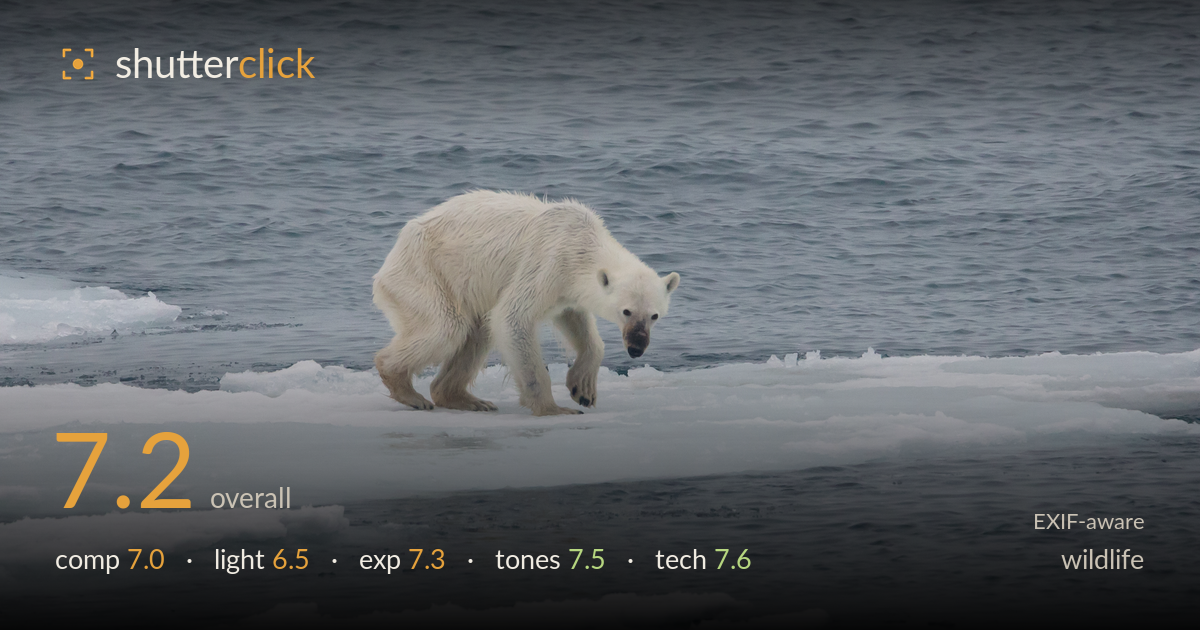
Lean polar bear on thinning ice
Photo by Andreas Weith

| Focal length | 600 mm |
| Aperture | f / 8.0 |
| Shutter | 1/500 s |
| ISO | ISO 1250 |
| Exp. comp. | 0.0 EV |
| Shot at | 17:26 · Jul 29, 2015 |
A quietly powerful wildlife image that carries real narrative weight — a lean bear picking its way across thinning, fractured ice tells a story of a shrinking habitat without any need for caption. The environmental framing is the strength here: the water, broken floes and the animal's cautious posture all reinforce that theme. What holds it back most is the flat, overcast light, which robs the bear of dimensional modelling and separation from the pale ice, and a composition that leaves the animal facing into limited space. Strong storytelling instinct on a genuinely evocative subject.
Placing the bear left-of-centre on the ice edge works, and the fractured floes leading to open water reinforce the environmental story. The downward gaze and cautious step add tension. However, the animal faces frame-right into fairly limited space while the largest expanse of empty water sits behind it, slightly reversing the natural reading direction. The lower ice band is compositionally useful but reads as dead space. A crop giving more room in the bear's direction of gaze would balance the pull of that lowered head.
Flat, diffuse overcast light is honest to Arctic conditions but offers little modelling. The bear's fur reads as a fairly uniform tone with minimal shadow to describe its gaunt, bony frame, and there is little separation between the white animal and the pale ice beneath it. The soft light does avoid blown highlights on the fur and keeps detail throughout, which suits the subject's texture. Some directional light, even a low sun break, would have carved shape into the ribs and shoulders that the story depends on.
Exposure is well judged for a difficult white-on-white scene. The fur retains texture and detail without clipping, and the darker water holds tone without blocking up in the shadows. The wet, matted areas of the coat show gradation rather than muddy black. Given the risk of a camera meter underexposing bright ice, holding highlight detail here reflects sound control. Midtones sit a touch flat overall, but that is a lighting consequence more than an exposure fault. A slight highlight lift in post could add subtle brilliance.
The muted, cool palette suits the Arctic setting — steel-grey water against off-white ice creates a restrained, cohesive mood. White balance leans appropriately cool without turning clinically blue. The subtle warm cast in the bear's fur reads naturally against the surrounding cold tones. Contrast is gentle, matching the overcast conditions, though the overall image edges toward tonal sameness that mutes impact. A modest contrast increase in the water, or slightly warmer fur separation, would give the frame more tonal punch without breaking its cold, sombre character.
At 600mm handheld, 1/500s is on the edge of adequate for a moving animal, but the shutter has frozen the slow, deliberate step cleanly with no visible motion blur. f/8 on the Tamron is a smart choice — it pulls the lens into its sharper aperture range while keeping enough depth of field to hold the bear front-to-back at this distance. ISO 1250 is entirely reasonable for the overcast light and shows only mild noise, well controlled by the 5D Mark III's sensor. Focus appears placed on the head and shoulder region, and the eye reads acceptably sharp, though not tack-critical — the softness of the light works against edge crispness on the white fur. The lens's stabilisation clearly earned its keep. Overall a well-matched kit and settings for the reach and conditions; the main technical limitation is inherent lens resolving power at 600mm rather than any decision error. Focus locked onto the eye a hair more precisely would seal it.
What would elevate it
Tags
Shot something like this?
Expert photo critique, on demand — scored across six categories, EXIF-aware. Start with 3 free critiques, no credit card.
critique my photo — free