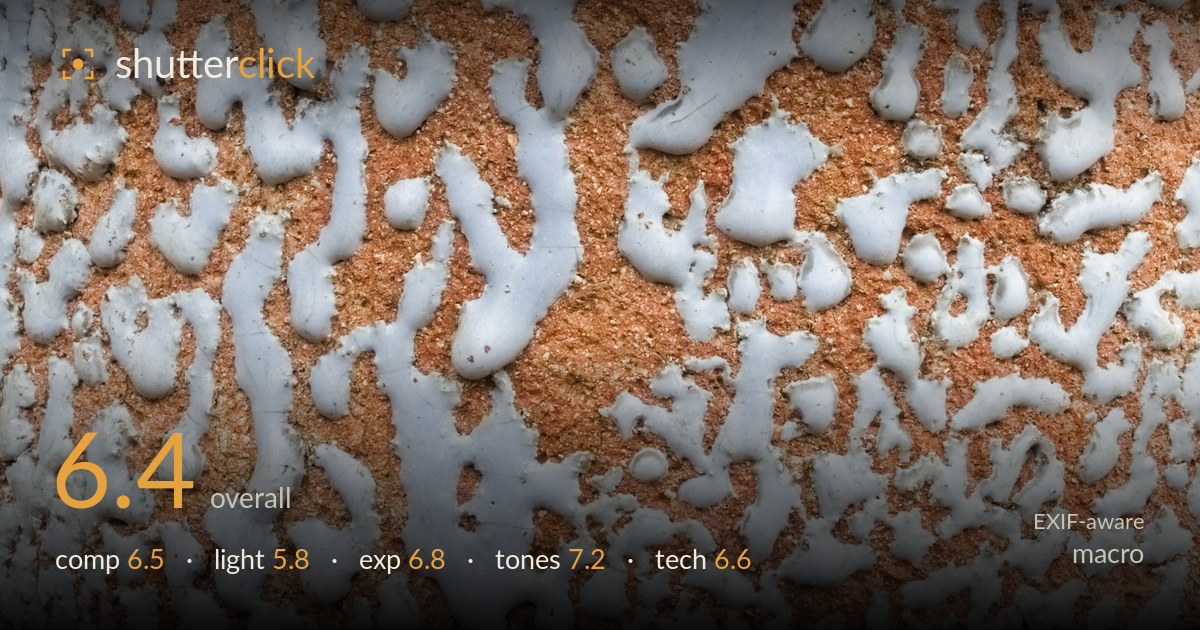
Lichen crust on warm stone
Photo by Adrian Tync

| Focal length | 50 mm |
| Aperture | f / 18.0 |
| Shutter | 3/5 s |
| ISO | ISO 80 |
| Exp. comp. | 0.7 EV |
| Shot at | 14:39 · Nov 13, 2025 |
A strong colour relationship carries this frame: the pale grey-blue lichen against warm terracotta stone is genuinely appealing and reads as a deliberate abstract study of texture. What most holds it back is the flat, even light. The pattern is legible but never sculpted — nothing rakes across the crust to reveal relief, so the surface reads more descriptive than dramatic. The composition is uniform-to-a-fault, filling the frame edge to edge without a resting point or a passage of contrast to anchor the eye. As a texture study it works; as an image with a point of interest it stops short.
The frame is filled corner to corner, which suits an abstract texture study and keeps attention on pattern rather than a single object. The loose vertical drift of the lichen gives a subtle sense of flow. What is missing is a focal accent — a knot of density, a clearing of bare stone, or a shift in scale that would give the eye somewhere to land and return to. As it stands the coverage is so even that the composition reads as a sample rather than a resolved picture.
The light is soft and shadowless, which renders colour cleanly but does little for the raised, crusty relief that is the whole point of this surface. The lichen sits flat against the stone with almost no shadow to describe its thickness or edges. A low, raking side light would carve out the three-dimensional build-up and turn a flat map of colour into a landscape of texture. The current lighting is safe and even but leaves the most tactile quality of the subject unexploited.
Exposure is handled well. The pale lichen holds detail without blowing to paper white, and the +0.7 EV compensation looks like a sound decision to keep those bright tones bright while retaining surface information. Shadows in the stone crevices stay open and readable. The histogram sits in a comfortable range with no meaningful clipping at either end. If anything a touch more midtone separation would help the flatter passages, but the technical brightness placement is deliberate and clean throughout the frame.
The best aspect of the image. The complementary pairing of cool grey-blue lichen and warm rust-orange stone is pleasing and coherent, and the white balance sits believably neutral. Saturation is restrained rather than pushed, which keeps the mineral surface credible. Tonal range is a little compressed by the flat light, so contrast is gentle throughout, but the gradation within the terracotta is smooth and the greys stay clean. A small contrast lift would add snap without harming the natural palette.
The settings are well matched to a static macro subject. ISO 80 delivers a clean, noise-free file with excellent tonal smoothness, and the 3/5 s shutter is a non-issue on a stationary surface, implying tripod support. f/18 was chosen to hold depth across the raised relief, and across most of the frame that pays off — the crust reads sharp corner to corner. Be aware that at f/18 on this sensor diffraction is beginning to soften fine detail slightly; f/11 to f/13 would likely have preserved a touch more crispness while still covering the shallow depth of a near-flat subject. The 50 mm on APS-C is a reasonable working length though not a true macro optic, so the reproduction ratio is modest rather than intimate. Focus placement is even and accurate. Overall a technically careful capture; the only refinement is easing off the aperture to sidestep diffraction.
What would elevate it
Tags
Shot something like this?
Expert photo critique, on demand — scored across six categories, EXIF-aware. Start with 3 free critiques, no credit card.
critique my photo — free