Light at the end of the forest
Photo by jwvein

No EXIF metadata in this file
Technical analysis based on visual assessment only.
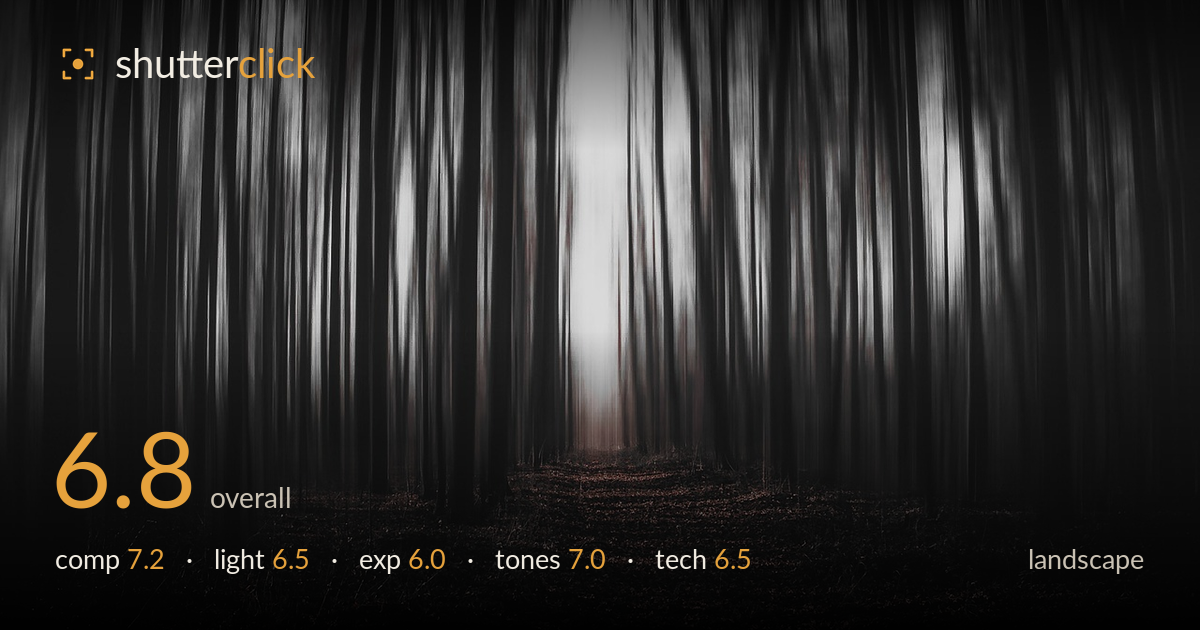
A moody, atmospheric forest interior built on vertical motion blur and a bright central clearing that draws the eye straight down the frame. The symmetry and the glowing gap work as a beacon, and the warm leaf-litter path adds a welcome anchor amid the dark trunks. What holds it back is the heavy blackness swallowing the lower-left and lower-right corners, where detail collapses into muddy shadow, and a central bright zone that pushes toward blown highlights. The vertical-blur effect is applied evenly and reads as intentional, but it also flattens the sense of real depth. A more controlled tonal balance would let the mood breathe.
The mirror-like symmetry funnels attention to the luminous central gap, and the leaf-strewn path leading from the foreground into that light gives a clear route through the frame. Placing the bright clearing on the vertical centreline suits this symmetrical, almost portal-like concept. The lower corners, however, are near-empty black masses that add weight without information, and the frame edges are cropped through trunks somewhat arbitrarily. A touch more foreground detail on the path would strengthen the depth the composition promises.
The light is the concept here: a bright wash pouring through the central gap between trunks, spilling warm tones onto the path. That single glowing source gives the image its atmosphere and mystery. The trade-off is a very high contrast between that hot centre and the deep surrounding shadow, which leaves much of the forest reading as flat black. Softer, more directional light — or shooting when the clearing glow was less overpowering — would reveal more trunk texture and separate the trees.
Exposure is stretched hard between extremes. The central bright zone crowds the top of the histogram and looks close to clipping, losing subtle detail in the brightest patch, while the lower corners fall into near-total black with no recoverable detail. The path midtones are where the exposure sits best — warm and readable. Pulling the highlights down and lifting the deepest shadows slightly would restore range and stop the frame feeling as though it is fighting between pure white and pure black.
The near-monochrome treatment with warm reddish-brown leaf litter running through the centre is the strongest tonal choice — that muted rust against the cool grey trunks gives the image its identity. Contrast is high and mostly serves the mood, and the desaturated palette suits the eerie, dreamlike intent. The blacks are crushed quite far, though, flattening the shadow gradation. A gentler shadow roll-off and a hint more separation in the darkest trunks would give the tones more depth without losing the atmosphere.
The vertical streaking is a deliberate motion-blur or ICM effect rather than accidental camera shake — it is consistent across the frame and clearly the intended aesthetic, smearing the trunks into soft vertical bands. Judged on that intent, it is executed cleanly and evenly, though the effect is applied so uniformly that it removes almost all real texture from the trunks, leaving little for the eye to rest on. The path retains the most genuine detail and grounds the image. Noise is well controlled in the shadows given how dark they are, and there is no obvious sharpening halo or artefacting. The main technical limitation is that the blur, combined with the deep shadow clipping, leaves very little tactile information anywhere except the central path. Retaining one or two trunks with sharper edges — through masking during the blur process — would give the eye an anchor and make the effect feel like a choice against reality rather than the whole reality.
What would elevate it
Tags
Shot something like this?
Expert photo critique, on demand — scored across six categories, EXIF-aware. Start with 3 free critiques, no credit card.
critique my photo — free