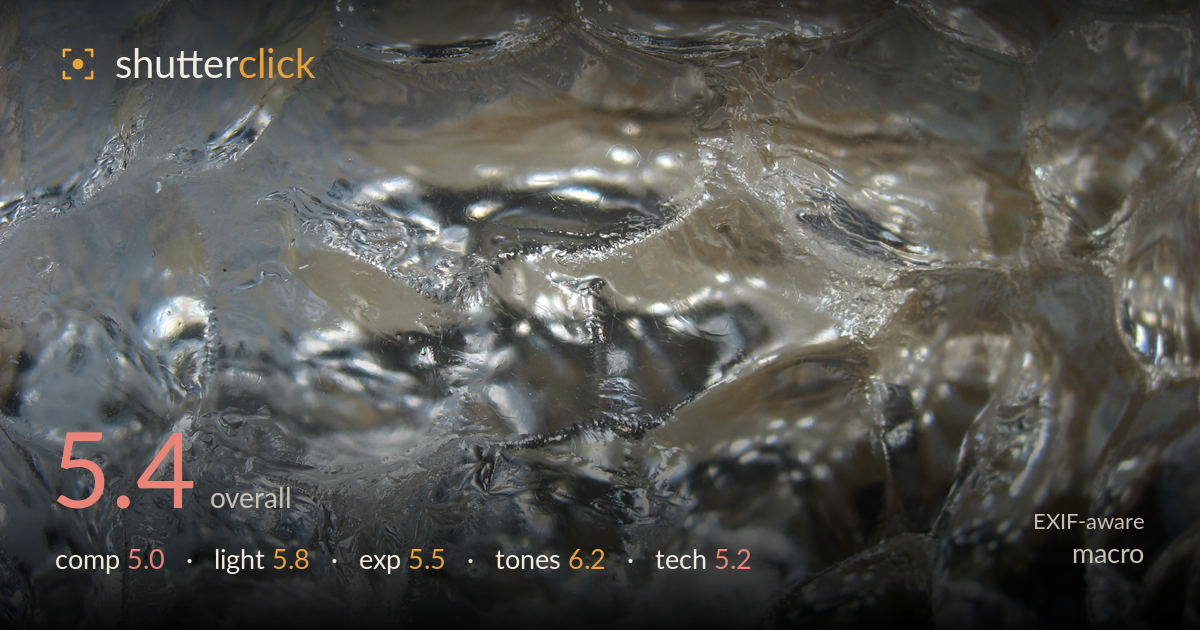
Light through textured glass
Photo by Kim Hansen

| Focal length | 6 mm |
| Aperture | f / 5.6 |
| Shutter | 1/800 s |
| Exp. comp. | 0.0 EV |
| Shot at | 18:08 · Jul 7, 2007 |
The dimpled, honeycomb-textured glass makes a genuinely appealing abstract surface — the interplay of refraction, caught light, and rippled distortion carries real graphic interest. What most holds the image back is the lack of a clear focal anchor and inconsistent sharpness: the eye wanders without a dominant point of tension, and no single region reads as crisp resolving detail. Highlights push toward clipping in the brightest specular streaks. As an abstract of texture and light it works on impact but reads as a grab shot rather than a deliberate study; more considered framing of the repeating cell pattern would lift it substantially.
The repeating hexagonal cells create an organic pattern with promise, but the frame lacks a governing structure — no dominant cell, rhythm, or line guides the eye, so attention drifts. The brightest concentration sits low-centre, giving weak balance against the busier top. Isolating a tighter cluster of cells, or letting the pattern run edge-to-edge with intent, would strengthen the graphic read. As it stands the crop feels arbitrary rather than chosen, and the strongest refractions in the lower third are undercut by clutter above.
Directional light rakes across the textured surface and does the heavy lifting here, carving the raised cell walls and lighting the internal refractions with sparkle. That specular play is the image's main asset. The trade-off is harshness: the brightest speculars run hot and lose detail, while the interstitial channels drop to near-black. Softer or more diffused light, or a slight angle change, would tame the extremes and reveal more of the subtle internal structure without sacrificing the glassy shimmer.
Overall brightness is roughly workable for a bright, reflective glass subject, but the brightest specular streaks in the centre and lower frame clip to pure white with no recoverable detail. The darker channels between cells hold reasonable information. Given the high-contrast subject, slight negative exposure compensation would have protected those highlights while the shadows had headroom to spare. The histogram likely spikes hard at both ends — a more restrained exposure would have preserved the glass's finest surface texture in the hottest areas.
The near-monochrome palette of cool silver-grey with warm amber refractions is the image's quietest success — restrained, coherent, and appropriate to glass. Contrast is strong, giving the surface presence, though it tips toward blown highlights. White balance sits neutral to slightly warm, which suits the caught sunlight. Midtone gradation in the transitional greys is smooth and reads well. A touch less global contrast would recover subtlety in the brightest cells without dulling the overall shimmer that gives the frame its material believability.
At 6mm and f/5.6 on a compact IXUS, this is not true macro but a close-up of a textured surface, and the small sensor's deep inherent depth of field means most of the frame sits within focus range — yet nothing resolves to crisp micro-detail. The softness reads as a mix of the compact's limited lens resolution and likely minor camera or subject shake despite the fast 1/800s shutter, which itself was more than adequate here and points to focus rather than motion as the issue. The lens struggled to lock onto the low-contrast, semi-transparent glass, a known challenge for contrast-detect AF on this class of camera. ISO appears low given the bright conditions, so noise is controlled. For a subject this reflective, a smaller aperture would not help much given the DOF already present; instead, manual or single-point focus on a defined edge of a cell wall, plus a tripod, would sharpen the key plane and give the pattern the bite it currently lacks.
What would elevate it
Tags
Shot something like this?
Expert photo critique, on demand — scored across six categories, EXIF-aware. Start with 3 free critiques, no credit card.
critique my photo — free