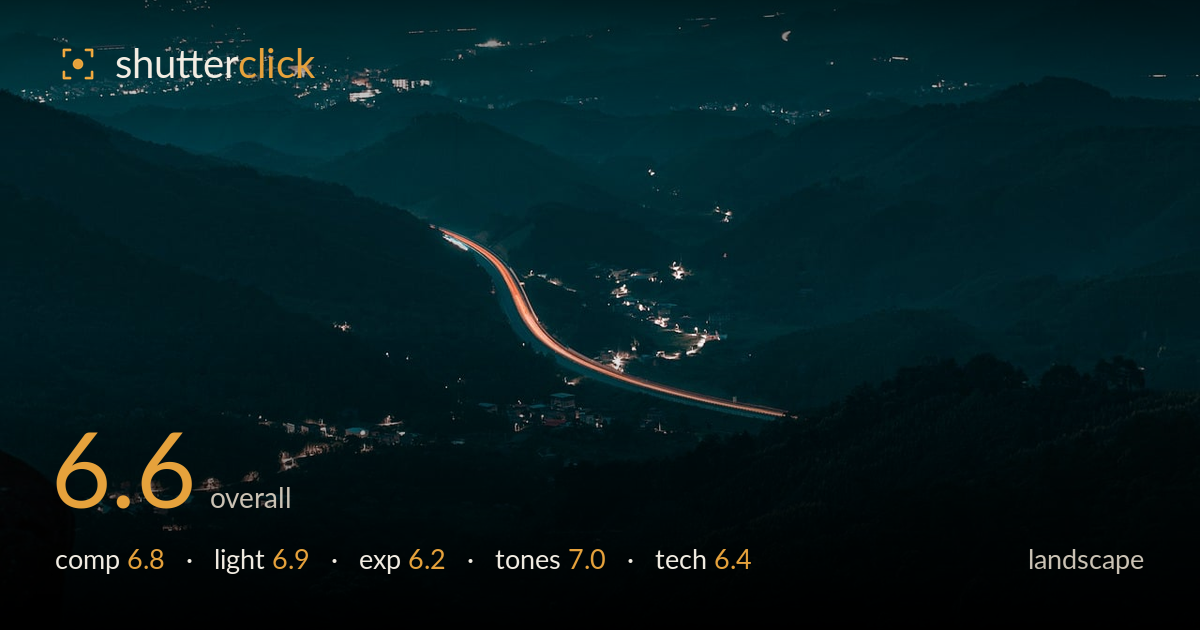
Light trail through a night valley
Photo by PasutaR

No EXIF metadata in this file
Technical analysis based on visual assessment only.
A warm ribbon of road light threading through a cool, layered valley at blue hour is the strongest asset here, and it earns the frame. The receding mountain ridges build genuine depth and scale. What holds the image back is a heavy, murky foreground that occupies nearly half the frame with little detail or interest, and a bottom-heavy balance that leaves the lit road and village sitting high. The lower third reads as dead space rather than anchoring foreground. Tighter framing on the valley and the light trail, plus lifted shadow detail, would concentrate the impact considerably.
The winding light trail is a natural leading line and the layered ridges give strong atmospheric depth, the image's best qualities. But the balance is off: the road and lit village sit in the upper-middle while the lower half is a dark, near-featureless slope that adds weight without payoff. The dark rock intrusion at bottom-left is distracting rather than a useful foreground anchor. A crop that reduced the empty foreground and placed the light trail nearer a thirds line would tighten the whole scene and give the eye a clearer path.
Blue-hour timing is well chosen — the residual sky glow keeps the ridges separated by tone rather than crushing them to black, and the atmospheric haze layering the mountains is exactly what makes this kind of scene work. The warm road and window lights read beautifully against the cool ambient wash, a satisfying temperature contrast. The main limitation is that the lower foreground receives almost no light, so it becomes a heavy void. A slightly earlier capture with more sky luminance would have given the foreground slope some shape.
The exposure protects the small point-source lights well — the road trail and village windows hold colour without blowing out, which is the hard part in a night scene. The trade-off is a foreground that falls into near-black with little recoverable detail, and the overall image sits dark enough that the lower half reads as empty. The midtones in the mid-distance ridges are handled nicely. Lifting shadows selectively in the foreground, or bracketing for a blended exposure, would reveal the terrain currently lost to the dark.
The teal-cyan grade is cohesive and suits the blue-hour mood, and the warm accents of the road and lights provide effective complementary contrast. The atmospheric gradation across the receding ridges is the tonal highlight — subtle, layered, and believable. White balance leans cool but reads as an intentional and successful choice here. Shadows are perhaps a touch too dense in the foreground, flattening detail, and a slight lift in the darkest areas would restore some tonal separation without disturbing the mood.
Without EXIF, judgement rests on visual evidence, and it points to a competent night capture. The light trail shows the smooth, continuous streak of a genuine long exposure, and the point lights remain crisp rather than smeared, suggesting a stable tripod and a well-judged shutter duration. Noise is controlled well for a low-light scene — the smooth ridges show little chroma speckle, indicating a sensible ISO or effective processing. Focus appears set on the mid-distance valley, which is the right plane, and the ridges hold acceptable sharpness given the haze. The main technical shortfall is the crushed foreground, where either exposure blending or a lifted shadow curve would recover terrain detail. Depth of field is adequate throughout, appropriate for a distant landscape. Overall the execution is solid; the improvements needed lie more in framing and shadow management than in capture technique.
What would elevate it
Tags
Shot something like this?
Expert photo critique, on demand — scored across six categories, EXIF-aware. Start with 3 free critiques, no credit card.
critique my photo — free