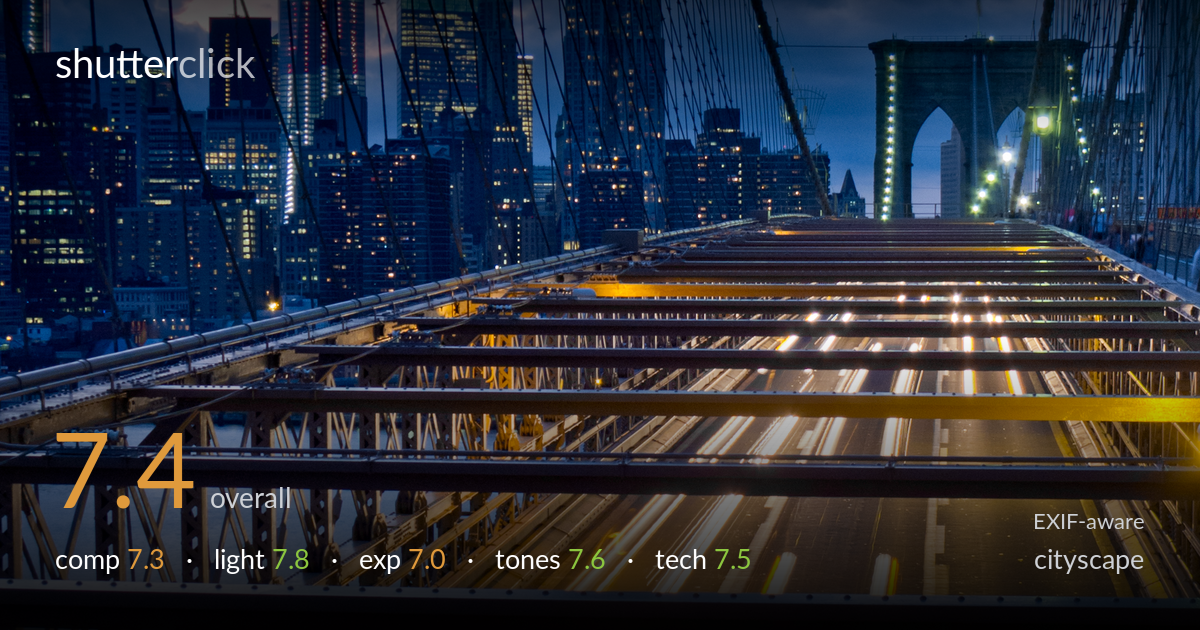
Light trails on the brooklyn bridge
Photo by Carlos Delgado

| Focal length | 10 mm |
| Aperture | f / 4.0 |
| Shutter | 2.0 s |
| ISO | ISO 80 |
| Exp. comp. | 0.0 EV |
| Shot at | 00:34 · Jul 31, 2012 |
A confident blue-hour cityscape that leans on two strong assets: the converging traffic trails pulling the eye toward the bridge tower, and the moody, layered cloud cover over the Manhattan skyline. The vertical framing and the diagonal sweep of the roadway give real depth and momentum. What holds it back is the heavy steel cross-beams in the lower foreground — they cut across the light trails and crowd the bottom third, dividing attention. The exposure also lets the foreground steelwork fall murky while the brightest trails edge toward clipping. Strong timing and a clear sense of place carry it.
The roadway and light trails form a powerful leading line toward the bridge tower on the right, while the skyline anchors the left — a satisfying two-subject balance for a cityscape. The vertical orientation suits the converging perspective. The weakness is the foreground: the thick horizontal steel beams stack across the lower third and interrupt the flow of the trails rather than framing them. A slightly higher vantage or a tighter crop from the bottom would let the trails breathe and reduce the visual clutter competing with the skyline.
Blue hour is the right call and it is well timed — enough ambient glow in the clouds to render their texture against the deep blue sky, with the city lights and bridge cables reading clearly. The warm sodium-orange of the traffic trails plays nicely against the cool sky, a classic and effective contrast. The dramatic cloud break over the towers adds mood. The only limitation is that the foreground steel receives little useful light and sinks into a flat, dim mass without modelling.
The two-second exposure balances the bright trails against a darkening sky reasonably well, but the brightest white trails are pushing toward clipping in places while the foreground girders fall into muddy, detail-poor shadow. The skyline windows hold their highlights, and the cloud detail is preserved, which is the harder part to get right at this hour. A slightly shorter exposure or a graduated approach would have protected the hottest trail cores and kept midtone separation in the steelwork.
The cool-versus-warm split — deep blue sky and steel against amber traffic trails — is the image's tonal engine and it works. White balance sits in a believable blue-hour register without going excessively teal. Contrast is healthy, the cloud gradation is rich, and saturation is restrained enough to feel natural. The foreground steelwork is where tones suffer: it reads as a flat, slightly green-grey block with little tonal range, dragging down the lower frame that otherwise should support the warm trails.
For a small-sensor PowerShot G11, the execution is sound. ISO 80 keeps noise minimal in the sky, and the two-second shutter at f/4 was the right combination to render the traffic as continuous light trails — the core technique here lands. At 10mm (roughly 47mm equivalent) the wide framing captures both skyline and bridge with good depth of field; focus holds acceptably from the foreground girders to the distant towers. The main constraint is the gear itself: the small sensor limits dynamic range, which is why the foreground shadows block up and the brightest trails risk clipping. A tripod was clearly used given the steady long exposure. Bracketing exposures and blending, or stopping down slightly to f/5.6 for a touch more trail definition, would have squeezed more out of the scene. Stability and technique are not the issue — sensor latitude is.
What would elevate it
Tags
Shot something like this?
Expert photo critique, on demand — scored across six categories, EXIF-aware. Start with 3 free critiques, no credit card.
critique my photo — free