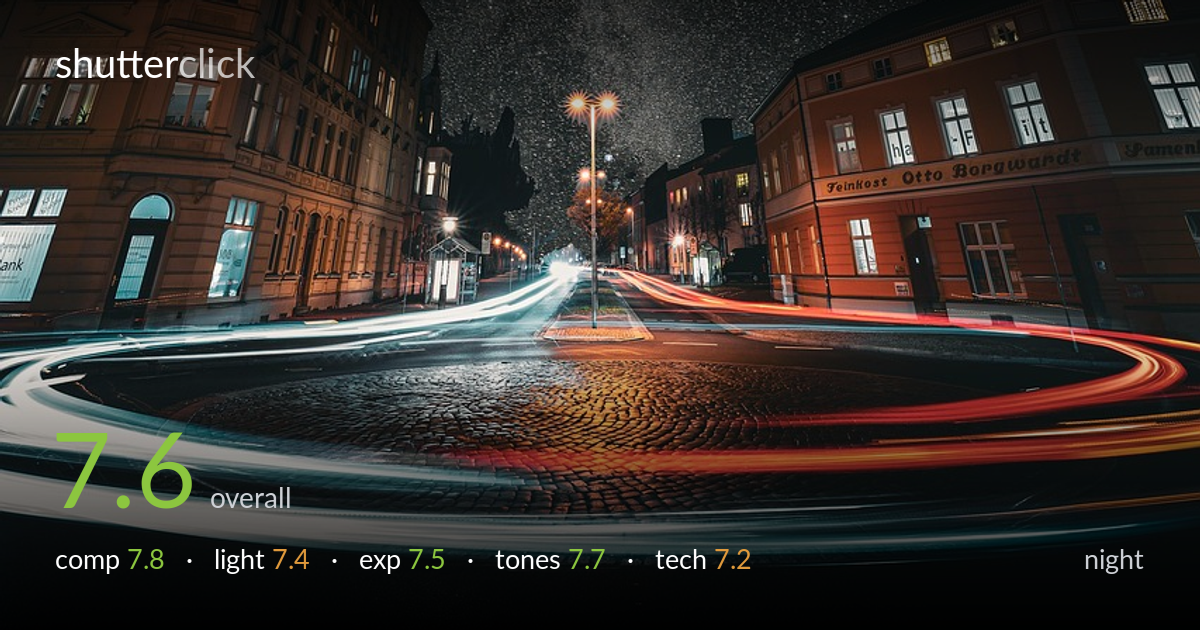
Light trails under a starry sky
Photo by RickieTomSchünemann

No EXIF metadata in this file
Technical analysis based on visual assessment only.
A confident night composite that pairs sweeping light trails on a cobbled roundabout with a star-filled sky — the curving red and white streaks are the strongest element, drawing the eye into the frame with real energy. The two flanking buildings, warmly lit and rendered with good window detail, frame the scene well. What most holds it back is the sky: the dense star field reads more composited than captured, and the Milky Way's clarity sits uneasily against an urban foreground that should carry far more light pollution. The trails also crowd the lower frame slightly, sacrificing breathing room.
The light trails form a strong, dynamic arc that anchors the lower frame and pulls the eye through the scene — a genuine compositional asset. The two warmly lit buildings act as natural side framing, and the central lamppost gives a vertical spine. The wide, near-fisheye perspective bends the trails attractively but stretches the buildings at the edges. The trails press tight against the bottom edge, costing a little foreground breathing room, and the vast sky dominates roughly two-thirds of the frame without quite earning all that space.
Artificial light does most of the work here, and it works: warm sodium tones wash the cobbles and building facades, the lit windows add interior glow, and the lamppost provides a believable point source. The light trails themselves are the headline lighting event, balancing cool whites against warm ambers. The disconnect is between foreground and sky — a scene this brightly lit by streetlamps would normally swamp the stars overhead, so the pristine Milky Way reads as added rather than ambient. Tonal continuity between zones would sell it.
Exposure is well managed across a very wide brightness range. The cobbles hold detail under the trails, building facades retain texture, and the brightest trail cores stay mostly within range rather than blowing out harshly. Shadow areas in the side streets keep some information without going muddy. The sky is exposed to reveal faint structure without crushing to black. The only soft spot is the brightest white trails, which clip in places — a touch more headroom there would preserve the streak edges more cleanly.
The warm-cool interplay is the tonal highlight — amber facades and red trails set against cool white streaks and a steely sky. The cobblestones glow nicely with reflected warmth. Contrast is punchy and suits the night mood. The sky carries a faint reddish cast in the upper right that feels slightly artificial, and overall the grade leans toward a processed, high-impact look. Pulling the sky's saturation back a touch and unifying its white balance with the warmer ground would feel more cohesive and less composited.
The long-exposure execution on the trails is clean and deliberate — the streaks are smooth, continuous, and free of stutter, indicating a stable tripod and well-judged duration. Sharpness on the buildings and cobbles is good where it counts, and noise is controlled across the darker passages. The wide, strongly curved lens introduces noticeable distortion at the frame edges, stretching the buildings; that's a stylistic choice but worth being aware of. The main technical question is the sky: the density and clarity of the star field, combined with the brightly lit urban foreground, strongly suggests a blended or composited exposure rather than a single frame. There's nothing wrong with blending, but the seam shows in the mismatched light logic — stars this prominent wouldn't survive the streetlamp glow. Matching the noise grain, white balance, and brightness falloff between sky and ground would make the composite read seamlessly. Focus and overall capture discipline are otherwise solid.
What would elevate it
Tags
Shot something like this?
Expert photo critique, on demand — scored across six categories, EXIF-aware. Start with 3 free critiques, no credit card.
critique my photo — free