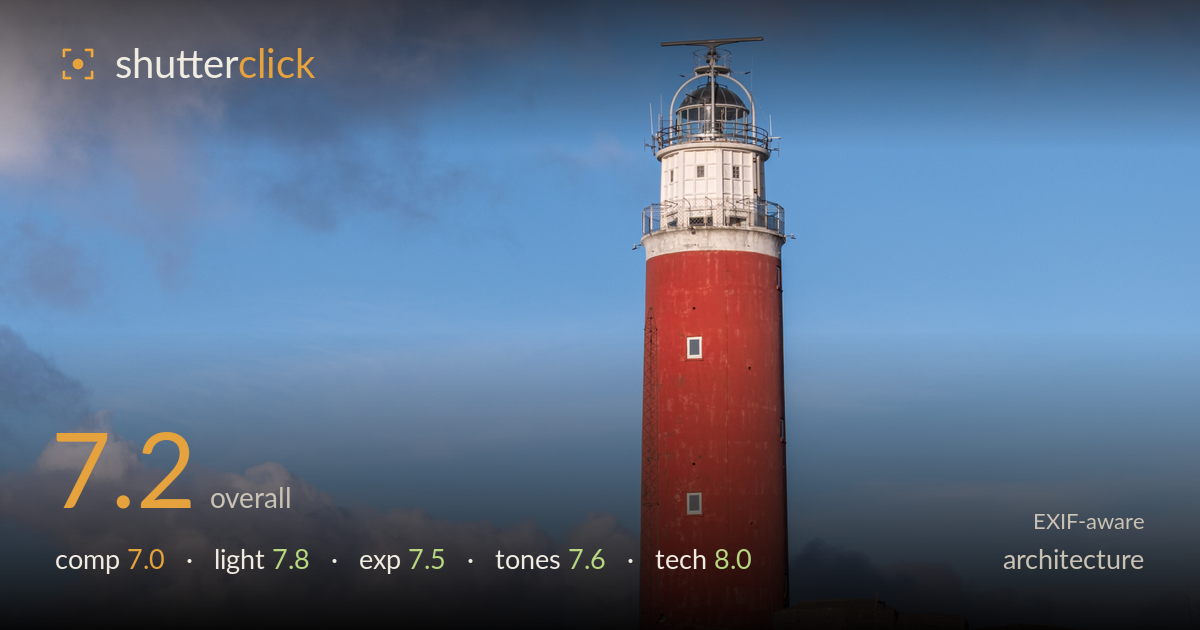
Lighthouse above the dune path
Photo by Dietmar Rabich

| Focal length | 45 mm |
| Aperture | f / 11.0 |
| Shutter | 1/200 s |
| ISO | ISO 125 |
| Exp. comp. | 0.0 EV |
| Shot at | 16:36 · Mar 14, 2026 |
A well-executed dune-landscape approach to a lighthouse, carried by warm low-angle light on foreground grasses and a crisp red tower against a dynamic sky. The cobbled path and the curving fence rail work as leading lines, though they run out of the frame rather than delivering the eye all the way to the tower. The lighthouse sits high and slightly right, which reads as portrait framing more than deliberate architectural placement. The verticals are clean. What most holds it back is the disconnect between the strong foreground and the distant subject — the two halves compete rather than lock together.
The cobbled path and the diagonal fence rail set up promising leading lines, but they sweep toward the right edge and lose the tower rather than carrying the eye to it. The lighthouse is pushed high and just right of centre, leaving a large expanse of foreground that is handsome but not clearly directed at the subject. The dune crest cleanly separates land and sky. A viewpoint that aligned the path's vanishing point with the tower base would knit foreground and subject into one continuous read.
Low, warm side light rakes across the dune grasses and cobbles, giving real texture and dimension to the foreground — the strongest asset here. The red tower catches the same warm light and glows against the cool sky. Shadows are directional without being harsh, suggesting golden-hour timing. The broken cloud adds tonal variety behind the subject. The only limitation is that the tower's front face is fairly flat-lit compared with the richly modelled foreground, so the light shapes the ground more than it shapes the architecture.
Exposure is well judged across a wide brightness range. Highlight detail survives in the brighter clouds, and the sunlit sand and grass retain texture without blowing out. Shadow areas in the cobbles and dune hollows hold detail. The red tower keeps its saturation without clipping into a flat block. At 0.0 EV the balance between bright sky and warm ground is handled cleanly, with no obvious accidental under- or over-exposure. The histogram looks full and controlled, with midtones sitting comfortably.
A pleasing complementary palette — warm ochre grasses and red tower against cool blue sky — gives the frame natural punch. White balance leans warm, appropriate for the low light, and the reds stay rich without oversaturating. Contrast is healthy, with good separation between the sunlit foreground and shadowed cobbles. The clouds carry subtle grey-blue gradation. If anything, the shadows on the cobbled path run slightly cool and dense, and a touch of shadow lift there would balance the warmth elsewhere.
Settings are well matched to the scene. At f/11 the depth of field runs sharp from the foreground cobbles to the distant tower, exactly what a deep-focus landscape-architecture frame needs. ISO 125 keeps the image clean with no visible noise, and 1/200s comfortably freezes the wind-blown grasses despite the breeze evident in their lean. The 45mm focal length on this zoom gives a natural perspective that keeps the tower's verticals essentially upright with no significant keystoning — a strong result without needing correction. Focus appears accurately placed with detail crisp across the frame. The lens resolves fine texture in the grass and the tower's railings well. The only refinement would be that at f/11 on this sensor diffraction begins to nibble at critical sharpness; f/8 would have preserved depth while extracting marginally more edge detail. Overall the execution is clean and deliberate, with no technical missteps holding the image back.
What would elevate it
Tags
Shot something like this?
Expert photo critique, on demand — scored across six categories, EXIF-aware. Start with 3 free critiques, no credit card.
critique my photo — free