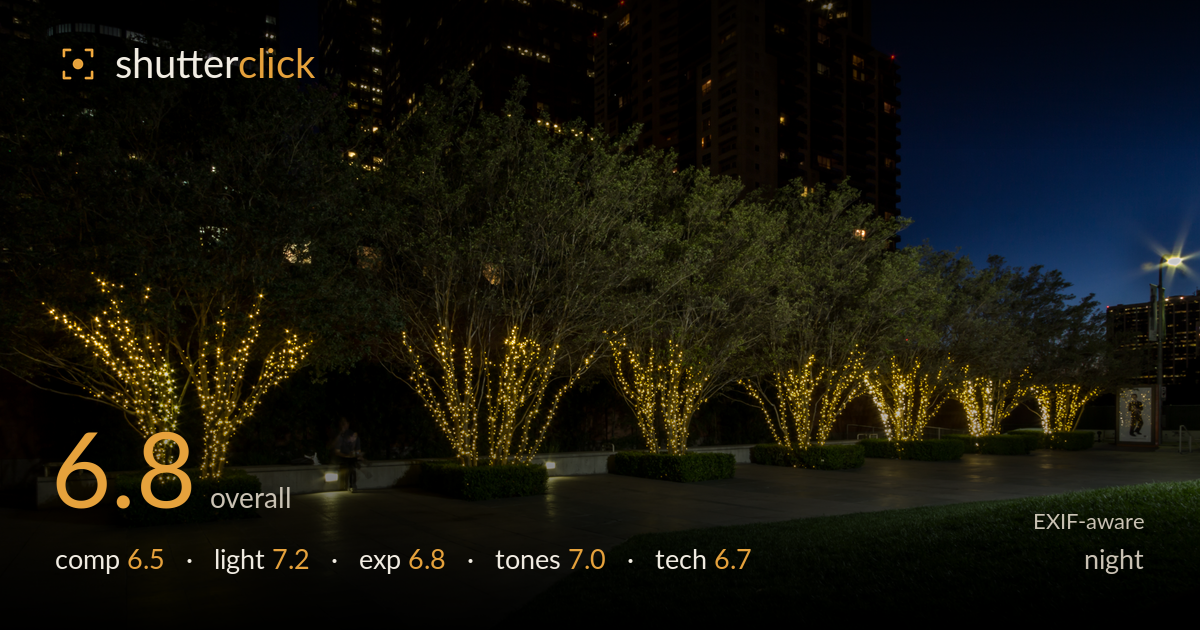
Lit trees at dusk in the plaza
Photo by Dietmar Rabich

| Focal length | 12 mm |
| Aperture | f / 22.0 |
| Shutter | 30.0 s |
| ISO | ISO 100 |
| Exp. comp. | 2.0 EV |
| Shot at | 20:46 · Jul 19, 2012 |
A well-observed row of fairy-lit trees receding into the frame, with the warm glow set against a clean deep-blue dusk sky — the colour contrast is the photograph's real strength. What most holds it back is the flat, repetitive rhythm of the trees, which line up in a near-uniform row without a clear anchor or hierarchy, and a foreground of empty paving that eats a large share of the frame without contributing. The receding diagonal of lit trees carries the eye, but the arrangement reads as a documentation of the plaza rather than a shaped composition. Tightening the framing and finding a stronger lead-in would lift it considerably.
The line of illuminated trees creates a natural recession from left to right, and the deep-blue sky gives the warm lights room to breathe. The dark towers anchor the top, but they crowd the upper frame while the lower third is dominated by empty, featureless paving that adds little. The near-uniform spacing of the trees reads as repetitive rather than rhythmic — no single tree dominates as a subject. The grass wedge at lower right and the streetlight flare on the right add welcome variation. A stronger foreground anchor would give the eye somewhere to start.
The warm fairy lights against the cool residual dusk sky is the picture's core appeal — a genuine complementary-colour relationship handled well. The uplights at the tree bases add pools of warmth on the paving and lend depth. The building windows and the flared streetlight on the right introduce secondary points of interest without overwhelming. Timing at blue hour was the right call: the sky retains colour rather than going black. The trees themselves, however, sit somewhat evenly lit, and the foreground paving falls into shadow that reads as dead space rather than shaped light.
The 30-second exposure at ISO 100 with +2 EV holds the dark sky and shadow towers without crushing them, and the bright fairy lights stay largely under control despite their intensity — only the base uplights and streetlight flare push toward clipping. Shadow detail in the foreground paving is preserved but at the cost of that area looking muddy and grey. The overall balance is well judged for the mood, keeping midtones low without losing the trees. A touch less exposure compensation would have deepened the sky and given the lights more punch against it.
The warm-cool split — amber lights over a saturated navy sky — is the tonal highlight and reads cleanly. White balance sits in a believable range, keeping the lights golden without going orange. The building facade retains its brick tone. Contrast is a little soft in the paving, which drifts toward a flat mid-grey that dulls the lower frame. The greens of the trees are muted and dark, appropriate for the hour. Slightly deeper blacks in the foreground and a touch more sky saturation would strengthen the overall separation and richness.
The settings are well matched to the scene: ISO 100 keeps noise negligible, and the 30-second shutter on a tripod is the right approach for a static night scene. f/22, however, is an unnecessary choice — at that aperture on this ultra-wide lens, diffraction softens the entire image, and the fairy lights lose crispness they would have kept around f/8–f/11. The depth of field was never in question here, so stopping down that far gained nothing and cost sharpness. The 12mm focal length on the EF-S 10-22 suits the sweep of the plaza and keeps the towers upright reasonably well, with only mild wide-angle stretching at the edges. Focus appears accurate across the tree line. The long exposure has smoothed any figures — the seated person mid-frame is slightly ghosted, which is a natural consequence and not distracting. Reshooting nearer f/9 would recover meaningful bite in the lights and foliage without any downside.
What would elevate it
Tags
Shot something like this?
Expert photo critique, on demand — scored across six categories, EXIF-aware. Start with 3 free critiques, no credit card.
critique my photo — free