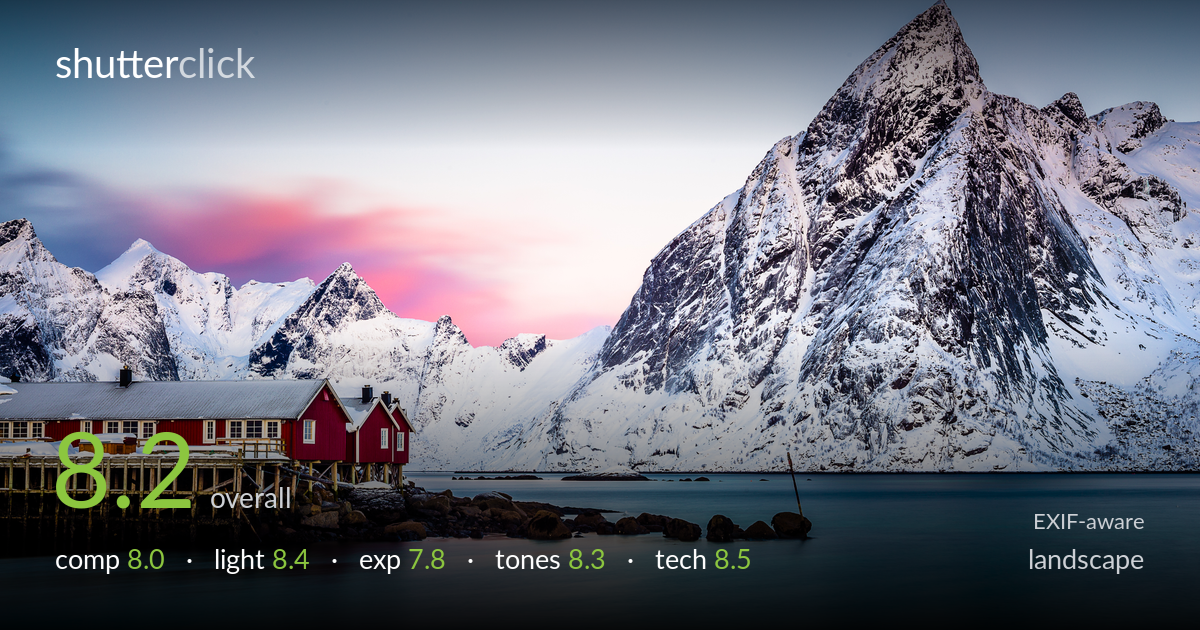
Lofoten cabins twilight
Photo by Martin Sojka
.jpg)
| Focal length | 50 mm |
| Aperture | f / 16.0 |
| Shutter | 57.0 s |
| ISO | ISO 100 |
| Exp. comp. | 0.0 EV |
| Shot at | 06:43 · Mar 13, 2013 |
A classic Lofoten composition that earns its keep through the interplay of the dominant snow-clad peak, the iconic red rorbuer, and the silken long-exposure water. The pink alpenglow against cool blue gives the frame real emotional pull. What most holds it back is balance: the left edge feels cropped tight, clipping the cabins and pier awkwardly, while the foreground water occupies a large, near-featureless zone. The pink cloud band, smeared soft by the long exposure, reads slightly artificial. Strong, well-executed work that a touch more breathing room on the left and a stronger foreground anchor would lift further.
The peak anchors the right, the red cabins counterbalance on the left, and the curving rock spit leads the eye between them — a sound triangular arrangement. The horizon sits low, giving the mountain room to dominate, which suits the scale. The weakness is the left edge: the cabins and pier are clipped, severing the structure rather than framing it cleanly. The lower third of glassy water is large and empty; the lone post offers a small anchor but little else. A wider left margin would resolve the crop.
The soft pre- or post-sunset light is well chosen, washing the peak in subtle warmth while the lower slopes stay in cool shadow — that temperature split gives the scene depth. The pink band of cloud catches the most colour and provides the emotional focus. Light is diffuse and directionless on the foreground, which keeps the water serene but flattens the rocks and cabins slightly. Catching a moment with stronger directional glow on the main peak's face would have added more dimensional modelling to the snow.
Exposure is well controlled for a high-contrast snow-and-sky scene. Highlights on the bright snowfields and the glowing sky hold detail without clipping to paper white, and the shadowed rock faces of the peak retain texture. The midtones in the water sit cleanly. The brightest core of the sky near the horizon edges toward blown but stays recoverable. Overall the dynamic range is handled with care, likely aided by the long exposure smoothing tonal transitions. A hair more shadow lift on the dark rock faces would add openness.
The cool blue-and-teal water against the warm pink sky is the frame's tonal signature, and the complementary palette works well. White balance leans cool, fitting the winter mood and rendering the snow convincingly neutral-to-blue in shadow. The red cabins punch as a saturated accent without tipping garish. The pink cloud is the one concern — its smeared, slightly oversaturated quality reads as part long-exposure artifact, part grade. Pulling its saturation back marginally would let it feel more naturally atmospheric rather than painted on.
The 57-second exposure at f/16, ISO 100 on the 6D is a textbook long-exposure landscape recipe, and it delivers: the water is rendered to a flawless milky calm and the drifting cloud smeared into soft motion. f/16 secures front-to-back depth, keeping the foreground rocks, the cabins, and the distant peak all acceptably sharp, though at f/16 some diffraction softening is inevitable on the 6D's sensor — f/11 would have held marginally crisper detail with adequate depth from this distance. The Makro-Planar 50mm is a superb optic, and its rendering of the snow texture and cabin detail confirms it. ISO 100 keeps noise invisible. Focus appears placed well into the scene, with the cabins and mid-ground crisp. A solid ND filter was clearly used to achieve a near-minute exposure in this light, and it was executed cleanly with no obvious vignette or colour cast from the glass. Strong technical command throughout.
What would elevate it
Tags
Shot something like this?
Expert photo critique, on demand — scored across six categories, EXIF-aware. Start with 3 free critiques, no credit card.
critique my photo — free