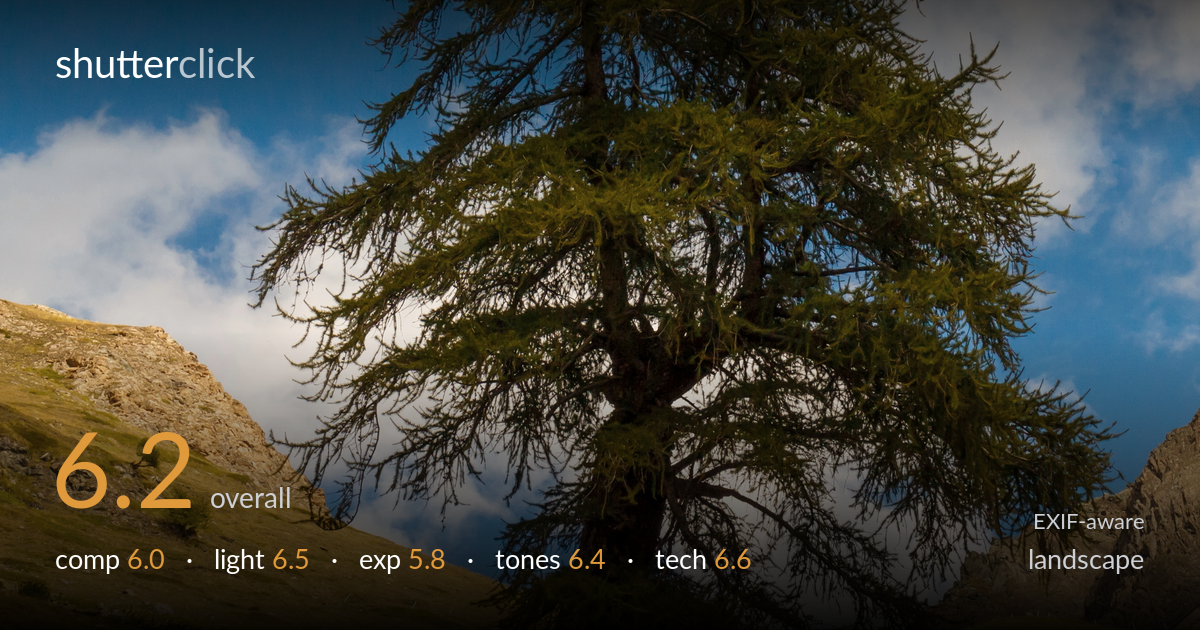
Lone larch on an alpine slope
Photo by Agnes Monkelbaan

| Aperture | f / 13.0 |
| Shutter | 1/320 s |
| Exp. comp. | -1.0 EV |
| Shot at | 08:03 · Feb 19, 2016 |
A single larch set against a deep blue alpine sky makes a clear, confident subject, and the diagonal of the slope adds energy. What most holds the frame back is the tree's foliage rendering: the dense canopy reads as a dark, undifferentiated mass with crushed interior detail, the result of underexposing for the sky. The portrait crop centres the trunk a touch too rigidly, and the slope diagonal climbs to the upper-left corner without a clear anchor. The light is pleasant low-angle afternoon warmth on the grass, but the subject itself sits flat. Strong bones, held back by tonal balance.
The lone larch is an inherently strong subject and the diagonal slope gives the frame movement, sweeping the eye up to the left. The portrait orientation suits the tree's vertical reach and the generous sky gives it room to breathe. The trunk sits close to the centre, though, which feels slightly static, and the slope runs out of the top-left corner without a clear stopping point. The rocky outcrop on the left edge competes mildly for attention. Placing the trunk nearer a third and lowering the horizon line would sharpen the balance.
Low-angle afternoon light rakes warmly across the dry grass and rocks, giving the slope pleasant texture and dimension. The directional light separates the foreground stones nicely. The problem is how it falls on the subject: the tree's dense interior is largely in shade, so the canopy reads as a dark silhouette rather than a form with depth. Side or back light skimming the foliage would model it better. As shot, the warm ground and cool sky are attractively contrasted, but the central subject misses the light that would have given it real presence.
The -1.0 EV compensation protected the bright sky and held the cloud highlights well, keeping the blue saturated and detailed. But it came at the cost of the tree, whose foliage is pushed into blocked-up shadow with little recoverable detail in the canopy mass and trunk. The grass holds up, but the subject itself sits too dark. A brighter exposure with later highlight recovery, or a graduated approach, would have balanced sky against subject. As it stands the exposure reads as a compromise that favoured the background over the focal point.
The colour palette works: a deep, clean alpine blue against warm golden-green grass is a satisfying complementary pairing, and white balance looks accurate. Saturation is healthy without tipping garish. The clouds carry soft, believable tonal gradation. The weakness is the tonal range within the tree, where greens collapse toward near-black and lose the variation that gives foliage life. A gentle shadow lift and a slight reduction in overall contrast would reopen the midtones in the canopy and recover separation between branches without flattening the sky.
At f/13 the depth of field is ample for a near-far landscape, keeping both the foreground slope and the distant ridge acceptably sharp, and 1/320s comfortably freezes any breeze in the foliage — sound choices for the scene. ISO appears low given the clean shadows in the grass, and the lens resolves the needle detail and rock texture well. Focus sits correctly on the tree. The main technical cost is the exposure trade: -1.0 EV held the sky but starved the canopy of detail, and at f/13 some diffraction softening is creeping in on a sensor of this class — f/8 to f/11 would have given comparable depth with marginally crisper detail. There is also faint vertical banding visible in the upper sky, possibly from sharpening or compression. Overall the execution is competent and the settings are defensible; the headroom lies in metering the subject rather than the highlights.
What would elevate it
Tags
Shot something like this?
Expert photo critique, on demand — scored across six categories, EXIF-aware. Start with 3 free critiques, no credit card.
critique my photo — free