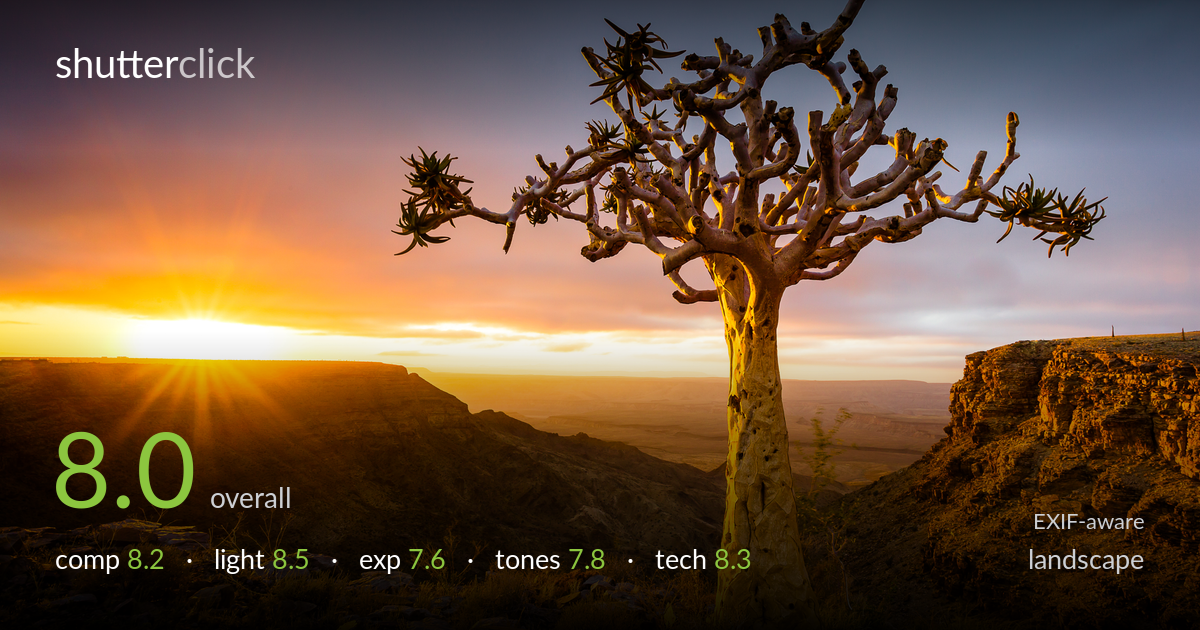
Lone quiver tree sunset
Photo by Martin Sojka
.jpg)
| Focal length | 18 mm |
| Aperture | f / 16.0 |
| Shutter | 3/10 s |
| ISO | ISO 100 |
| Exp. comp. | 0.0 EV |
| Shot at | 04:16 · Apr 15, 2012 |
A confident hero-tree composition that uses a charismatic quiver tree to anchor a vast canyon sunset, with the low sun providing a clean starburst and warm rim light across the rock. The branching silhouette reads beautifully against the graduated sky, and the wide-angle perspective conveys real scale. What holds it back most is tonal heaviness in the foreground warmth — the orange grading is pushed far enough that the rocks lean monochromatic and lose some natural variety — and a slightly busy lower-left frame edge. Tightening the grade and balancing the warm/cool split would lift an already strong frame.
The quiver tree is placed just right of centre with its outstretched canopy reaching back toward the setting sun, an effective counterweight to the starburst on the left. The horizon sits low, giving the sky room and emphasising scale across the canyon. Foreground rocks and scrub add depth and a clear near-to-far progression. The cliff on the right balances the tree's mass. The lower-left corner is a little cluttered with scrub and could be cleaner, but the overall balance and subject-to-environment relationship are well handled.
Timing is the strength here — the sun caught right on the horizon delivers a crisp starburst from the small aperture and rakes warm light across the canyon walls and the tree trunk. The directional low light models the bark texture and rim-lights the branches nicely. The sky holds a pleasing warm-to-cool gradient. The trade-off of shooting straight into the sun is that the right-hand cliffs catch intense warm light while parts of the midground flatten into haze, but the overall light is the image's biggest asset.
Exposure is broadly well judged for a difficult into-the-sun scene. The sky gradient holds detail and the sun core, while blown, is contained to a small area as expected. Shadow detail in the foreground rocks and trunk is recovered well with no muddy blacks. The brightest highlights near the horizon push close to clipping and lose some subtlety in the sun's immediate surround. A bracketed blend or slightly darker base exposure for the horizon band would preserve more gradation there without sacrificing the foreground.
The warm grade suits the golden-hour mood and the sky's purple-to-amber transition is handled with restraint. The problem is the foreground: the orange saturation is pushed hard enough that rocks, scrub and trunk all converge toward the same amber, costing natural tonal separation and making the lower third feel monochromatic. The cooler upper sky provides welcome contrast. Pulling back orange saturation and reintroducing some neutral and green variation in the foliage would restore realism and let the warm light read as light rather than a global colour cast.
The settings are well chosen for this scene. The Zeiss Distagon 18mm on the full-frame 5D Mark II is ideal for the sweeping wide perspective, and at f/16 depth of field comfortably spans the near foreground rocks to the distant horizon — the small aperture is also what produces the clean, well-defined sunstar. ISO 100 keeps noise negligible and preserves dynamic range, important when lifting shadows in a backlit frame. The 0.3s shutter is fine on a tripod, which this clearly required. Focus appears accurately placed for front-to-back sharpness, and the Zeiss optic renders the bark and branch detail crisply with minimal flare given the sun is in frame. The main technical caution is diffraction at f/16 on this sensor, which softens fine detail slightly; f/11 with careful focus placement or a focus blend would have held marginally more bite. Lens flare and veiling haze are controlled impressively for shooting into the sun. Overall a clean, deliberate execution.
What would elevate it
Tags
Shot something like this?
Expert photo critique, on demand — scored across six categories, EXIF-aware. Start with 3 free critiques, no credit card.
critique my photo — free