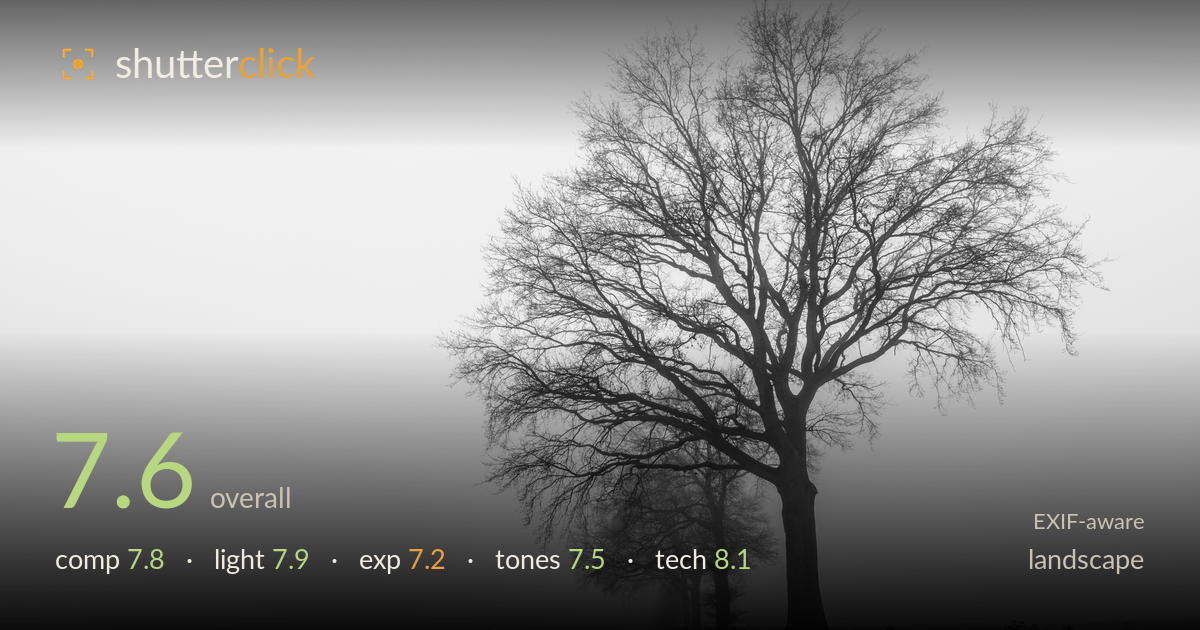
Lone tree in the fog
Photo by Dietmar Rabich

| Focal length | 20 mm |
| Aperture | f / 9.0 |
| Shutter | 1/5 s |
| ISO | ISO 100 |
| Exp. comp. | 0.0 EV |
| Shot at | 07:27 · Jan 26, 2020 |
A quiet, atmospheric fog study that leans on a strong lone tree and a receding avenue to carry the frame. The mood is the real achievement — the mist strips away distraction and lets the tree's branch structure read as delicate line work against near-white. What holds it back is the overall flatness: the tonal range never quite anchors in true black, so the image sits pale rather than luminous. The dirt road is a functional lead-in but competes with the tree for attention. Tightening the black point and refining the road-to-tree balance would lift this from atmospheric to memorable.
The dominant tree is well placed off-centre in the right third, and the fading row of trees behind it builds convincing depth. The dirt road works as a lead-in from the bottom edge, but it runs slightly left-of-centre and its vanishing point drifts away from the main tree, so the two strongest elements pull against each other rather than reinforcing. The vast empty sky on the left is bold and supports the isolation, though it edges toward feeling like dead space. Horizon placement low in the frame is a sound call.
Flat, diffused fog light is exactly right for this subject — it silhouettes the branch tracery cleanly and lends the receding trees their ghostly gradient. There is no directional modelling, which is inherent to the conditions rather than a fault, and the soft luminosity of the mist is the picture's central strength. A faint suggestion of brightness near the vanishing point hints at where the sun sits behind the haze, adding a subtle focal glow. Timing the shoot for this dense, even mist was the correct instinct.
Exposure is safe and holds detail throughout, with no meaningful highlight clipping in the bright sky and open shadow in the foreground brush. The trade-off is that everything sits in the upper-mid register — the histogram bunches high and lacks a true black, leaving the image looking slightly washed. The tree trunks and darkest branches could carry deeper tone without harming the fog effect. A touch of negative exposure compensation, or a black-point adjustment in post, would give the frame more presence and grounding.
The black-and-white conversion suits the misty scene, and the mid-tone gradation across the receding trees is handled gracefully. Contrast, however, is muted — the whole image lives in pale greys with little separation between the brightest sky and the mist, and the shadows never resolve into genuine black. The foreground vegetation reads a little muddy and flat as a result. A gentle contrast lift with a firm black point set on the nearest trunk would sharpen the tonal architecture while preserving the delicate high-key mood.
The settings are well matched to the situation. At f/9 on a 20mm lens, depth of field is more than sufficient to hold both foreground road and distant trees sharp, and ISO 100 keeps the file clean with plenty of latitude. The 1/5s shutter is slow, but on a static, windless foggy scene it poses no risk provided the camera was steady — and the branch detail suggests it was, likely tripod-supported. Focus is accurate on the main tree, with its fine twigs crisply resolved against the mist. The 20mm wide angle is a considered choice: it exaggerates the sweep of the road and gives the lone tree room to dominate, though at this distance it also renders the tree smaller than a longer lens would, which is a stylistic call rather than an error. One minor note: the extreme wide angle slightly stretches the empty left side, amplifying the dead-space feel. Overall this is competent, deliberate execution with no technical missteps.
What would elevate it
Tags
Shot something like this?
Expert photo critique, on demand — scored across six categories, EXIF-aware. Start with 3 free critiques, no credit card.
critique my photo — free