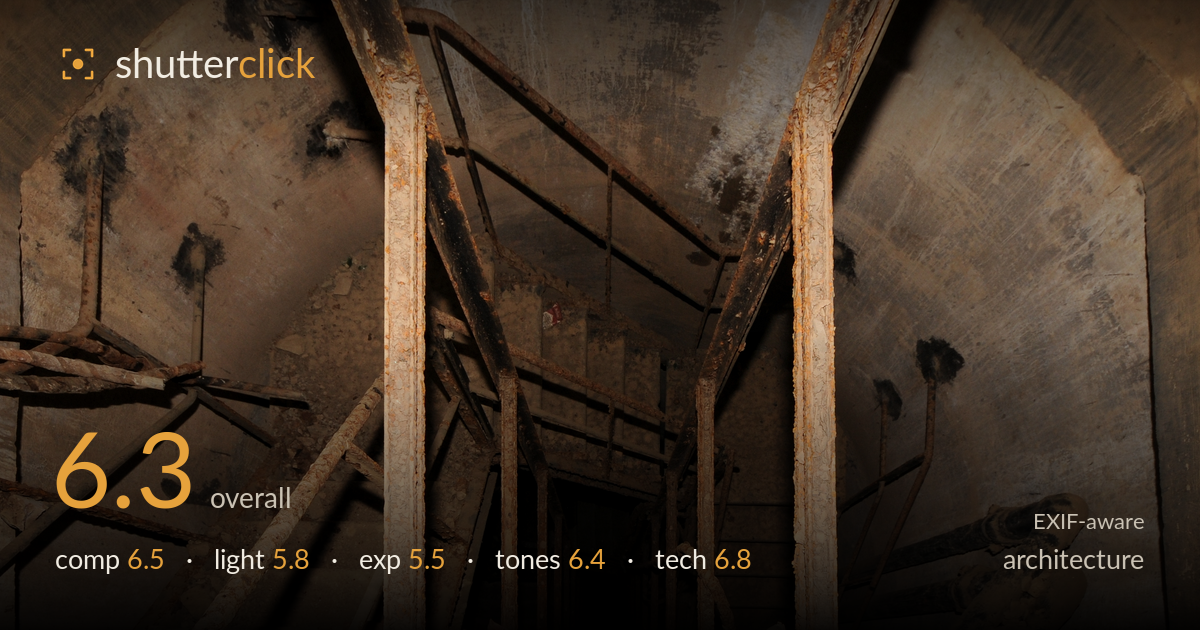
Looking down a rusted shaft
Photo by Thomas Bresson

| Focal length | 10 mm |
| Aperture | f / 8.0 |
| Shutter | 1/60 s |
| ISO | ISO 200 |
| Exp. comp. | 0.0 EV |
| Shot at | 10:09 · Apr 24, 2011 |
A textural study of industrial decay that trades on rust, grime, and the plunging perspective of a stairwell or shaft looking downward. The ultra-wide 10mm view creates real depth and a sense of vertigo, and the converging rusted beams give the frame energy. What most holds it back is exposure control: the shadows at the base swallow detail while the upper walls sit muddy and flat, so the eye never fully resolves the space. The centred, symmetrical framing is bold but the clutter of struts competes rather than leading. The strongest asset is texture — surface corrosion rendered with genuine bite.
The downward-plunging perspective is the strongest compositional idea, with the rusted beams converging toward a dark base to create depth and disorientation. The near-symmetrical vertical struts frame the descent, but the middle of the frame is a tangle of overlapping bars that reads as clutter rather than structure, so the eye struggles to settle. The bright red debris at the bottom pulls attention downward, which helps anchor the composition. A slightly higher vantage or a cleaner central axis would let the geometry breathe rather than fight itself.
The light is flat and directionless, likely from a mounted flash or ambient wash, which flattens the deep space and robs the rusted surfaces of the raking modelling that would make texture sing. Highlights on the nearer beams show some dimension, but the far walls fall into an even murk with no clear source shaping them. The dark base is dramatic but underlit rather than deliberately black. A raking side light or off-camera source skimming the corroded metal would carve out far more depth and surface relief.
Exposure is the weakest link. The base of the shaft blocks up into featureless shadow while the upper walls sit muddy in the low midtones, and the overall image reads underexposed for the amount of detail the scene contains. At 1/60s, f/8, ISO 200 there was room to open up or lift the shadows in processing without wrecking the highlights. The dynamic range of the scene is wide, but the capture doesn't use it — the histogram is bunched dark with little separation. Bracketing would recover the deep base.
The rust palette of oranges, browns, and blacks is cohesive and suits the decayed subject, and white balance sits believably warm. Contrast, however, is compressed in the shadows, leaving the darker areas a flat brown-black rather than a rich one. The corroded surfaces carry the most tonal interest where light reaches them. Mid-tone gradation on the walls is muddy and could use more separation. A touch more contrast and controlled shadow depth would give the tones the grit the subject deserves.
The 10mm ultra-wide is a sound choice for cramming this claustrophobic vertical space into a single frame, and it delivers the exaggerated convergence the shot depends on. f/8 is well judged for depth of field across the near beams to the distant base, and at this focal length near-everything falls within acceptable focus. ISO 200 keeps noise clean. The 1/60s handheld shutter is the concern — at 10mm it's steadier than a longer lens would be, but the far detail looks slightly soft, which may be a mix of subtle motion and the flat lighting hiding definition. Focus appears set on the nearer struts, which is reasonable given the wide DOF. The main technical shortfall isn't the settings themselves but the tonal capture — a tripod and a slower exposure, or bracketed frames, would have let the deep shadows retain detail without pushing ISO. Solid execution of a difficult, cramped subject overall.
What would elevate it
Tags
Shot something like this?
Expert photo critique, on demand — scored across six categories, EXIF-aware. Start with 3 free critiques, no credit card.
critique my photo — free