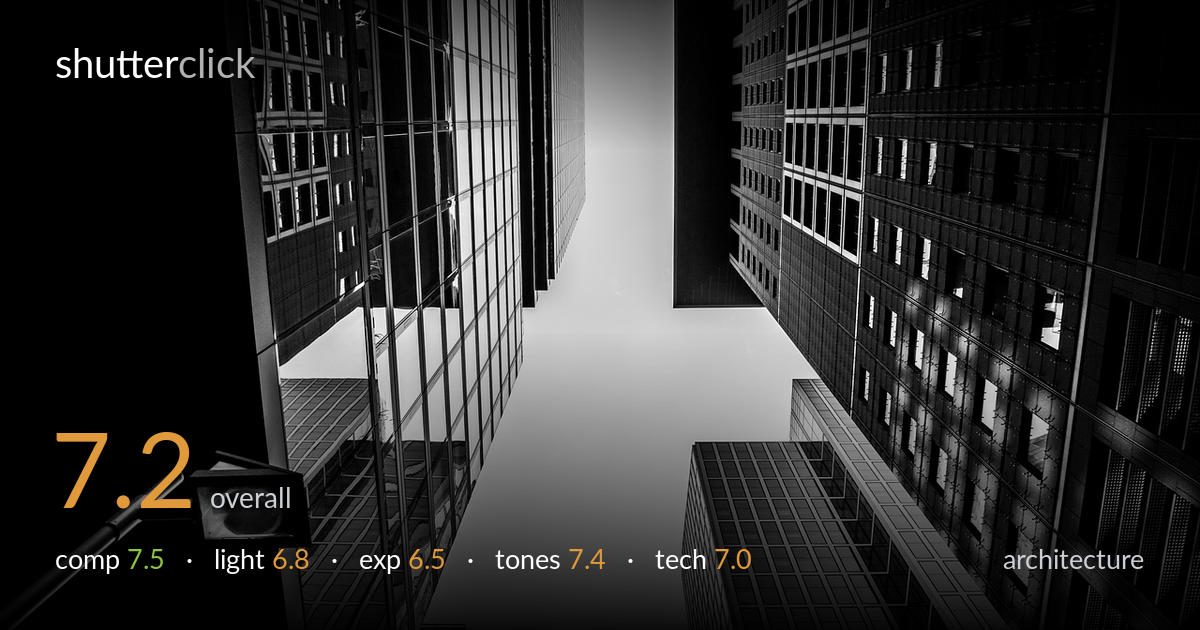
Looking up the glass canyon
Photo by Leonhard_Niederwimmer

No EXIF metadata in this file
Technical analysis based on visual assessment only.
A confident look-up composition that turns a corridor of glass towers into a bright sky channel — the converging facades pull the eye upward with real energy. The high-contrast monochrome treatment suits the geometry. What most holds it back is the blown sky: the central negative space is pure white with no tonal information, so the buildings read as edges against a void rather than against a sky. The dark left edge and the streetlamp add a foreground anchor but feel slightly arbitrary in placement. Strong graphic bones; tighter exposure discipline in the highlights would lift it.
The vertical look-up with facades converging toward a jagged channel of sky is a strong architectural device, and the asymmetric split between the brighter right tower and shadowed left wall gives the frame tension. The streetlamp in the lower left adds a foreground counterpoint but sits awkwardly, neither fully integrated nor clearly intentional. The central white channel functions as effective negative space, drawing the eye up. The bottom-right tower edge leads well, though the cluster of competing rooflines near centre slightly muddies the focal hierarchy.
Flat overcast light flattens the facades, which works for the graphic intent but sacrifices the modelling that raking light would bring to the glass and mullions. The right tower catches a touch more directional light, giving it dimension the left wall lacks. Without a sky that holds tone, the lighting reads as a silhouette study rather than a study of surface. Some interior window glows on the right add welcome small accents. Shooting under a textured sky or low sun would have given the metal and glass far more depth.
The central sky is fully clipped to paper white with no recoverable detail, which is the dominant exposure weakness — even a hint of cloud structure would anchor the composition. The shadow side on the left is crushed to near black, holding little texture in the glass. This high-contrast split may be partly intentional for the monochrome graphic effect, but the highlight loss looks more like overexposure than a chosen blow-out. Midtones in the right facade are well placed, with windows and structure clearly readable across a wide range.
The black-and-white conversion is the image's strongest asset: deep, clean blacks on the left wall, crisp whites in the sky channel, and good mid-tone separation across the right facade's grid. Contrast is pushed hard, suiting the bold geometry, though it tips toward losing detail at both ends. Highlight roll-off is essentially absent where the sky clips. The reflective glass on the left tower renders with pleasing tonal variation. A slightly gentler curve would preserve more gradation while keeping the punchy, graphic mood intact.
Sharpness is solid across the facades, with the window grids and mullions resolving cleanly even toward the frame edges, suggesting a capable wide lens stopped down adequately for the depth involved. The wide focal length drives the dramatic convergence, which is well suited to the look-up concept. Focus appears accurately placed on the building planes. Noise is well controlled in the mid-tones, though the crushed left shadows hide whether detail survives there. The main technical shortfall is exposure management rather than gear: the clipped sky indicates metering biased toward the darker facades, pushing highlights past recovery. Verticals are deliberately allowed to converge rather than corrected, which is appropriate for this expressive upward perspective rather than a documentary record. The streetlamp, slightly soft and close, sits at a different focal distance and reads as an intrusion rather than a controlled foreground element. Overall the execution is clean and assured, let down chiefly by highlight handling.
What would elevate it
Tags
Shot something like this?
Expert photo critique, on demand — scored across six categories, EXIF-aware. Start with 3 free critiques, no credit card.
critique my photo — free