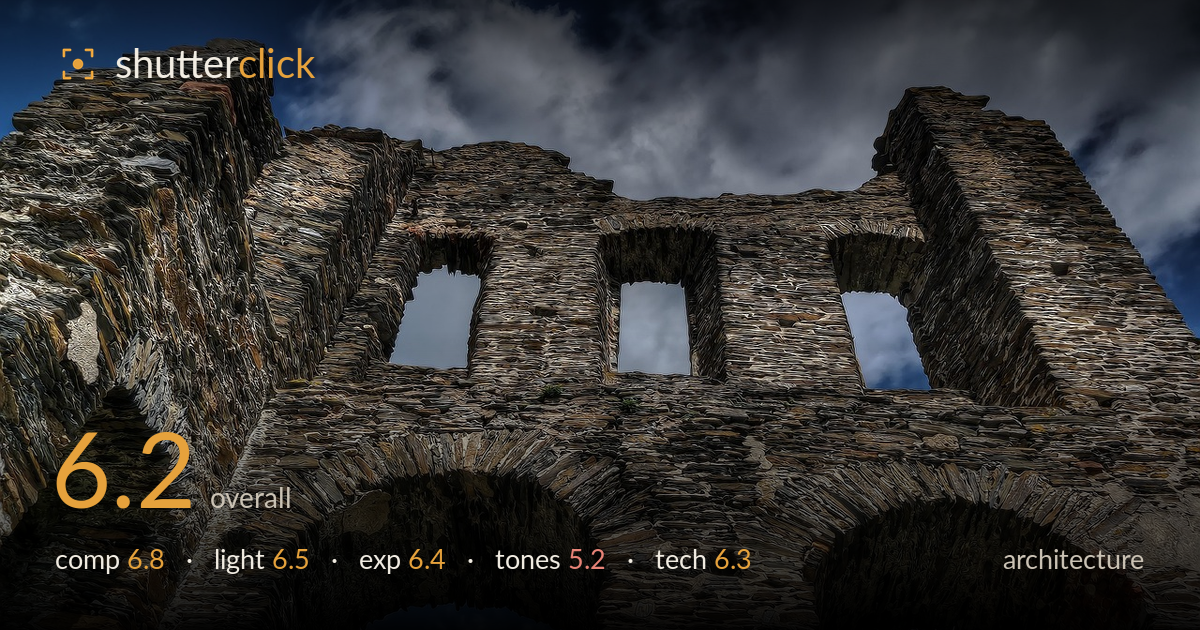
Looking up through castle ruins
Photo by DavidPogue

No EXIF metadata in this file
Technical analysis based on visual assessment only.
A dramatic worm's-eye view of a stone ruin that uses the arches and window openings well to frame a turbulent sky, but heavy HDR processing is the biggest thing holding it back. The tone-mapping has crushed local contrast into a flat, crunchy texture across every stone, added dark halos around the wall edges against the sky, and pushed the blues into an unnatural, oversaturated register. The upward perspective and the sky framed through the arches are genuinely strong ideas. Dialing back the processing to let the stone breathe naturally would transform this from an effect into a photograph.
The steep upward angle gives the ruin real presence and the twin lower arches framing the cloudscape are the strongest element here. The row of three window openings creates a useful rhythm across the upper wall. The V-shape of the two towers converging toward the sky pulls the eye up effectively. What weakens it is the slightly lopsided balance, with more visual weight on the left wall, and the tight top crop that clips the highest stone edges. A touch more headroom would let the structure resolve against the sky.
Soft, diffused daylight from an overcast-but-breaking sky renders the stonework fairly evenly, which suits the texture but flattens the sense of form. There is no strong directional light to carve depth into the wall, so the arches and recesses rely on the processing rather than genuine shadow to read as three-dimensional. The dramatic clouds provide the mood the scene depends on. A moment with lower, raking sunlight skimming across the stone face would reveal far more of the surface relief the subject offers.
Exposure holds detail across a wide range, keeping the bright cloud highlights from fully blowing out while retaining shadow information in the deep window openings and arch undersides. This is largely the work of HDR blending, and it succeeds on the technical goal of range. The bright cloud edges sit close to clipping in places, and the darkest recesses are pushed slightly muddy. Overall brightness is well judged for the subject, but the tonal compression that keeps everything visible also robs the image of natural contrast.
This is where the image struggles most. The HDR tone-mapping has oversaturated the sky into a harsh, artificial blue and introduced grey-to-dark halos along the wall silhouettes where they meet the clouds. Local contrast is exaggerated to the point that every stone reads as etched and crunchy rather than solid. White balance leans cold. The stone's natural warm-and-grey palette is buried under global saturation. A gentler grade, reduced clarity/structure, and desaturated blues would restore believability and let the material tones speak.
Focus is accurate across the wall and depth of field appears deep enough to keep both the near arches and the distant upper windows acceptably sharp, which is appropriate for architecture. There is no motion blur and the framing is steady. The dominant technical issue is post-processing rather than capture: aggressive tone-mapping has produced halos around high-contrast edges, amplified sensor-level texture into a painterly crunch, and introduced a slightly plasticky rendering on the stone. This kind of artifact is difficult to remove after the fact, so a single well-exposed frame or a more restrained bracket blend would serve better. The wide-angle choice suits the worm's-eye approach and the perspective convergence reads as deliberate rather than accidental keystoning. Sharpening also looks pushed, adding to the harshness. Reining in clarity, structure, and edge sharpening while working from raw would recover a natural, detailed rendering without sacrificing the drama the composition already has.
What would elevate it
Tags
Shot something like this?
Expert photo critique, on demand — scored across six categories, EXIF-aware. Start with 3 free critiques, no credit card.
critique my photo — free