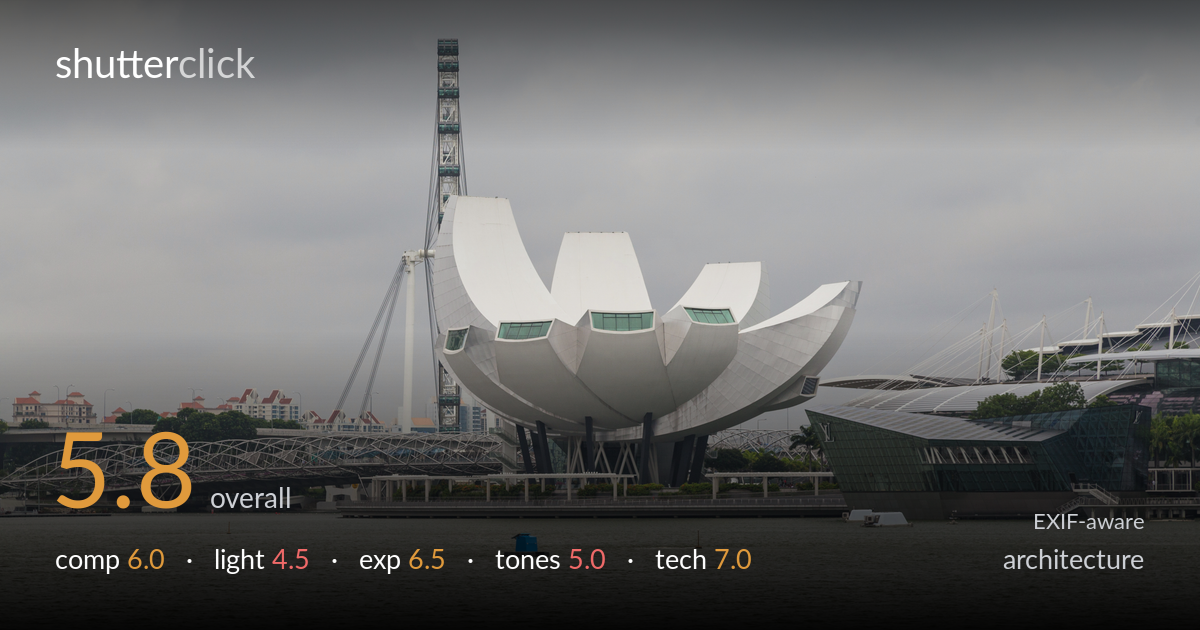
Lotus museum across the water
Photo by Marcin Konsek

| Focal length | 105 mm |
| Aperture | f / 7.1 |
| Shutter | 1/320 s |
| ISO | ISO 200 |
| Exp. comp. | 0.0 EV |
| Shot at | 09:37 · Feb 10, 2016 |
The lotus-form museum is a strong central subject, well isolated against the bridge and pavilion behind it, but the flat overcast light drains the scene of the modelling that white architecture depends on. The composition divides cleanly into water, building, and sky, yet the foreground water occupies nearly half the frame without adding interest, while the heavy grey sky reads as dead space. The structure's curved petals are the clear draw and the lines hold level. Better light and a tighter framing would lift this from a competent record shot toward something memorable.
The museum sits roughly centred with the helix bridge leading in from the left and the pavilion anchoring the right, giving a reasonable horizontal layering. Verticals stay clean and the waterline is level. The problem is proportion: the lower third of empty water and the upper half of featureless sky both starve the frame. A floating buoy near centre catches the eye but adds little. Tightening onto the building band, with the bridge running fully through, would concentrate attention and respect the strong horizontal geometry already present.
Heavy overcast flattens everything. The white petals of the museum, which rely on directional light to reveal their faceted curves and shadow lines, render almost shadowless and lose their sculptural drama. There is no highlight sparkle on the metal cladding and no modelling on the bridge trusses. The flat light does keep the green glass window panels readable and avoids blown highlights, but the overall effect is muted and lifeless. Side light from a low sun, or a break in the cloud, would transform the form.
Exposure is handled sensibly for the conditions. The bright white cladding holds detail without clipping, and the green roof glazing retains tone. Shadow areas under the structure and within the bridge stay open with recoverable detail. The grey sky sits in the midtones as it should. The histogram is compressed into a narrow band because the scene itself is low-contrast, not because of error. There is a touch of headroom that a slight positive compensation could have used, but nothing here reads as a mistake.
The grey-on-grey palette is the scene's natural state under cloud, but it leaves the image looking washed out. The water is a flat olive-grey, the sky a uniform pale grey, and the white building drifts toward dullness. White balance is neutral, perhaps a hair cool. There is little tonal separation to work with, and contrast sits low across the frame. A targeted contrast lift and some clarity on the building, with the sky luminance pulled down, would inject the separation the conditions denied.
The settings are well matched to the situation. At 105mm the long end of the zoom compresses the scene appropriately for a distant subject across the water, and f/7.1 delivers front-to-back sharpness with the lens near its sweet spot, keeping the bridge, museum, and pavilion all crisp. ISO 200 keeps noise negligible, and 1/320s is more than fast enough to counter any handheld shake at this focal length, leaving the architecture cleanly resolved. Focus lands accurately on the building, with the petal edges and window frames showing good detail. The 6D and 24-105L combination is a fitting choice here. The only technical note is that the frame could have been stopped down marginally less or the focal length pushed longer to crop in-camera, but neither would have meaningfully changed sharpness. Execution is the strongest aspect of this image; the limiting factors are light and tonal flatness, not the gear handling, which is sound throughout.
What would elevate it
Tags
Shot something like this?
Expert photo critique, on demand — scored across six categories, EXIF-aware. Start with 3 free critiques, no credit card.
critique my photo — free