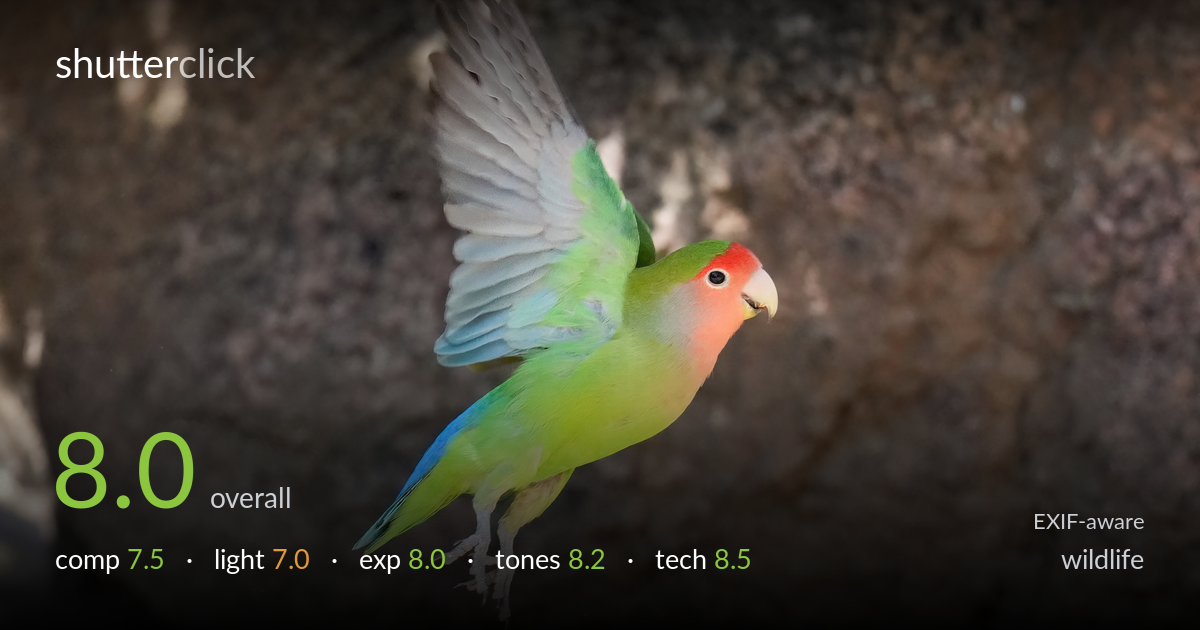
Lovebird in mid-flight
Photo by Giles Laurent

| Focal length | 400 mm |
| Aperture | f / 6.3 |
| Shutter | 1/3200 s |
| ISO | ISO 5000 |
| Exp. comp. | 0.0 EV |
| Shot at | 12:02 · Aug 2, 2025 |
A crisp, well-frozen lovebird in flight with the head and eye sharp and the wing raised in a classic upbeat pose — exactly the moment that earns a wildlife capture. The diffuse rocky background isolates the colourful subject cleanly and the colour rendering is faithful and lively. What most holds it back is breathing room: the bird's beak nearly meets the right edge, so the flight path runs out of space in front of it. Slightly less frame-filling framing and a touch more directional light on the near side would lift this from very good to outstanding.
The subject sits high and right, with the raised wing balancing the frame and the diffuse rock keeping attention on the bird. The problem is forward space: the beak nearly touches the right edge, so the bird flies out of the frame rather than into it. A flying subject needs room ahead of its direction of travel. The diagonal of the body and wing gives good energy, and the soft brown background separates the colourful plumage well. A reframe placing the bird left of centre would resolve the cramped lead-in.
Light is bright and frontal-to-side, lighting the head, eye and breast well and producing a clean catchlight in the eye — essential for a flight portrait. The wing and back fall into cooler shade, which adds dimension but leaves the far side a little flat. Midday-quality light keeps the colours vivid but renders some hard edges on the highlit plumage. A lower-angle or slightly warmer light would model the form more gently and bring out feather texture across the body.
Exposure is well judged for a tricky high-key subject against a darker ground. The brilliant yellow-green breast holds detail without blowing out, and the white beak retains texture. Shadow areas on the wing and feet keep enough information to read structure. The background sits a stop or so darker, which helps the bird pop without feeling artificially dim. Nothing important clips. A marginally brighter rendering of the shaded feet would aid the read of the lower body, but the balance is sound.
Colour is the standout here — the saturated greens, the peach face, the blue wing flash and red crown all read true and vivid without tipping into oversaturation. White balance is neutral, and the muted brown background provides a complementary, non-competing surround that lets the plumage sing. Contrast is healthy, separating subject from ground cleanly. The shaded wing carries a slight cool cast that sits naturally. Tonal gradation through the breast feathers is smooth and detailed.
Excellent execution for birds in flight. At 400mm, f/6.3 and 1/3200s the wing and feet are frozen cleanly, and the head and eye are tack sharp — the most important plane is nailed. ISO 5000 is a sensible trade for that shutter speed on the ILCE-1M2, and noise is well controlled, visible only faintly in the smooth background. The 400-800mm G lens delivers crisp feather detail across the lit areas. Depth of field at f/6.3 keeps the whole bird acceptably sharp while melting the rock into a clean wash — a good balance for a small, fast subject. The only minor weakness is that the raised wingtip drifts slightly soft at the edge of the focal plane, but that is a near-inevitable consequence of a flapping subject. Autofocus tracking clearly locked onto the eye. Settings choices were appropriate and decisive throughout; this is confident, technically assured flight work.
What would elevate it
Tags
Shot something like this?
Expert photo critique, on demand — scored across six categories, EXIF-aware. Start with 3 free critiques, no credit card.
critique my photo — free