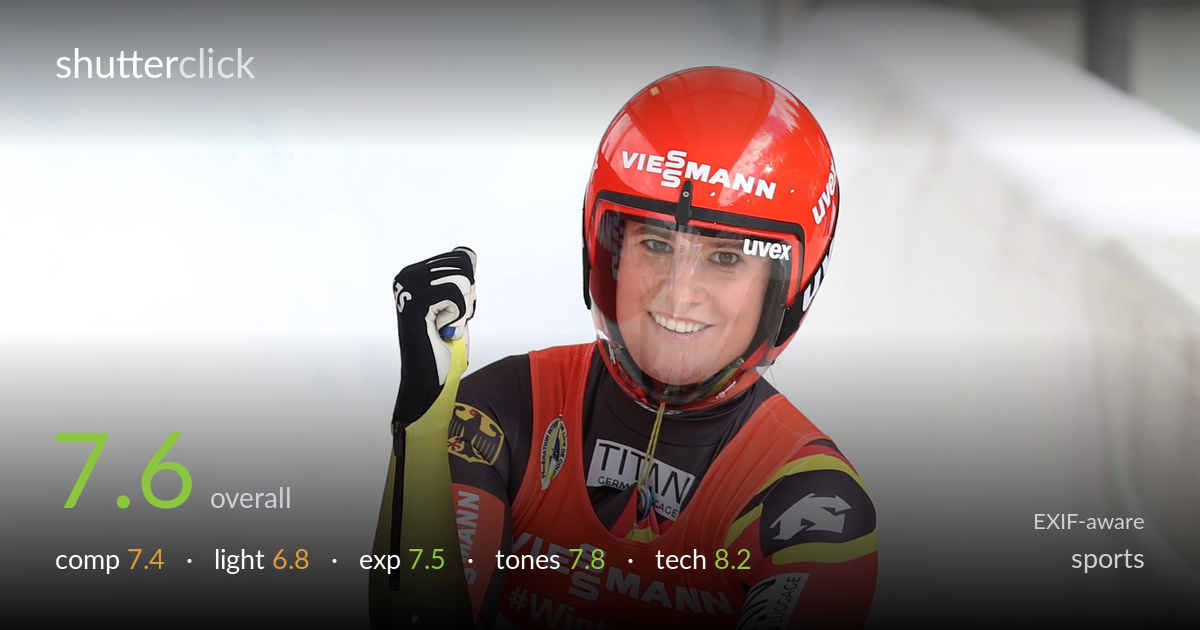
Luge athlete celebrating at the finish
Photo by Sandro Halank, Wikimedia Commons

| Focal length | 155 mm |
| Aperture | f / 4.0 |
| Shutter | 1/1250 s |
| ISO | ISO 640 |
| Exp. comp. | 0.0 EV |
| Shot at | 12:06 · Nov 24, 2018 |
A clean, well-timed finish-area capture of a luge athlete with a raised-fist celebration and the brake spray frozen mid-flight. The moment carries genuine emotion, the eyes are sharp behind the visor, and the bib number anchors the storytelling. The framing is portrait-tight and reads well, though the slightly low, head-on angle compresses the legs and crowds the frame. The flat, overcast light is the main limiter — it serves accuracy but does little to model the form or separate the bright suit from the white surroundings. A touch more breathing room and directional light would lift this from competent to memorable.
The vertical framing suits the seated, knees-up pose and keeps attention on the face and fist. The number 28 bib, raised glove, and direct gaze form a strong narrative cluster, and the snow spray adds energy in the lower third. The head-on, slightly low angle, however, foreshortens the legs and pushes the boots near the bottom edge, leaving little breathing room beneath. The white walls behind are clean but featureless, removing any sense of track or speed. A fraction more space at the base would settle the pose.
Flat, diffuse overcast light dominates — it renders the scene evenly and avoids harsh shadows on the face, which keeps the expression readable. But that same softness gives the form almost no modelling: the bright suit, helmet, and snow sit on similar tonal planes with little separation, and the whole frame risks visual flatness. There are no catchlights or directional shaping to give dimension. Side or low-angle light would have carved the suit's curves and lifted the subject off the uniformly bright background.
Exposure is handled well for a high-key snow scene. The whites of the track retain texture rather than blowing to pure paper, and the colourful suit holds saturation without clipping in the reds and oranges. The face sits at a natural midtone under the visor, with shadow detail preserved in the dark sled and boots. A few of the brightest snow highlights edge toward clipping but nothing distracting. The zero exposure compensation worked because the bright suit kept the meter honest against all that white.
Colour is the image's strongest tonal asset — the gradient suit shifts from green through orange to yellow against the red helmet and bib, and it all reads cleanly without oversaturation. White balance is neutral, the snow staying believably white rather than blue or grey. Contrast is moderate, appropriate for the flat light, though the overall palette leans bright and could use slightly deeper blacks in the sled and boots for added punch. Skin tones are accurate and natural under the visor.
The settings are well matched to the subject. At 1/1250s the spray of snow is frozen crisply mid-air, and there is no motion blur on the athlete despite the dynamic moment — exactly what peak-action sports demands. f/4 on the 70-200 at 155mm gives enough depth to hold the whole seated pose sharp from helmet to boots while still softening the background walls slightly for separation. ISO 640 is a sensible choice in flat daylight, delivering a clean file with no visible noise. Focus is accurately placed on the eyes behind the visor, which is the critical plane here. The 1D X Mark II and this lens combination is the right tool, and the execution is essentially flawless on the technical front. The only refinement would be a marginally wider aperture or longer focal length to push the white background further out of focus, since at f/4 it remains fairly defined rather than melting away.
What would elevate it
Tags
Shot something like this?
Expert photo critique, on demand — scored across six categories, EXIF-aware. Start with 3 free critiques, no credit card.
critique my photo — free