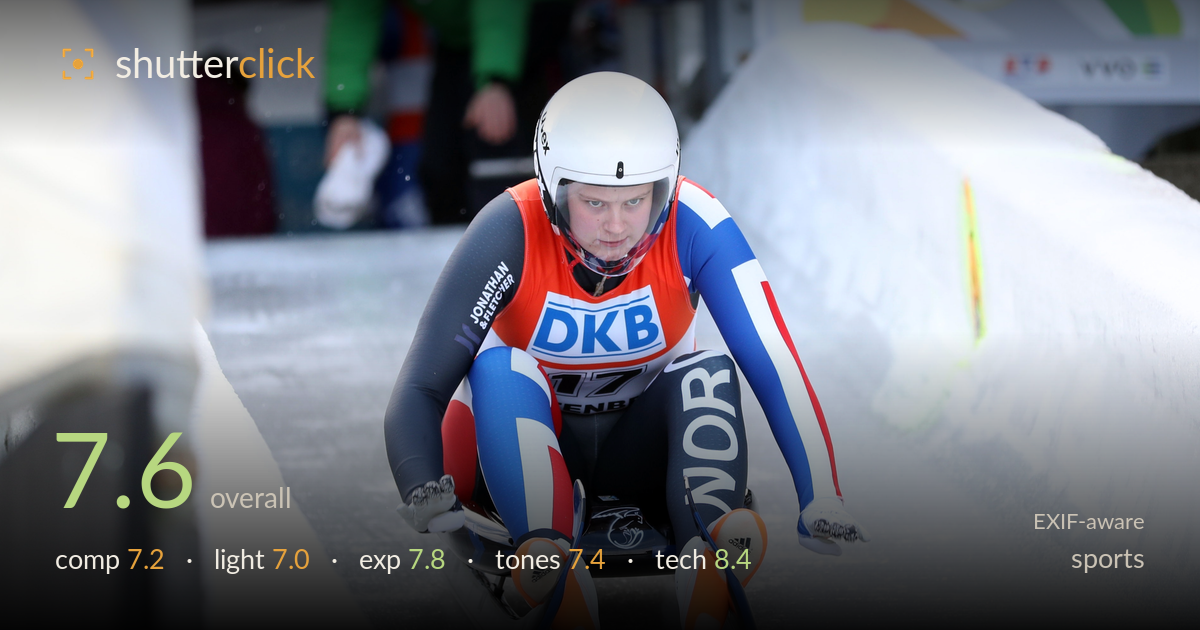
Luge racer speeding down the track
Photo by Sandro Halank, Wikimedia Commons

| Focal length | 200 mm |
| Aperture | f / 2.8 |
| Shutter | 1/1000 s |
| ISO | ISO 640 |
| Exp. comp. | 0.0 EV |
| Shot at | 13:55 · Feb 2, 2018 |
A well-timed luge frame that catches the athlete head-on with the sled feet splayed and the face locked in concentration — the peak-action posture reads clearly and the eyes are sharp. The head-on angle and shallow depth of field isolate the subject cleanly from a soft, distracting start-area background. What most holds it back is the light: flat, high-key sun on ice flattens contours and blows the surrounding snow toward pure white, and the ice walls dominate the lower and right thirds, leaving the subject compressed into the centre-left. The moment and technical execution carry the shot further than the framing does.
The head-on framing works for the confrontational sense of speed, and the sled's orange booties splaying outward add a strong graphic anchor at the base. Placement is centred-left with the athlete's forward lean pointing into the frame, which gives some direction. But the ice walls consume large bright expanses on the right and lower corners, crowding the subject and adding little. A tighter crop favouring the sled and torso, or a lower angle to trade white ice for the track's line, would concentrate the energy where it belongs.
Bright direct sun on snow delivers even, front-favouring illumination that keeps the face and bib legible, but the trade-off is flatness — contours on the racing suit and the ice surface lose their modelling, and the surrounding snow reads as an undifferentiated white field. There is a small catchlight in the eyes, which helps the expression register. Softer, lower-angle light or a slight side rake would have carved shape into the suit and ice, giving the frame more dimension without sacrificing the readability of the moment.
Exposure is well handled for a snow-dominated scene, which routinely fools meters into underexposing. The face and bib hold detail, the reds and blues of the suit sit at full saturation without clipping, and the sled booties retain colour. The brightest ice edges push near pure white but that suits the setting rather than reading as an error. Shadow detail under the visor and in the darker suit panels is preserved. A touch of negative compensation might have recovered a little more texture in the whitest snow.
White balance is clean and neutral, with the snow reading white rather than blue or yellow — a good result under bright winter sun. The suit's primary reds and blues are vivid and the orange booties pop against the ice. Contrast, however, is inherently low because of the flat light, so the overall tonal range sits compressed toward the highlights. The mid-tones on the ice carry little separation. A modest contrast lift with recovered highlight texture would give the frame more tonal depth without going harsh.
Execution is the strongest element here. The 70-200mm at 200mm and f/2.8 is the right tool — the reach compresses the track and the wide aperture throws the busy start area into a soft wash, isolating the athlete cleanly. At 1/1000s the fast head-on approach is frozen crisply, with no motion smear on the sled or gloves. Focus lands on the face and eyes, which are tack sharp, exactly where it needs to be for a subject-facing action shot. ISO 640 is a sensible choice in bright conditions, keeping noise negligible while leaving shutter headroom. The only caution with f/2.8 on a head-on subject is depth of field: the face is sharp but the outstretched sled booties sit slightly softer, which is a reasonable trade for background separation but worth noting. Overall this is confident, well-judged sports shooting — the settings, focus, and timing all align to serve the moment.
What would elevate it
Tags
Shot something like this?
Expert photo critique, on demand — scored across six categories, EXIF-aware. Start with 3 free critiques, no credit card.
critique my photo — free