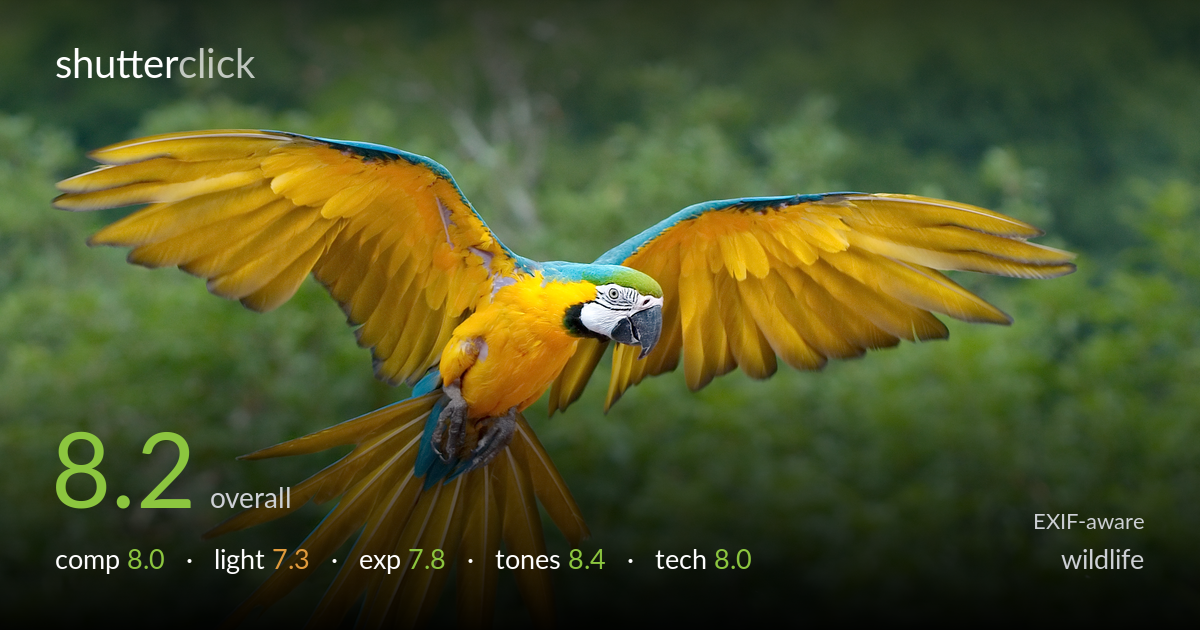
Macaw banking in full flight
Photo by Luc Viatour

| Focal length | 150 mm |
| Aperture | f / 5.0 |
| Shutter | 1/640 s |
| ISO | ISO 400 |
| Exp. comp. | 0.0 EV |
| Shot at | 16:19 · Jul 15, 2009 |
A clean, full wingspread of a blue-and-gold macaw caught at a near-perfect moment, with the bird banking toward the camera and both wings fanned wide. The fully spread tail and outstretched wings fill the frame with a strong radial structure, and the green wash of foliage isolates the subject without distraction. The eye is sharp and well-placed. What most holds it back is the flat, overcast light, which keeps the plumage from reaching its full luminosity, and a wingtip that grazes the right edge a touch tightly. A stop more separation light would lift this further still.
The diagonal bank with both wings raised gives the frame energy, and the fanned tail anchors the lower half with a striking radial spread. Placing the head right of centre on a thirds intersection works well, leaving room into which the bird flies. The uniform green backdrop isolates the subject cleanly. The right wingtip nearly clips the edge, which tightens the frame more than ideal — a fraction more room on that side would let the wingspread breathe. The overall balance and energy are genuinely strong.
Soft, overcast light wraps the bird evenly and avoids any blown highlights on the white facial skin or harsh shadows under the wings — kind to detail, and the diffuse quality suits the dense green setting. The trade-off is flatness: the yellows and blues read accurately but never catch and glow the way directional light or a low sun angle would render iridescent plumage. There's little modelling across the wing surfaces, so the feathers appear somewhat two-dimensional rather than sculpted.
Exposure is well judged for a bright subject against a darker backdrop. The white facial mask and pale yellow feathers hold detail without clipping, and the green foliage sits in the midtones without muddying. Shadow detail under the body and in the wing roots is retained. There's no obvious need for exposure compensation here, and at 0.0 EV the balance landed cleanly. A touch more brightness on the bird's body could lift it slightly off the background, but nothing is genuinely lost.
The colour rendering is the standout — saturated golds, vivid teal flight feathers, and the green facial cap all read true without tipping into oversaturation. White balance is neutral and the foliage stays a natural green that complements the bird's warm palette beautifully. Tonal separation between the bird and background is excellent thanks to the complementary green-and-gold relationship. Contrast is gentle, in keeping with the flat light, but the colour itself carries the image with real richness and no visible casts.
At 150mm, f/5.0, 1/640s and ISO 400 on the D300, the settings are sensibly chosen for a moving bird in flat light. Focus landed accurately on the eye, which is critical — it's sharp and shows good detail in the iris pattern. The 1/640s shutter froze the body and head cleanly while leaving the faintest softness in the fastest-moving wingtips, which actually reads as natural motion rather than error. ISO 400 keeps noise negligible and detail clean in the feathers. f/5.0 gave enough depth of field to hold the head and near wing sharp while throwing the background into smooth, distraction-free blur. The 150mm focal length suits the subject distance, filling the frame without crowding. One consideration: 1/800s or faster would have nailed the wingtips fully, and the slight margin for a tighter wing meant near-clipping. Overall the execution is sound — focus, motion control and noise are all handled competently for a bird-in-flight capture.
What would elevate it
Tags
Shot something like this?
Expert photo critique, on demand — scored across six categories, EXIF-aware. Start with 3 free critiques, no credit card.
critique my photo — free