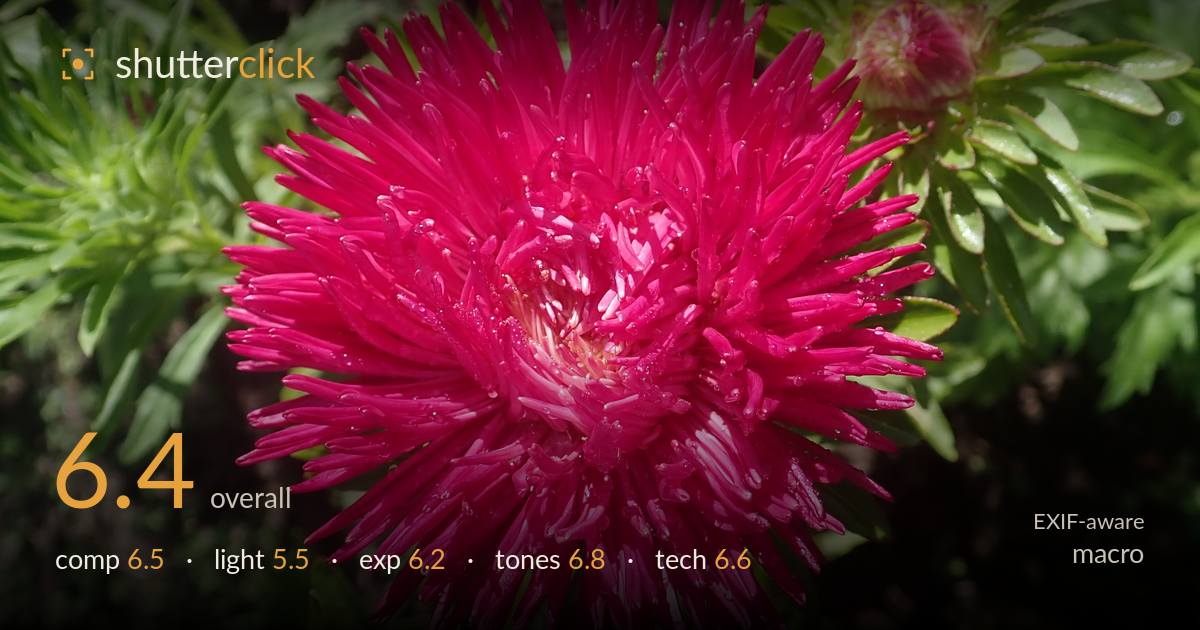
Magenta aster in full bloom
Photo by Salicyna

| Focal length | 6 mm |
| Aperture | f / 3.2 |
| Shutter | 1/800 s |
| ISO | ISO 100 |
| Exp. comp. | -0.7 EV |
| Shot at | 07:41 · Aug 28, 2023 |
The saturated magenta aster commands attention against a green surround, and the inclusion of the emerging bud upper-right adds a useful narrative counterpoint of life stages. What most holds the frame back is harsh midday light: the direct sun blows small specular highlights across the wet petals and casts hard shadows into the foliage, flattening the bloom's dimensionality. Focus lands well on the near petals but the central disc — the natural focal anchor — sits slightly soft. A softer light and a plane of focus locked on the core would lift this from a competent garden record to a genuinely refined macro study.
The main bloom sits left of centre with the developing bud balancing the upper right — a sensible two-subject relationship that gives the eye somewhere to travel. The flower is placed a touch low and tight against the bottom edge, cramping the lower petals. The busy green background competes rather than recedes cleanly. A slightly higher framing to give the bloom breathing room beneath, or a tighter crop isolating the flower and bud pair, would strengthen the arrangement and reduce the distracting foliage clutter at the edges.
Direct overhead midday sun is the weakest element here. It produces hard specular hits on the water droplets and petal tips, and drops the background foliage into harsh, contrasty shadow with distracting bright patches. The light does little to model the flower's spherical form — it reads flat despite the layered petals. Overcast light or a diffuser held above the bloom would soften those highlights, deepen colour saturation, and reveal the subtle texture and gradation within the densely packed petals far better than raw sun.
The -0.7 EV compensation was a sound call to protect the intense magenta from clipping, and the petals largely hold detail. A few of the brightest specular droplet highlights still blow, but those are inherent to the hard light rather than an exposure fault. Shadows in the background retain some detail without going muddy. Overall the exposure is deliberate and well judged for the conditions; the histogram sits comfortably, with the saturated reds close to but not fully over the edge.
The magenta is rich and reads true, and the pink-to-yellow transition at the disc adds warmth. The green-versus-magenta complementary pairing is punchy. Saturation runs slightly hot in the deepest petals, where colour begins to block up into a single mass and lose separation. White balance is neutral and believable. The background greens vary from vivid highlight to dark shadow, which fragments the tonal field. Pulling saturation back a touch and evening the green tones would let the bloom's colour breathe.
The TG-5 at f/3.2, 1/800s and ISO 100 is a reasonable set of choices for a bright garden macro. The fast shutter froze any breeze-induced petal movement cleanly, and base ISO keeps the image noise-free with good micro-detail on the near petals and droplets. The 6mm focal length (roughly 25mm equivalent) means the depth of field, while shallow-looking on this close subject, still had to cover a deep, layered bloom. Focus landed on the front-facing petals rather than the central disc, leaving the core marginally soft — the natural point of sharpest interest. Stopping down to around f/5.6 would have carried more of the flower's depth into focus at negligible cost given base ISO and abundant light, and focus stacking (which the TG-5 supports) would have been ideal for a subject this three-dimensional. Sharpness where achieved is crisp and the lens renders detail well; the limitation is focus placement and depth, not resolution.
What would elevate it
Tags
Shot something like this?
Expert photo critique, on demand — scored across six categories, EXIF-aware. Start with 3 free critiques, no credit card.
critique my photo — free