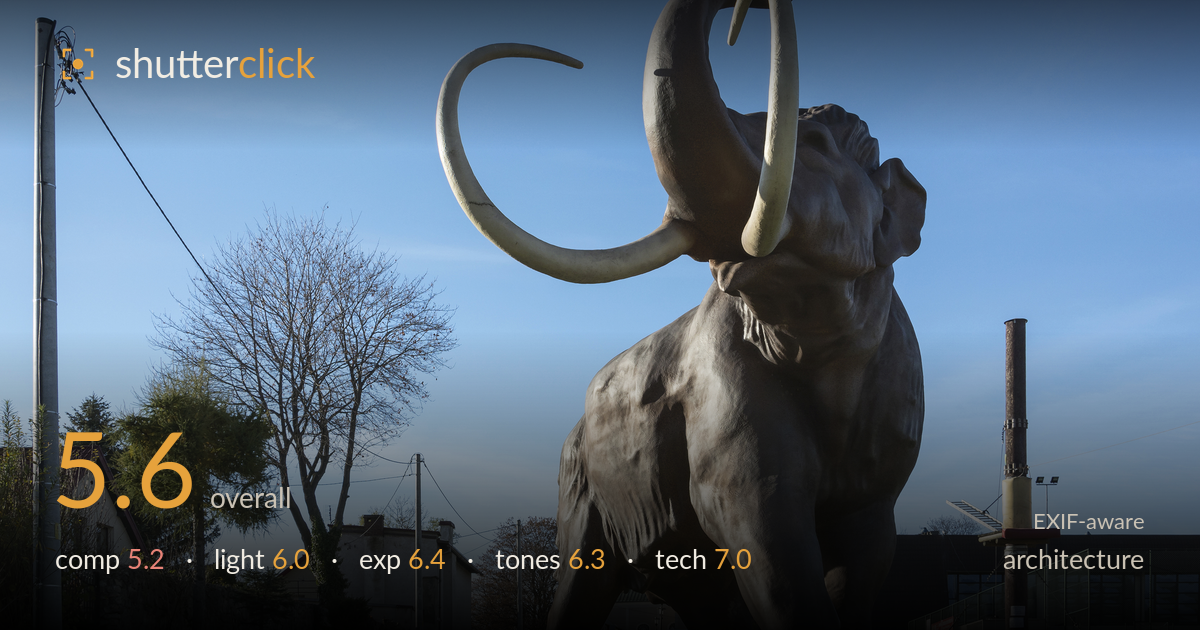
Mammoth sculpture against a blue sky
Photo by Jacek Halicki

| Focal length | 24 mm |
| Aperture | f / 10.0 |
| Shutter | 1/400 s |
| ISO | ISO 200 |
| Exp. comp. | 0.0 EV |
| Shot at | 14:36 · Nov 1, 2015 |
A monumental mammoth sculpture anchors the frame with real presence, but the surroundings actively work against it. The subject is dramatically lit and cleanly rendered against blue sky, yet the cluttered background — utility pole, wires, a parked car, mixed rooflines, and an industrial chimney — fragments attention and undercuts the drama. The low angle and upward reach of trunk and tusks give the piece scale, which is the shot's strongest asset. The largest gains lie in cleaning up the setting through position and framing, and in lifting the shadowed flank that currently swallows detail.
The low viewpoint gives the mammoth genuine stature, and placing it right-of-centre with the tusks sweeping into open sky reads well. But the environment fights the subject: the utility pole and drooping wires on the left, the parked car beneath the belly, and the industrial chimney at right all pull the eye away and clutter the negative space. The tusk tips very nearly kiss the top edge, which feels cramped. A cleaner shooting position — or a tighter crop excluding the pole and chimney — would let the form breathe.
Low, raking side light from the right models the sculpture's musculature and wrinkled hide effectively, giving the surface real dimension and separating the pale tusks from the darker body. The clear blue sky provides a clean backdrop for the upper form. The trade-off is a heavily shadowed near-side flank and legs that lose much of their sculptural detail. Shooting when the light wrapped a little more toward the front, or on a slightly overcast day, would retain the modelling while opening those shadows.
Exposure holds the bright sky and the pale tusks without meaningful clipping, and the sky retains a smooth gradient — a sensible choice that protects the highlights. The cost is the shadowed side of the body, which sits dark and detail-starved in the lower left of the animal. The histogram leans toward the shadows as a result. A half-stop lift in post to the darker flank, or bracketing for a blended exposure, would recover hide texture without endangering the sky or tusk highlights.
The deep blue sky and warm bronze of the sculpture make a pleasing complementary pairing, and white balance looks accurate under the direct sun. Contrast is on the strong side, which suits the sculptural subject but deepens the shadow side into near-black. The dry grass and autumn foliage add muted warmth in the lower frame. A touch more shadow recovery would improve tonal gradation across the body, where the transition from lit to shadowed sides is currently abrupt rather than graduated.
The settings are well matched to the task. At 24mm and f/10 the depth of field carries sharpness from the sculpture through to the distant houses and chimney — appropriate for an environmental record of the piece. ISO 200 keeps noise negligible, and 1/400s is more than enough to guarantee a crisp handheld frame at this focal length. Focus is accurate on the mammoth's body, and the pale tusks are rendered with clean edge detail. The 18-105 kit lens performs respectably here, with reasonable corner sharpness and controlled flare given the bright side light. The one technical note against the architecture genre: at 24mm the wide framing introduces some perspective distortion and the verticals of the pole and chimney lean slightly, though the sculpture itself has no strict verticals to hold true. Stopping to f/10 was a touch conservative — f/7.1 would have preserved ample depth while sidestepping any diffraction softening. Execution overall is solid and dependable.
What would elevate it
Tags
Shot something like this?
Expert photo critique, on demand — scored across six categories, EXIF-aware. Start with 3 free critiques, no credit card.
critique my photo — free