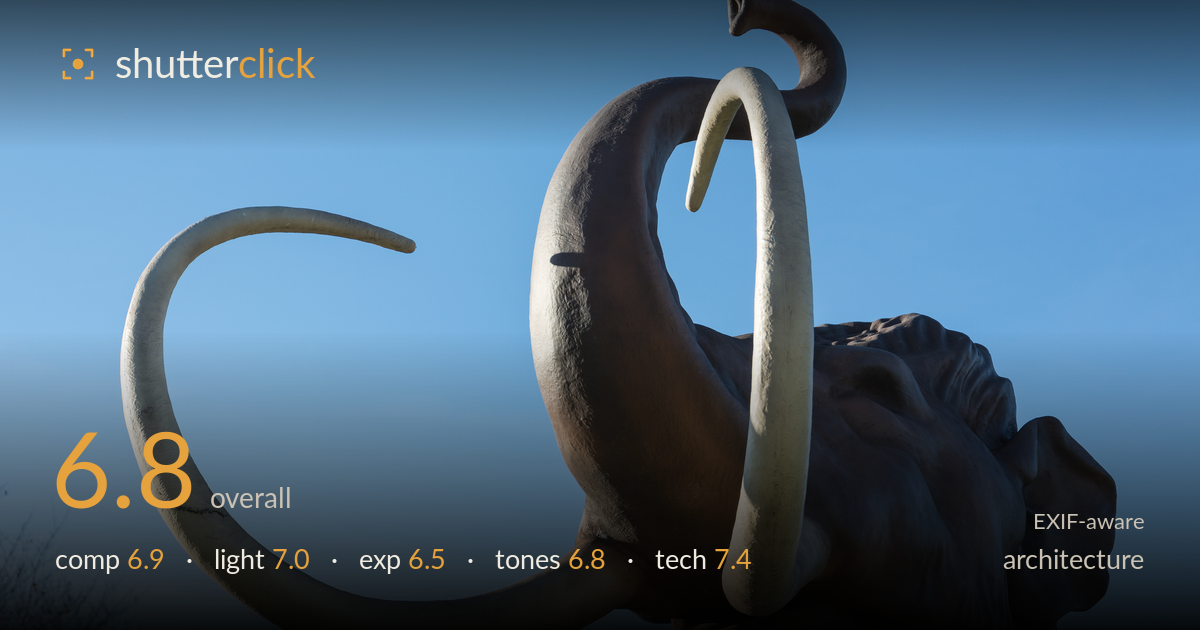
Mammoth sculpture against blue sky
Photo by Jacek Halicki

| Focal length | 58 mm |
| Aperture | f / 6.3 |
| Shutter | 1/640 s |
| ISO | ISO 200 |
| Exp. comp. | 0.0 EV |
| Shot at | 14:37 · Nov 1, 2015 |
A bronze mammoth sculpture rendered against clean blue sky, with the sweeping curves of tusks and trunk forming the strongest graphic element. The dark bronze against the gradient sky reads with pleasing weight, and the diagonal upward thrust gives the frame energy. What most holds it back is the head crop: cutting the animal off at the bottom edge and the trunk tip at the top leaves the composition feeling squeezed at both ends. The bronze surface also loses highlight and shadow separation in the darker mass, flattening the texture that could have carried the shot.
The interlocking curves of the tusks and raised trunk are the real subject here, and they carry strong visual rhythm — the near tusk sweeps into negative sky space on the left while the trunk arcs up top-right. That diagonal dynamism works. The weakness is the framing: the head is cropped hard at the bottom and the trunk tip nearly clips the top edge, leaving no breathing room. The bare tree in the lower left adds little and competes faintly. Placing the sculpture with more sky headroom would let the forms resolve.
Low, raking sunlight catches the tusks and one side of the trunk cleanly, giving the ivory surfaces a warm glow that separates them from the sky. The direction is favourable — side light reveals the modelling of the trunk's ridges and the tusk sheen. The trade-off is that the shaded bronze of the head falls into a fairly uniform dark mass, losing the surface detail that better fill or a different angle would have preserved. The sky gradient is a pleasant backdrop that keeps the light feeling natural rather than harsh.
Exposure is protecting the bright sky and sunlit tusks, which is the right priority — no obvious highlight clipping on the ivory. The cost is the bronze body, which sits dark and reads as a heavy silhouette with limited shadow detail in the head and ear folds. It's a defensible choice given the contrast range, but the darker mass could hold more information. A half-stop lift or shadow recovery in post would reveal the texture of the sculpted hide without endangering the highlights.
The colour palette is simple and effective: warm ivory and dark bronze against a graduated blue sky. White balance is neutral and believable. The tonal contrast between the sunlit tusks and shaded body carries the image, but the bronze compresses toward the shadow end, so mid-tone gradation on the head is thin. The sky gradient is smooth and clean. A touch more separation in the darker tones and slightly restrained blue saturation would keep the sculpture from reading as a flat cutout against the background.
The settings are well matched to the subject. At 58mm and f/6.3 the depth of field comfortably covers the sculpture, and the 1/640s shutter with ISO 200 is more than adequate for a static subject in daylight — no motion concerns, no noise penalty. Focus lands accurately on the tusks and trunk, where detail is sharpest, and the ivory surfaces hold fine texture. The mid-range focal length avoids the exaggerated distortion a wider lens would introduce on the projecting tusks, keeping the curves natural. This is a clean, competent capture technically. For a sculpture shot the aperture could have been closed a touch more if front-to-back sharpness on the receding head were a concern, but at this distance it isn't. The only technical limitation is dynamic range: the scene's contrast exceeds what a single exposure holds gracefully, leaving the bronze dark. Bracketing or shooting raw for shadow latitude would have given more room to balance the tonal extremes.
What would elevate it
Tags
Shot something like this?
Expert photo critique, on demand — scored across six categories, EXIF-aware. Start with 3 free critiques, no credit card.
critique my photo — free