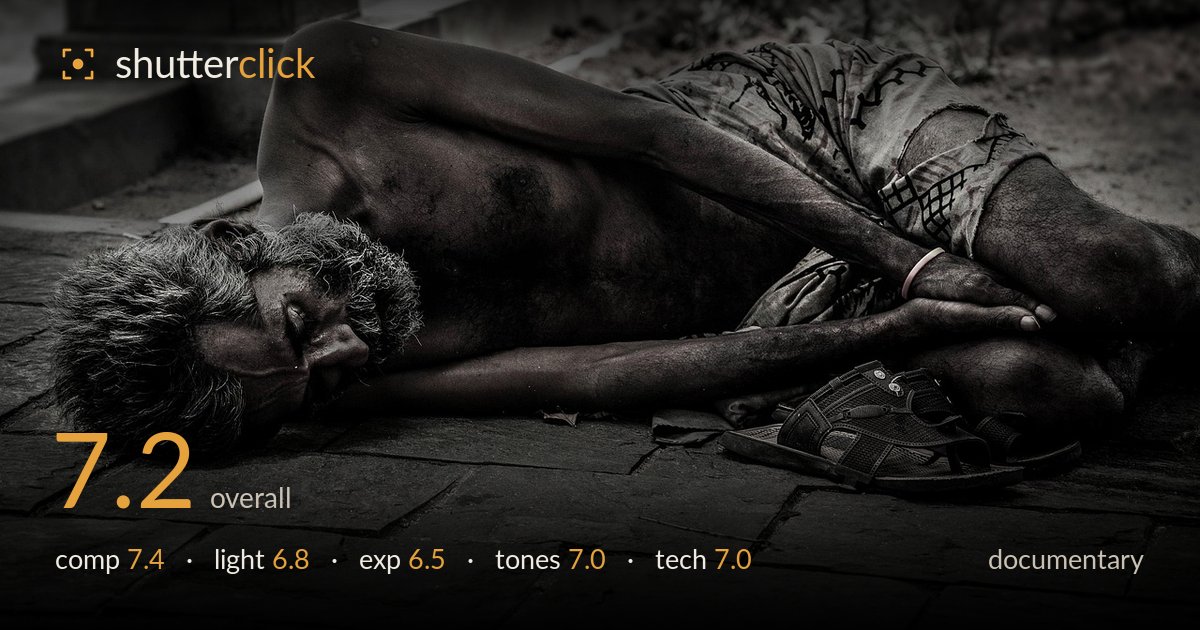
Man sleeping on the pavement
Photo by KasunChamara

No EXIF metadata in this file
Technical analysis based on visual assessment only.
A quietly powerful documentary frame that trades on vulnerability and dignity rather than spectacle. The horizontal body sprawled across the stone floor, the worn sandals placed beside the folded hands, and the coiled, foetal posture together carry a strong narrative of hardship and rest. What most holds the image back is the heavy, near-crushed shadow rendering across the torso and lower body, which swallows detail that would deepen the story. The near-monochrome grade suits the mood but flattens some tonal separation. A more open exposure in the darkest zones and a slightly cleaner frame edge would let this reach its full weight.
The reclining figure runs along a strong horizontal, anchored by the face at the lower left and closed by the sandals at right, which act as a deliberate secondary focal point and narrative detail. The paving stones create a receding foreground texture that grounds the subject. The soft, out-of-focus steps and foliage in the upper band give context without distraction. The tighter framing on the face works, though the top-right corner with the bright bush pulls a little attention. A fraction more space beyond the feet would balance the leftward lean of the head.
Soft, diffused daylight wraps the figure evenly, avoiding harsh contrast that would fight the sombre mood — appropriate for the subject. The gentle modelling across the shoulder and arm gives the body form. However, the light does little to lift the deep recesses of the torso, chest, and folded legs, leaving large passages reading as near-black mass. A touch of fill or a lower shooting angle catching more reflected ground light would have revealed skin texture and detail that the story would benefit from.
The exposure protects the mid-tone skin on the shoulder and face but lets the shadows fall very deep, with the chest, folded arms, and lower legs blocking into near-featureless black. Some of this is a grading choice, yet detail that matters to the narrative is lost there. Highlights on the paving and background hold well with no significant clipping. Lifting the darkest zones by a stop in post would recover texture without breaking the mood. The face, the emotional core, is adequately placed but sits close to the shadow floor.
The desaturated, near-monochrome grade with faint warm undertones suits the melancholy of the scene and unifies skin, cloth, and stone. Contrast is pitched fairly high, which drives the drama but crushes shadow gradation across the body. The paving retains pleasant mid-tone separation and texture. The background greys and muted greenery recede cleanly. A gentler shadow curve would restore gradation in the torso, and pulling back a touch of overall contrast would keep the grit while opening the tonal range where it counts most.
Focus lands accurately on the face and hair, which carry crisp detail, and the sandals hold sharpness as the secondary anchor — a sensible plane of focus for the story. The shallow depth of field softens the steps and foliage behind, isolating the subject well without erasing context. There is no visible motion blur, and the sleeping stillness of the subject made a moderate shutter speed sufficient. Noise is well controlled in the mid-tones, though the deep shadows may hide some in the blacks. The lens rendering is clean with no distracting aberration at the edges. The main technical limitation is the depth of shadow: whether from exposure or grading, the darkest regions offer no recoverable structure, which is more a processing decision than a capture fault. Shooting with a hair more exposure to the shadows, or bracketing, would have preserved that latitude and left more room to shape the tones afterward.
What would elevate it
Tags
Shot something like this?
Expert photo critique, on demand — scored across six categories, EXIF-aware. Start with 3 free critiques, no credit card.
critique my photo — free