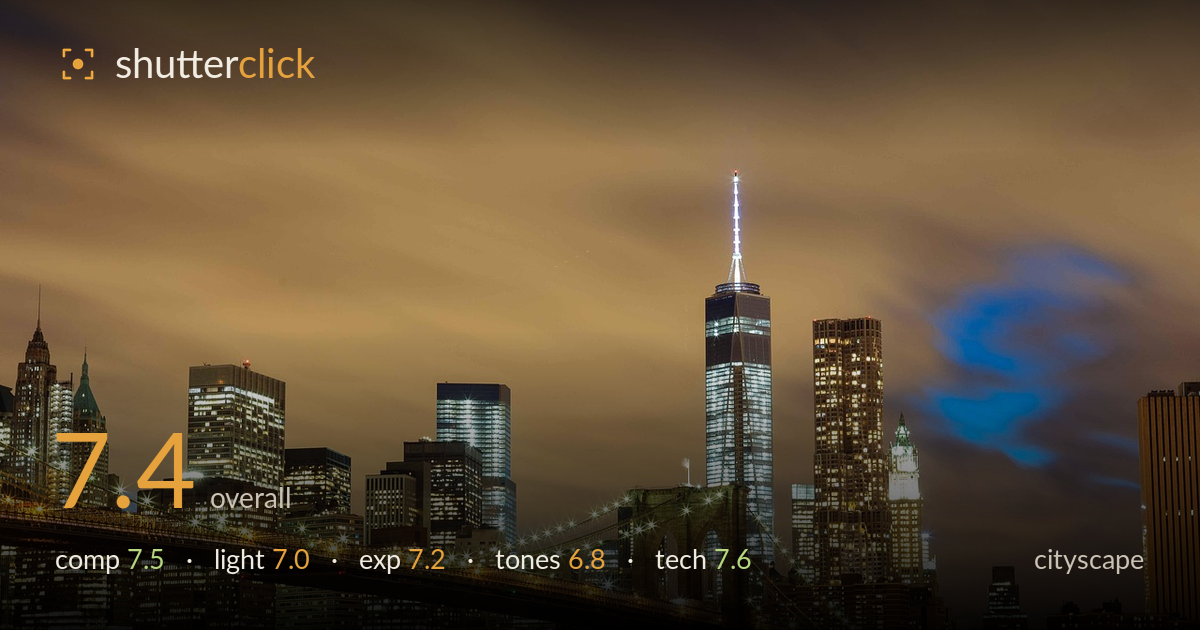
Manhattan skyline behind the bridge at night
Photo by Pexels

No EXIF metadata in this file
Technical analysis based on visual assessment only.
A confident, classic rendering of the Lower Manhattan skyline anchored by the Brooklyn Bridge — the strongest asset is the layered depth, from the bridge's illuminated sweep across the mid-ground towers to One World Trade Center rising as a clear focal peak. What most holds it back is the tonal treatment: the sky carries a heavy warm-orange cast from light pollution that flattens the mood, and the odd blue plume on the right reads as an intrusive anomaly. Verticals are largely clean and the long-exposure water adds calm. A cooler white balance and stronger sky contrast would lift this from a solid postcard toward something more atmospheric.
The bridge leads the eye diagonally from the lower left into the cluster of towers, a proven and effective structure. One World Trade sits near a thirds line as a natural apex, and the skyline layers well from left to right. The foreground water occupies roughly the bottom fifth, giving useful breathing room and a base of reflections. The right edge feels slightly heavier and less resolved than the left, and the tall dark tower at the far right competes for attention. A touch more water or a slightly lower framing would strengthen the base.
The mix of building interior lights, sodium-vapour street glow, and the bridge's warm bulbs creates a lively, textured skyline typical of blue-hour-into-night city work. The illuminated bridge cables read as tidy points of light, and One World Trade's lit facade stands out against darker neighbours. The sky, however, is entirely lit by light pollution rather than any residual dusk colour, so it lacks the graduated depth a slightly earlier blue-hour capture would provide. The overall balance between artificial sources and ambient sky is workable but leans monotone.
Exposure is well controlled for a demanding high-dynamic-range night scene. Bright window and street lights hold their shape without blowing into large white masses, and the darker tower faces retain enough structure to read as buildings rather than silhouettes. Shadow areas at the waterline stay open with visible detail. The brightest bridge lamps and a few window clusters show minor clipping, which is largely unavoidable here. The midtones sit a little high in the sky, contributing to the washed feel, but the histogram is otherwise handled with care.
This is where the image is weakest. The sky's uniform warm-orange cast from urban light pollution dominates and drains atmosphere, pushing the whole frame toward a single muddy hue. The blue plume at the right clashes with that warmth and reads as an unnatural distraction rather than an accent. Building lights carry pleasant amber warmth, but overall contrast is soft and the tonal range compresses in the sky. A cooler white balance and deeper, more separated sky tones would restore mood and let the lit skyline pop.
Execution is sound for a night cityscape. The long exposure has smoothed the water into a calm sheen and blurred the clouds into soft streaks, both signs of a stable tripod and a deliberate slow shutter. Depth of field is deep and appropriate, keeping the bridge, skyline, and distant towers all acceptably sharp. Focus lands well on the mid-ground buildings, and fine detail such as the bridge cables and One World Trade's spire holds up. Noise is well managed in the shadows, suggesting a low ISO and clean capture. The bright light sources render with modest starbursts, indicating a stopped-down aperture. The main technical limitation is the sky, where the long exposure has captured drifting light-polluted cloud that muddies rather than adds interest — a shorter blend or a graduated approach for the sky would help. Overall the craft is dependable and the discipline of the long exposure clearly pays off in the water and structure.
What would elevate it
Tags
Shot something like this?
Expert photo critique, on demand — scored across six categories, EXIF-aware. Start with 3 free critiques, no credit card.
critique my photo — free