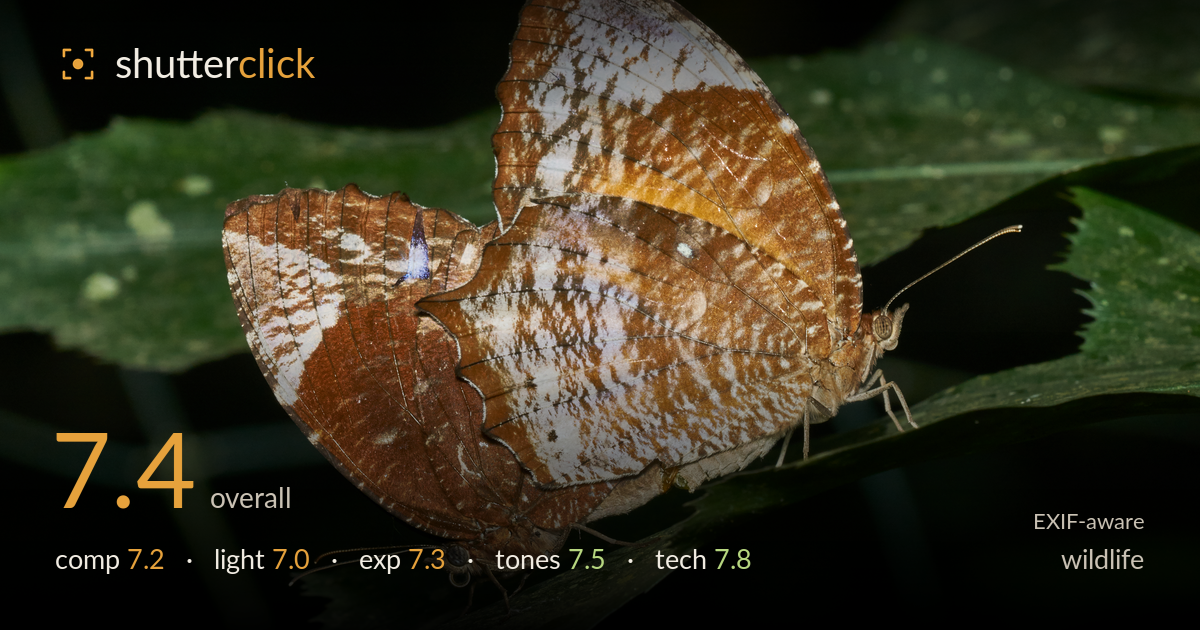
Mating butterflies on a leaf
Photo by Jeevan Jose, Kerala, India

| Focal length | 150 mm |
| Aperture | f / 14.0 |
| Shutter | 1/250 s |
| ISO | ISO 320 |
| Exp. comp. | 0.0 EV |
| Shot at | 14:47 · May 14, 2017 |
A pair of mating butterflies rendered with strong detail and a clean fall-to-black background that isolates the subject well. The dark backdrop and flash-like light give the wing scales real texture and dimensionality. What holds the shot back is the placement of the two eyes: the near butterfly's head sits low-right in shadow while the lower one is tucked at the frame edge, so neither eye anchors the composition cleanly. The wings dominate and read almost like abstract pattern, which is a strength, but tighter attention to the head and a touch more breathing room would elevate an already competent macro-wildlife frame.
The overlapping wings form a strong diagonal wedge that fills the upper frame and the dark background isolates the pair effectively. Placement leans right, leaving the busy wing patterns as the visual mass while the two heads fall to the lower and right edges — the lower butterfly's head is nearly clipped at the bottom. The result reads more as pattern study than a clearly anchored subject. Shifting weight to give the primary head more space and a cleaner edge margin would balance the frame.
Directional light, likely flash, rakes across the wings and lifts the scale texture nicely while dropping the background to near-black — a classic and effective approach for forest-floor macro. The falloff creates good separation. The tradeoff is slightly harsh specular hits on the upper wing highlights and deep shadow swallowing the near butterfly's head and legs. A softer, more diffused source or a second fill would open those shadows and reveal the eye and antennae with more modelling.
Exposure is well managed for a dark-background flash frame. The wing midtones and pale scale patches hold detail without blowing out, and the black surround is clean rather than muddy noise. The brightest highlights on the upper wing edge push close to clipping but retain texture. The main casualty is the shadowed near-head, which loses information. A hair less flash power or a lifted shadow recovery in post would preserve highlight texture while rescuing the eye detail.
The brown, ochre, and lavender-white wing palette is rendered with pleasing warmth and the subtle blue-violet flecks add interest against the earthy tones. White balance sits neutral-to-warm and suits the subject. Contrast is punchy from the flash, which suits the textured scales, though it slightly crushes the darkest wing areas. The green leaf substrate reads naturally in the pools of light. Overall tonal range is satisfying; a gentle lift in the deepest browns would recover a little lost gradation.
At f/14 on a 150mm macro the depth of field is deep enough to carry both overlapping wings largely sharp, a sensible choice for a two-subject frame at this magnification. Focus lands well on the upper butterfly's wing scales, which show crisp scale-level detail. The near butterfly's eye and the lower head sit slightly soft and in shadow, so the critical wildlife plane — a sharp eye — isn't fully nailed on the primary subject. ISO 320 keeps noise negligible and the files clean. 1/250s is adequate for static, resting insects and shows no motion blur, though it relied on flash to freeze and light the scene. The main technical gain would come from focus-stacking or careful plane placement to bring an eye into decisive sharpness, and from angling the light to reach the shadowed head. Lens and aperture selection are sound; execution is strong overall, held back only by the head detail on the closer specimen.
What would elevate it
Tags
Shot something like this?
Expert photo critique, on demand — scored across six categories, EXIF-aware. Start with 3 free critiques, no credit card.
critique my photo — free