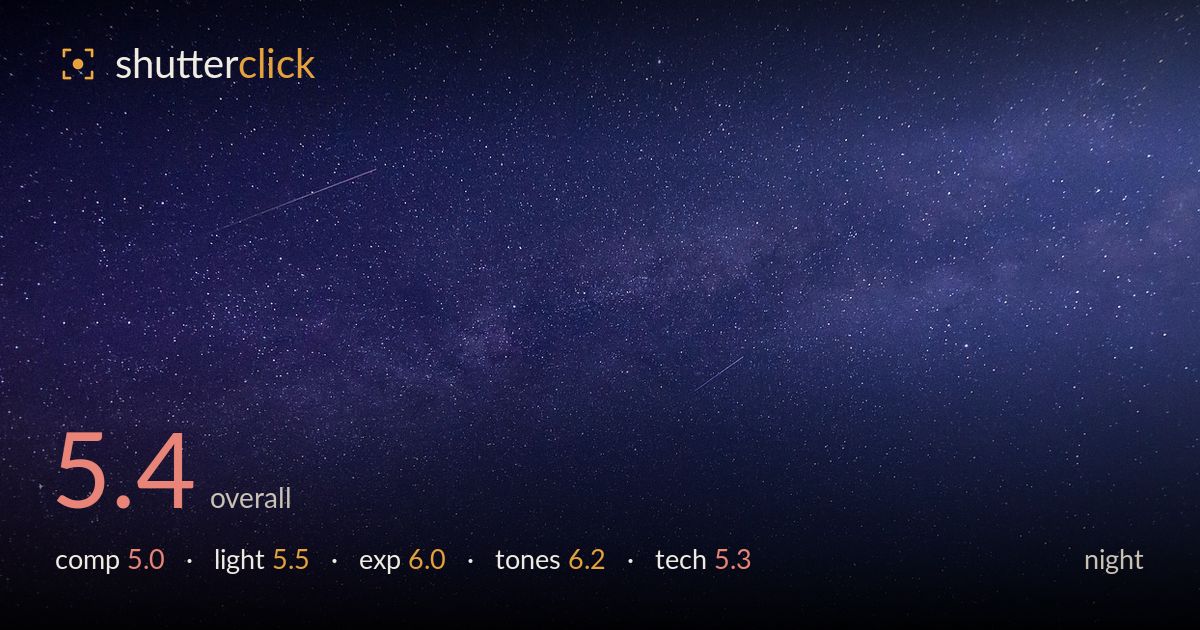
Milky way across a starry sky
Photo by Pexels

No EXIF metadata in this file
Technical analysis based on visual assessment only.
This is a pure sky frame with no foreground anchor, which is the single biggest limitation. The Milky Way band runs diagonally through the frame and there are two faint streaks — possibly meteors or satellites — but without any terrestrial element for scale or context the image reads as a texture rather than a scene. The colour balance is pleasant and the star field is reasonably clean, but the composition lacks a place for the eye to land. A landscape element along the bottom edge would transform this from a sky sample into an astro-landscape with depth and narrative.
The frame is entirely sky, with no horizon, foreground, or anchor to ground the viewer. The Milky Way's faint diagonal band is the strongest compositional element, running lower-left to upper-right, but it's subtle and uncentred without intent. The two thin streaks add minor interest but sit unremarkably. Without a silhouetted tree, ridgeline, or structure along an edge, there is no sense of scale or place. A composition that dedicated the lower third to foreground would give the star field context and a far stronger visual hierarchy.
This being ambient starlight, the 'lighting' is what the sky itself offers, and the capture pulls out the Milky Way's dust lanes and a broad star scatter. There is no light pollution glow overpowering the frame, which keeps the sky relatively clean. That said, the natural contrast between the galactic core region and surrounding sky is gentle here — the band reads faintly rather than dramatically. Shooting toward a richer, higher-contrast section of the core would give the light structure more presence and dimension.
Exposure is handled sensibly for a night sky — stars are recorded without blowing out, and the darker sky regions retain a smooth gradient rather than crushing to pure black. The Milky Way's faint detail survives, suggesting the exposure reached deep enough into the shadows. There is no obvious highlight clipping on the brighter stars. Midtones sit a touch flat, which mutes the galactic band's impact. A marginally longer integration or stacking multiple frames would lift faint detail further while keeping noise controlled.
The blue-to-violet palette is attractive and reads naturally for a night sky, with a warmer band through the Milky Way region adding subtle variation. White balance is well judged — neither the cold sterile blue nor an artificial magenta cast. Tonal gradation across the frame is smooth, with no harsh banding in the darker corners. Saturation is restrained and believable. The main limitation is overall flatness; a modest contrast lift targeted at the dust lanes would separate the galactic structure from the surrounding sky more convincingly.
Without EXIF, judgement rests on visible evidence. Stars appear mostly as points rather than trails, indicating the shutter stayed within the limit for the focal length, or that stacking was used — either way, motion was controlled well. Focus on the stars is reasonably sharp in the central region, though the finest points look slightly soft, hinting focus was very close to but not perfectly at infinity. Noise is present but restrained in the shadow areas, suggesting either a moderate ISO with a clean sensor or noise reduction applied. The lens appears wide, which suits the sky coverage, but there is faint softening and possible mild aberration toward the frame edges where the brightest stars sit. The absence of any foreground means depth of field is a non-issue here. Overall the technical execution is competent for a handheld-difficulty subject, with careful focus and a slightly wider aperture the two areas that would sharpen the star rendering most.
What would elevate it
Tags
Shot something like this?
Expert photo critique, on demand — scored across six categories, EXIF-aware. Start with 3 free critiques, no credit card.
critique my photo — free