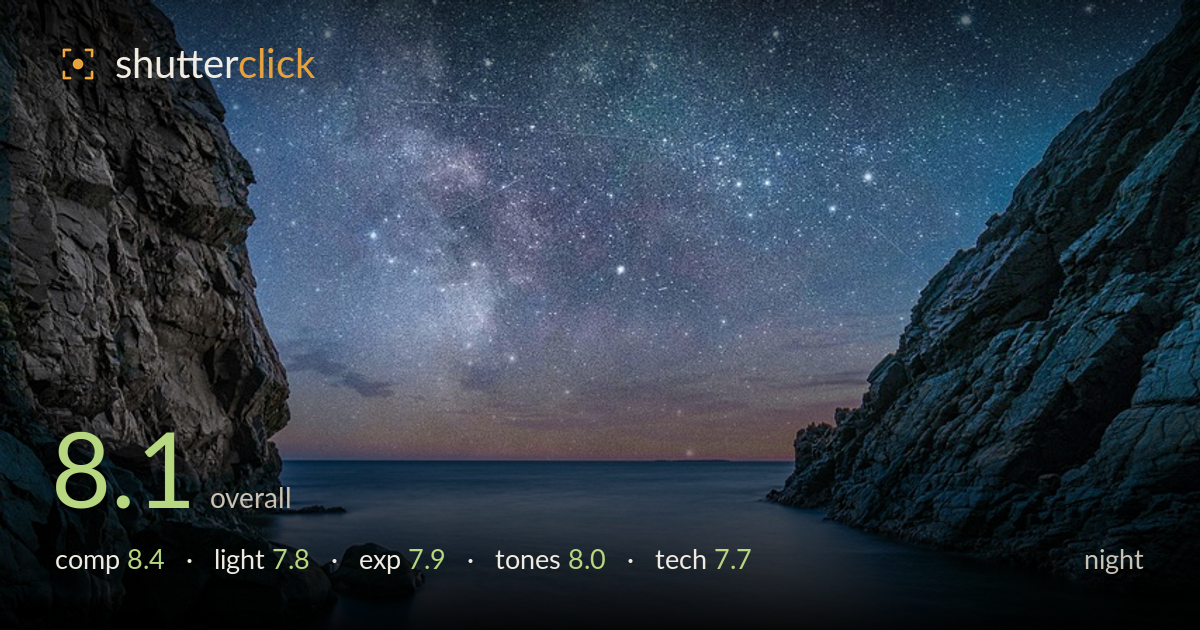
Milky way over a rocky cove
Photo by RezaAskarii

No EXIF metadata in this file
Technical analysis based on visual assessment only.
A well-constructed nightscape that uses a natural rock funnel to frame the Milky Way and channel the eye from the pebble foreground out to the horizon. The vertical orientation suits the composition, and the pebbles provide genuine foreground interest. What most holds it back is the composite feel — the Milky Way core sits high and slightly detached in colour from the warm horizon glow, and the foreground rocks read a touch flat and under-lit compared to the bright sky. Tighter attention to foreground illumination and a more natural blend at the horizon transition would lift an already accomplished frame toward exceptional.
The two converging rock walls form a strong natural frame that funnels attention through the cove toward the horizon, and the Milky Way rising in the gap is well placed. The large central boulder anchors the foreground and the pebble field adds depth and scale. The centred water channel works because the flanking rocks are asymmetric enough to avoid dead symmetry. The foreground boulder sits slightly too central and low; nudging it off-axis would ease the static, bullseye pull toward frame centre.
The blended light of Milky Way core, faint airglow, and warm residual horizon glow gives the scene atmosphere and a sense of the hour. The sky is the clear light source and it reads convincingly. The foreground, however, is lit flatly and dimly, so the pebbles and central boulder lack the raking modelling that would give them texture and dimension. A low, warm side light on the foreground rocks — or a subtly dodged blend — would separate them from the shadow and balance the luminous sky above.
Exposure is well judged for the difficulty of the scene: the star field holds detail without blowing out, and the horizon glow retains its subtle colour gradient. Shadow detail survives in the rock walls, though the darkest foreground areas edge toward muddy black with little recoverable texture. Highlights on the water reflections are controlled. The overall balance between a bright core and a dark foreground appears intentional and largely successful; lifting the deepest foreground shadows slightly would open up detail without flattening the mood.
The blue-dominant palette suits the nocturnal mood, and the warm horizon band provides welcome contrast against the cool sky and water. The Milky Way retains natural colour without oversaturating into false magenta, which is a common trap. White balance reads cool but deliberate. The transition from the warm horizon to the cool core is slightly abrupt, hinting at a blend seam. Gentler graduation across that boundary and marginally warmer foreground tones would unify the frame and reduce the layered, composite impression.
The long exposure smooths the water into a soft, glassy surface that contrasts nicely with the sharp, textured pebbles and rock — a deliberate and effective choice. Stars are rendered as clean points rather than trails, which points to either a short tracked exposure for the sky or a stacked and blended approach, since a single frame this deep would show star elongation at this focal length. The foreground appears sharp front-to-back, consistent with a small aperture and wide lens, and focus stacking or careful hyperfocal work. Noise is well controlled in the sky given the low-light demands, with no aggressive smearing of fine star detail. The main technical tell is the join between sky and foreground regions, where luminosity and colour don't fully reconcile. Attention to matching noise character and edge blending across the composite layers, plus a cleaner horizon transition, would make the execution read as seamless rather than assembled.
What would elevate it
Tags
Shot something like this?
Expert photo critique, on demand — scored across six categories, EXIF-aware. Start with 3 free critiques, no credit card.
critique my photo — free