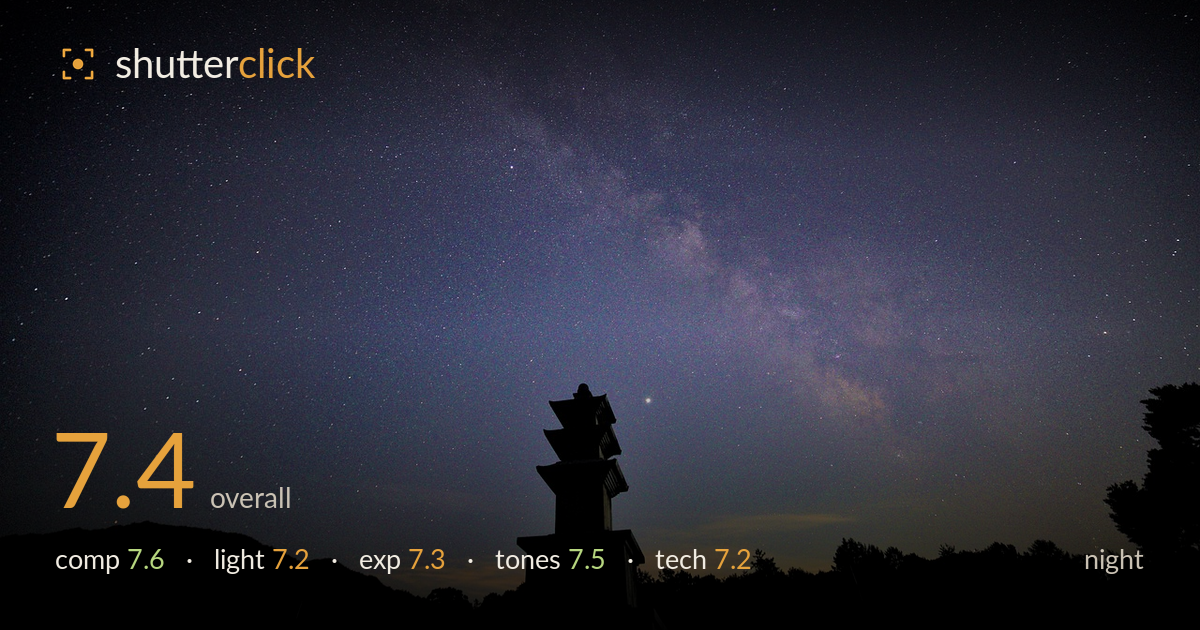
Milky way over a stone pagoda
Photo by ajs1980518

No EXIF metadata in this file
Technical analysis based on visual assessment only.
A well-executed Milky Way frame anchored by a distinctive silhouetted pagoda that gives the sky scale and cultural context. The galactic core arcs cleanly through the right of the frame, and the low horizon glow adds warmth beneath the stars. What most holds it back is the placement of the pagoda: pushed slightly left of the strongest part of the Milky Way, the two feel almost in tension rather than in dialogue. Star detail is present but slightly soft, and some chroma noise sits in the shadows. Solid foundations with clear room to sharpen the pairing of subject and sky.
The pagoda makes a strong graphic anchor and its stepped profile reads clearly against the sky. The Milky Way sweeps diagonally from upper left to lower right, giving the frame movement. However, the subject sits low and slightly left while the galactic core falls to the right, leaving the two competing rather than aligning. The tree mass on the right edge is heavy and a touch redundant. A subject positioned directly beneath the core, or a re-angle placing the pagoda under the brightest band, would unify the elements.
The natural light is well judged for this kind of shot: no moon washing out the sky, and a soft horizon glow — part twilight residue, part light pollution — that warms the base without overwhelming the stars. The core of the Milky Way carries good contrast against the darker surrounding sky. The subject sits in full silhouette, which suits the scene, though a faint hint of ambient fill on the near stone would have added dimension without breaking the mood. Overall the timing captures the core at a workable elevation.
Exposure is largely well balanced for night work. The stars are recorded without heavy clipping, and the horizon glow retains its orange-to-blue gradient rather than blowing out. Shadow areas hold as clean silhouette, which is the right call here. The sky midtones sit a touch dark, muting some of the fainter dust lanes that a slightly brighter lift could have revealed. The bright planet near the pagoda is cleanly rendered. No obvious accidental underexposure — the balance reads deliberate and controlled.
The blue-to-warm gradient from zenith to horizon is pleasing and natural, with the amber band grounding the cool sky above. White balance sits in a believable range for astro work. The Milky Way's subtle brown dust tones come through without heavy over-processing. Contrast is handled with restraint, avoiding the crunchy, over-saturated look that plagues many star shots. Some magenta cast lingers in the deeper shadows near the base. Overall a tasteful, controlled grade that lets the sky breathe.
Without EXIF, judgement rests on visual evidence, and the execution reads as competent astrophotography. Stars appear mostly as points rather than trails, suggesting exposure length was kept in check for the focal length used — a wide field of view is evident from the broad sky coverage and the modest star size. Focus on the stars is close but slightly soft; the brightest points show a small amount of bloat rather than crisp pinpoints, hinting focus was set just short of infinity or that atmospheric seeing softened them. Chroma noise is visible in the darker sky regions, typical of a high-ISO single frame; stacking multiple exposures would meaningfully clean this up. The silhouetted foreground is acceptably sharp given it reads as pure shape. Depth of field is a non-issue at these distances. A more precise infinity focus using live-view magnification on a bright star, plus noise reduction from stacking, would be the two highest-impact technical gains.
What would elevate it
Tags
Shot something like this?
Expert photo critique, on demand — scored across six categories, EXIF-aware. Start with 3 free critiques, no credit card.
critique my photo — free