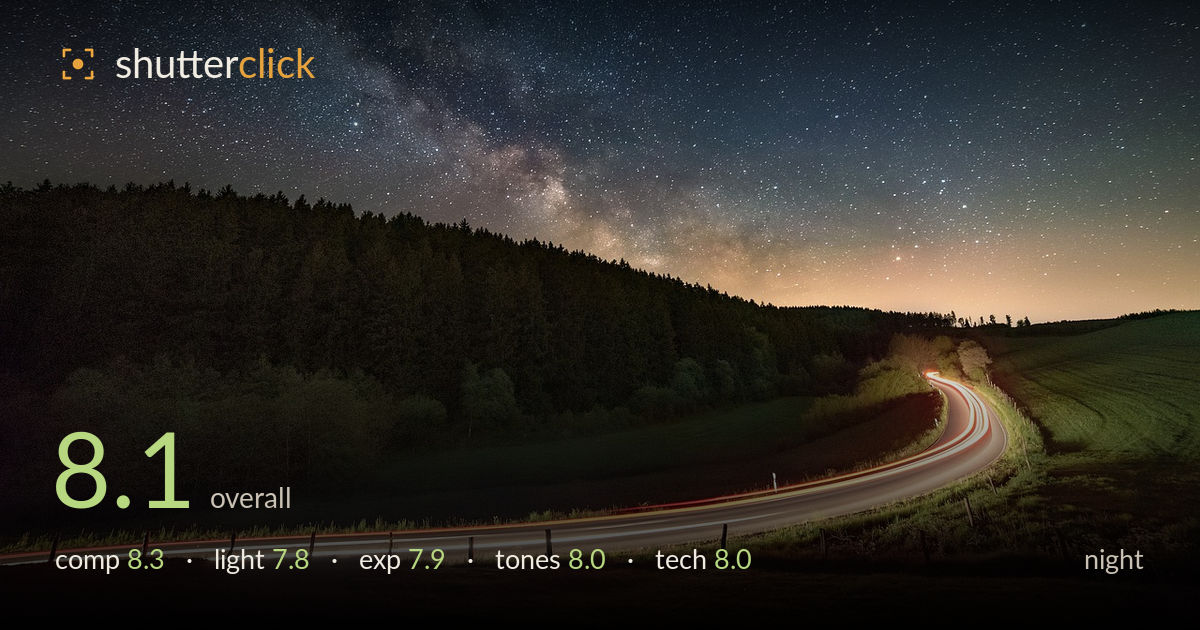
Milky way over a winding road
Photo by EvgeniT

No EXIF metadata in this file
Technical analysis based on visual assessment only.
A well-executed astro-landscape that pairs the Milky Way with a sweeping S-curve of car light trails — two strong elements working together rather than competing. The core is the composition: the road leads the eye from the foreground into the frame and up toward the galactic core, giving genuine depth. The light-pollution glow on the horizon is handled tactfully, adding warmth beneath the arch. What holds it back most is the very dark, empty foreground foreground land that offers little detail or interest, and the trails clip toward pure white in places. Still, this is confident, ambitious night work with a clear vision.
The winding light trails form a natural leading line that carries the eye from the lower-left foreground around the curve and toward the Milky Way core on the right — a smart pairing of two subjects. The forested ridge sits roughly on the lower third, letting the star field dominate, which suits the genre. The right side, where road, glow and galactic core converge, is the strongest zone. The lower-left corner of dark foreground land is somewhat dead space that adds little and slightly weighs the frame down.
The scene relies on ambient starlight and the car headlights that paint the road, and the balance between them reads well. The warm horizon glow from distant light pollution is a liability turned into an asset, giving a gradient that separates the treeline. The galactic core carries visible dust lanes and colour, meaning the light was captured under genuinely dark skies with good timing. The foreground remains almost entirely unlit, so its texture is lost — a touch of low ambient or light-painting would have shaped that land.
The exposure holds the fragile star field without crushing the sky to black, and the Milky Way core retains detail and gradation. The horizon glow is bright but not blown. The main clipping is in the brightest passages of the white light trails, where the headlights render as pure white with no gradation — hard to avoid with moving vehicle lights, but slightly hot here. The deep foreground sits near the noise floor with almost no recoverable detail. Overall a careful, deliberate balance for a demanding scene.
The colour palette is the image's quiet strength: cool blue-to-teal in the upper sky, transitioning to a warm amber horizon, with the red and white of the trails echoing that warmth. White balance is well judged — natural rather than the overcooked blue that plagues many astro shots. The greens in the moonlit field on the right read believably. Contrast is handled to keep faint stars visible without muddying the dust lanes. A hair more separation in the shadowed forest mass would prevent it reading as a single flat silhouette.
The result points to solid long-exposure and stacking or single-frame technique: stars are rendered as points rather than trails, suggesting the shutter was kept short enough to avoid star movement, while a separate longer or blended exposure captured the vehicle trails. Noise is well controlled for a high-ISO night frame — the sky is clean enough to show subtle dust-lane structure without heavy smearing from noise reduction. The wide focal length captures both the galactic arch and the sweeping road, an appropriate lens choice for this composition. Focus appears set correctly for the stars, which are crisp across most of the frame; corners could be checked for any softness or coma. The light trails are sharp-edged, indicating a stable tripod throughout. The one execution weakness is the near-total loss of foreground detail and the slight overexposure of the brightest trail segments — both addressable with an extra blended exposure and a touch of light management on the near ground.
What would elevate it
Tags
Shot something like this?
Expert photo critique, on demand — scored across six categories, EXIF-aware. Start with 3 free critiques, no credit card.
critique my photo — free